Time flies with great content! Renew in to keep enjoying all our premium content.
Prime
When to seek legal redress over a caricature
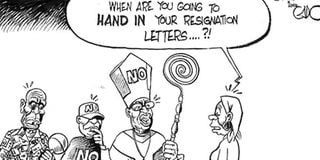
The use of caricatures and parodies seems to be illegal and defamatory, so what does the law provide for this? Cartoon/GADO
An important part of a newspaper’s content is the page that contains a satirical caricature which describes the current social-political state of a country.
Sometimes the quality of caricature and the extent to which it is satirical can rake in millions for artists as leading dailies compete to hire them.
A caricature is an exaggerated portrait of a person in visual or literal form.
Most caricatures include satire to drive a point home.
I saw a caricature that I found amusing and it was one of Naomi Campbell with the caption “Diamonds, A Girl’s Best Friend,” which was obviously meant to be a mockery.
In the music and entertainment world parody artists are people who specialise in critiquing or commenting on an original work by means of a satirical imitation.
Usually they will reproduce the exact same work, but use satire and mockery to portray their opinion of the original work.
In Kenya, we do not have many parody artists, but in the West especially the USA there are many parody artists whose performances and shows outnumber and out last the original author’s works.
The use of caricatures and parodies seems to be illegal and defamatory, so what does the law provide for this?
Just imagine that a caricature of your products or even of you is published in the newspaper and with a satirical caption, do you have legal redress?
Caricatures are just a form of expression and if it could put in words what he meant by the drawing then most of the times it would be an honest criticism of the state of affairs in a country.
The law provides that one of the defences to defamation is the defence of fair comment.
For example, if during campaigns a caricature is drawn of the losing side in a satirical manner, then the artist could always claim the defence of fair comment to justify the portrait.
In as much as caricatures seem demeaning and malicious if what the artist is portraying is true or reasonable then the artist has a good defence.
Caricatures are very demeaning due to the fact that the features on the portrait are exaggerated and also by the fact that a lot of satire is used to pass on the message.
Political humour uses satire to criticise the state of affairs in a country.
The legal position on caricatures and political humour is also balanced against the constitutional right to freedom of expression.
So long as the use of satire is within the confines of the freedom then there really should not be a problem for the artist.
Caricature artists therefore have to be careful when drawing portraits to ensure that they do not include treasonable matters or that they do not infringe on the rights of other people.
A caricature demeaning one race would be deemed to be racist. So would a caricature demeaning one religion.
The artists must also ensure that there is no malice involved and that what is portrayed is actually factual.
In Germany, there are express laws covering the use of caricatures.
A certain caricature artist was sued by a Bavarian Minister for a caricature that was so demeaning to his person as it portrayed the Minister as a pig and engaged in immoral activities with four other pigs.
The minister sued the artist for defamation and was successful.
An artist should therefore use caricatures reasonably and stick within the confines of satire and avoid being malicious.
Personal opinion is normally biased and therefore the artist should try to avoid his personal opinions.
One should focus on what is factual and what is fair comment.
Caricatures and satire are a sensitive part of defamation laws and are often overlooked.
While there may not yet be case law in Kenya on defamation arising from use of caricatures and political humour there is a wealth of case law in other jurisdictions.
The courts have considered the subject matter of the caricature and the context in which it has been used.
They have also considered whether what was being portrayed in the caricature was factual or was if it was only an opinion of the artist.
They have also considered the status of the person portrayed in the caricature, for example, a religious figure like the pope would get more awards from a defamatory caricature than would an ordinary person.
The courts have also considered if the artist was malicious in his portrayal.
Malice would amount to a scathing and personal attack on the person portrayed on the caricature.
The caricature of the Bavarian minister was loaded with malice and almost a personal attack on the minister.
Most states in the world are democratic and would rarely curtail or inhibit the work of caricature artists.
If anyone thought that the Government had ever been run in a dictatorial manner even in past regimes, then they should consider that caricature artists were rarely ever prosecuted in as much as some caricatures were on the extreme.
Mputhia is an advocate of the High Court of Kenya. [email protected]
Unlock a world of exclusive content today!Unlock a world of exclusive content today!