Time flies with great content! Renew in to keep enjoying all our premium content.
Prime
Playing mind games to ease labour pain
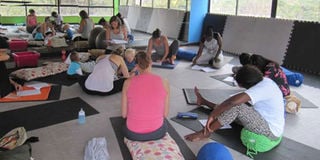
Mothers-to-be practising the hypnobirthing scripts at Acacia Studios in Nairobi. PHOTO | COURTESY
A mother-to-be who was consumed by fear of the pain of child birth figured out a way around it. When Yvonne Meyer-Onyando was pregnant with her first child, a friend told her about a course she had done in the UK—hypnobirthing.
“Every birth on TV is dramatic, the water breaks, someone is rushed to hospital and either gives birth in the car screaming flat on their backs. With this image every mom has fears,” she says.
To rid herself of the fear, she started doing online research. Her friend sent her some of the videos and materials from the hypnobirthing course.
“Hypnobirthing is a pain releasing technique. It allows you to release the fears surrounding pregnancy and increases a woman’s confidence in being able to deliver the baby,” she says.
She converted some of the reading materials into audio recordings which she kept listening to each time she went out for a walk and in the evenings with her partner.
Every day she kept at it, meditating on the birth affirmations and working on building the confidence that her body was indeed capable of birthing her child naturally and without. When the time came, the process was much smoother and less painful.
Her one regret, though, was she never got to use all the materials that had been at her disposal.
With her second pregnancy, she did more self-hypnosis which made the one and half hours of labour pass by easily.
There is a growing market for alternative therapies in Kenya, including antenatal yoga classes, home births and now hypnotherapy-assisted birth.
For hypnobirthing, a pregnant woman can master breathing techniques, positive affirmations, and self-hypnosis.
Instead of viewing a contraction as painful, women can focus on the excitement they feel to meet their child through deep mediation which encourages them to use their minds to manage unpredictability of childbirth.
Already popular in the West, a few mothers in Kenya who chose to hypnobirth swear by it as a powerful experience of reducing pain and discomfort.
For them, the body releases less stress hormones which are usually passed on to the baby. With hypnobirthing, they listen to their babies and breathe in a way that makes childbirth a beautiful experience. But does it actually work? How it is done?
For Thitu Kariba, a fitness instructor, her first delivery was not favourable. She felt the hospital imposed their processes on her, with very little consideration on what she really wanted.
“Being a fitness instructor the thought of having an epidural to ease pain and being paralysed waist-down even though temporary was not an option, so you can imagine what I had to go through,” she says.
For her second child, she decided to have the baby in a less traumatic environment, at a birthing centre and in water.
Thitu says she knew she was prone to depression and wanted to have a completely natural birth with no medications.
‘‘My partner and my mum had concerns but once they visited the Eve’s Mama birthing centre and had all there questions answered they got on board with the idea,’’ she says.
As she researched on natural birth, she discovered hypnobirthing as a pain coping technique.
‘‘At first I thought, okay! So does someone snap there fingers, then you bark like a dog once have contractions then have the baby,’’ she chuckles.
With no one offering the actual course in Kenya, she took online classes and read all the materials she could lay her hands on.
‘‘I used to do the hypnobirth exercises at night from the time I was five months and they helped build a lot of confidence in me as well as helped me handle the stress that come with pregnancy,’’ she says, adding that the only way to change the fear mind-set is to keep countering negative thoughts repeatedly.
She says hypnobirthing is not a religious act. Neither is it a session where a pocket watch is swayed back and forth, guiding a person into a semi-sleep, zombie-like state.
Also, a mother is not hypnotised before childbirth. The magic lies in what she calls birth affirmations.
‘‘It is just like talking to one’s self which people do all the time,” she says, adding that to listening over and over to ‘‘I believe everything will go smoothly, but I am open to whatever course the birth process will take’’ is an affirmation that targets the subconscious.
How did it go?
Combined with the lamaze classes, Thitu chuckles that if push came to shove she was certain she could deliver the baby by herself.
Labour began in the morning. She had a fitness session but opted not to do it. ‘‘I was so calm and relaxed, completely disappeared in my zone that when my water broke at 10:15 pm and we were on the way to the hospital I told my partner. ‘‘I’m sorry my water broke now, you have to go to the carwash.’’ He had this look of carwash, your water just broke, you are in labour!’’
That night, it was raining which was quite helpful as she had used the background of rain during her meditation practices which made her relax more. All the while she was calm and was even talking through the contractions.
“Lucy [the midwife at the birthing centre] knew that I wanted a natural birth and there was no rush to have me push. So she was going to get the heart monitor as I made myself comfortable. Then I felt the baby’s head,” she says.
The baby was in such a rush, that Thitu says, she never got to use the water birth. Six hours after delivery, the family was having breakfast at Nairobi’s Yaya Centre with their latest addition.
Another try
At six months pregnant with her third child, Thitu is taking the hypnobirthing classes again. This time she has a trainer, Yvonne who just completed a course as a KG Hypnobirthing trainer in August.
“With an actual trainer you get much more than what you can get from online resources. This time I want to have the delivery in my own house and retaking the course will only make the experience better,” she says.
Yvonne says there are several myths surrounding hypnosis-assisted birth; that it only works on intelligent people, or it is religion which is not true.
“Everyone has this image of hypnosis; someone is baiting someone, who runs around like a chicken and does embarrassing things. Under hypnosis you can only do things that you want to do and also you cannot reveal any secrets,” she says.
10 women
With hypnobirthing, one is still conscious. ‘‘You are still in control of everything, sometimes your mind drifts away and you don’t hear what the words are but the subconscious is still active,” she says.
Lucy Muchiri, a midwife who runs Eve’s Mama birthing centre says there are some women who don’t have a good coping mechanism for the pain.
“Hypnobirthing can work well as a coping mechanism for women who are able to meditate, go for the classes and listen to the instructor. It enables the mother to calm down and focus on something else other than just the pain,” she says, adding that with the mind engaged, the body is able to do what it needs to do smoothly.
Lucy who has attended to over 10 women who have used hypnobirthing as a coping measure says it helps if the mother is also physically fit throughout the pregnancy.
From her experience, she says doctors are not so much keen with coping mechanisms that women choose during labour.
But as a midwife, she says, she finds it helpful to take care of a woman who already has a coping technique.
‘‘With hypnobirthing it starts way before labour. A mother-to-be has already rethought the whole process so child birth is much easier. If it works for you then it definitely a great idea,” she says.