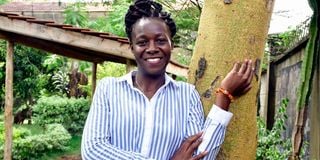
Julia Nechesa Shisia sits under a tree, drinking sparkling water and reflecting on how great this year has been. Until it wasn't. She reflects on her 20-year career in financial services, which has led her to her current role as Executive Director at Absa Bank's Bancassurance division.
A key milestone was attending the executive programme at Harvard Business School. She talks about her love for medicinal plants. For long walks in the forest. For swimming. Things she has always enjoyed, things she has enjoyed this year which, as mentioned, was going so great she rated it a 9/10 until her husband died suddenly overseas at the beginning of November.
Her days are mostly filled with grief, feeling her way in the darkness that sometimes sets over her days. She's now a widow, but it still doesn't feel like it. "You never really think that you will be the person ticking 'widow' on any form that requires you to identify your status."
Burying her husband is the single most important event that will dominate her life forever. The silver lining, if you could call it that, is that it has sharpened the need to treat people with kindness and compassion—a philosophy now extending from her boardroom to her personal life. "You never know what people are dealing with," she says. "Nobody here can look at me and think, 'that lady sipping sparkling water over there buried her husband two weeks ago.'"
Was business good this year?
When you're doing a billion point five in profitability, and you know that for insurance, that's more than good.
A billion! You're a powerhouse, aren't you?
Oh, yeah, of course. [Laughs] That I am. I go in to win. I don't go in to mess around, Biko. I go in for the kill. But winning doesn't mean you never fail. I've had low moments and key highlights. In the low moments, what matters is that I don't stay there—because I believe in winning. So I always ask: how can I do this differently and still win? If I can't do it alone, who can help me? Is it the skill? The approach? What needs to change?
What I believe is this: everybody can win. You just have to put all the pieces together. Life is not a straight line. It goes up, then down, then up again. But if your goal is to get there, you will always get there.
How did you get here?
It's been a 20-year journey. I started in insurance straight out of university as a sales executive at ICEA. It looked glamorous—titles, business cards, grooming allowances—but the work was tough. That's where I learned the business from the ground up.
My first real exposure came during a university break when a neighbour convinced me to try selling insurance. I earned my first commission, and that's when it clicked that insurance could be a career path. From ICEA, I moved through CIC, NIC—largely through people recommending me.
Later, I helped set up a bancassurance unit at Diamond Trust Bank and Jubilee. We broke even in 10 months. After that, Equatorial Group, then Standard Chartered, and now Absa.
At Absa, my focus has been on structure, people, and culture—getting the entire bank to buy into the bancassurance vision. With leadership support, we built the unit to over a hundred people within a year and a half. That's really how I got here—step by step, through people, resilience, and opportunity.
Where did you go to school?
Let me start with the letters that I like. I did my executive programme at Harvard, and together with my high school, those are the two institutions that shaped me the most—just in very different ways.
Harvard shaped how I think about building business, leadership, and impact. Moi Girls High School in Eldoret shaped my character. Being a national school, you'd arrive there thinking you're the top student, then suddenly you're ranked 56 out of 108. That humbled us very quickly. I realised there are people far brighter than me.
Beyond academics, we were grounded in values—discipline, focus, how to compete, and how to live with others. By the time I got to university, a lot of that foundation was already formed. When I entered the workplace, I assumed everyone was there simply because they were qualified.
Then I began to discover the many human dynamics inside organisations. That pushed me to read widely, to study leadership and human psychology. Eventually, I went to Harvard to understand leadership from a global perspective. Even today, I'm still learning. Leadership, for me, is a lifelong journey.
How was your childhood?
Happy. [Dreamy look]. Really happy. I adored my father—he felt like a superman. I grew up in Eldoret in a big family—brothers and sisters, a really happy childhood. We had a farm, I played with my siblings and neighbours, at school I joined the drama club, and recited poems.
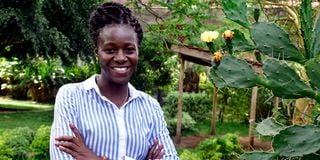
Absa Bank Kenya Executive Director Julia Nechesa Shisia poses for a photo following her interview on December 3, 2025.
Photo credit: Francis Nderitu | Nation Media Group
When I was a child, I loved drawing and writing, and I read a lot. I liked Yusuf Dawood's column, The Surgeon's Diary in the Daily Nation, and thought maybe being a doctor would be good. My father, a businessman who dabbled in many trades, would take me with him to pick berries and teach me how foods help our bodies. That inspired my interest in health and medicinal plants.
At university, I studied medicinal plants and did research on them. Science was tough, though, and I eventually moved into the financial sector. But I haven't let go of that passion for health—I still eat well, live healthily, and think of ways to help others live healthy lives.
Are you still interested in medicinal plants?
I am. In fact, at home I have a whole book on medicinal plants. I practice edible landscaping—jasmine to repel mosquitoes, moringa for nutrition, and berries as antioxidants.
If I have a cough or cold, I rely on natural remedies first—lemon, electrolytes, exercise—before medicine unless it's serious. I walk a lot and swim sometimes. Once a month, I do about 12,000 steps in Karura—roughly 5–7 km.
I enjoy movement, healthy eating, and staying active. I try to reduce carbohydrates and fats, especially as I age. I prefer boiling meat and bones to make broths, seasoning lightly with natural spices.
I believe natural flavours are enough—frying doesn't make food sweeter. For breakfast, I usually have smoothies. I eat a lot of fruits and vegetables. I enjoy sweets and cake occasionally, but they're not part of my routine.
How would you rate this year?
I'd rated it 9 over 10, but then last month, I dropped it to 7. My husband died.
Goodness, that's... horrible! I'm sorry to hear that. What happened, if you don't mind me asking?
He got a heart attack while sleeping. Unfortunately, he was out of the country. He'd gone for a UN assignment in Sierra Leone.
What do you remember about that night?
We were planning to go to the US with my daughter that night when I got a call from Gigiri. The caller worked for the UN, specifically for FAO [Food and Agriculture Organisation]. They said I needed to come to the UN office immediately.
I told them I was busy and travelling, and asked if we could meet later—but they insisted it had to be that day. I had to drive myself to meet them. While on the way, I called the number back and asked for the name—Penina. I googled her: UN Staff Counsellor. I wondered, why is the UN Staff Counsellor calling me? Something felt off. I told my daughter—
How old is she?
My daughter is 15. I told her I didn't understand why they were calling me. She said she hoped it was something good. I think she sensed my mood had changed. I told her I hoped so too. When I arrived at the UN, the lady was waiting for me at the gate. She took me into an office, and I saw signs for the counselling centre and clinic.
Inside, there were two people seated—a lady and a gentleman. She introduced them as my husband's colleagues from the Kenyan office, and herself as the UN staff counsellor. That's when my instincts went up.
I knew something was wrong, but death was not on my mind. I thought maybe there had been an attack, or an accident, or something related to his work. She asked me to sit down and asked what relationship I had with Edwin. I told her he was my spouse. Then she said, "Let me go straight to the point."
She told me that the previous day, my husband had not reported to work, and they were unable to reach him. His phone was ringing but not being picked. Because they had another mission scheduled, his colleagues went to his house.
When there was no response, they went to the back of the apartment and saw him lying on the bed. Following UN protocol, they brought a doctor, broke in, checked his vitals—and his body was lifeless.
Knocked you off your feet?
I asked them if he was really dead, and they confirmed he was. I asked if he was in the mortuary—they said yes. Living with someone, you never expect they will die. I broke down there, of course.
Coincidentally, a friend called while I was sobbing. She was checking my travel plans. I told her what had happened, and she invited me to her house, since my daughter was home and the other one was at school. I stayed there the whole day because I had to tell my daughters about their father's death at 4 pm, and cancel our US trip.
Then came the logistics—repatriating his body from Sierra Leone. For the first time, I was travelling with my husband as cargo, sitting on a plane knowing I would return with his body. [Pause] Anyway, let me not talk about it because I don't want to get emotional. So yeah, that was the downside of this year.
I'm sorry!
Yeah. I learned that there is always a lesson, even in the saddest moments. Life is very fickle—you can be healthy and still die suddenly. So you have to live each day fully.
If you want to sit in the garden and do nothing, that's your choice. But if you live today, make it count, because you never know. He had bought us gifts—beautiful fabric for me and clothes for the children. His colleagues even wrapped them. I've never opened them; they remain exactly as they were. I still look at them.
The girls must have been devastated.
Oh, my God. They loved their father, and he adored them. They were devastated. Even now, they talk about him in the present tense. My daughter was telling me yesterday, "Mom, what would you do if I had a boyfriend and he frustrated me?" I told her I would tell him to leave her alone. She said, "No, Dad would shoot them. Dad has a shotgun." He was always serious about protecting us. I keep quiet—they're still processing.
I also realised something about mourning: adults come to console me, but nobody remembers the children. Life moves on for them—they play, go to school, and normalise things. But who actually sits with children to help them process losing a parent at 15? Many children don't get the chance to grieve or cope like adults do. I want to take them to therapy.
When did this happen?
On the 3rd of November.
That's just the other day.
Yes. We buried him on the 19th. I just returned to work on Monday, which is why I couldn't meet you sooner. But here I am, talking about it without crying. I can smile.
And crying is also fine.
Yes. Two weeks ago, I was uncontrollable—I couldn't even talk. So many people have supported me, so many. But when I look at my children, I remind myself that if I break down, they will break too. So I try to hold myself together. And there are some journeys you take alone. Nobody sees themselves as a widow at such a young age.
Interestingly, the priest said it when he came to our house for the mass for the deceased: "Now it's time to pray for the widow." It was the first time I heard "widow," and I looked around, thinking it wasn't me. Then it struck me—it actually was me. [Laughs]
Generally, you've had a good life?
Yes, but we often take many things for granted. Small things people do for us go unnoticed until they're no longer there. For example, my daughter recently came to me saying she couldn't fix the Wi-Fi. I didn't know how either—it used to be handled by their dad.
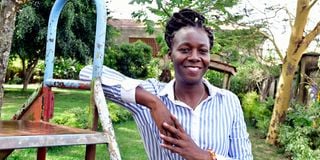
Absa Bank Kenya Executive Director Julia Nechesa Shisia poses for a photo following her interview on December 3, 2025.
Photo credit: Francis Nderitu | Nation Media Group
Once there was a problem, and when I called him in Sierra Leone, he asked if I had checked. Somehow it got fixed, but I hadn't even known how. I've realised all these little things were never just given. Now, I see their value. We shouldn't take people or things for granted.
How has this impacted other areas of your life, like work?
I try to handle people with kindness and compassion. Do you understand their journey, their story? It changes the dynamic. You don't know what someone is dealing with. The other day, I was in town, and a girl was passing by in tears. I didn't know why, but I could relate. I just thought, whatever it is, it's heavy—God have mercy.
If you could get one gift for Christmas, physical or metaphorical, what would it be?
The only gift I want right now is something that I can be reading every day to remind me that, you know what? You can do this. It is well. Because it is.
Has this shifted perspectives on the future, what you wanted?
Yes. There are a lot of responsibilities—my responsibilities. Now I realise I've got to handle things financially, because he carried a big chunk of them, like fees and all.
So you start thinking and planning, even if you haven't before. Even my career feels different. When I talk about insurance and death, it's real—it can actually happen. I've experienced it firsthand.
I also think about raising my daughters—they're teenagers, they loved their father. How do I balance things to help them be okay? Society is made of males and females, and there's a part he played in their life that I may not fully fulfill.
But what can I do to make life lighter for them, and to give them some sense of that male perspective? Those are the things going through my mind right now.
Was your husband happy?
He was. [Pause] He was. He loved rhumba and bango music, loved hosting people. He loved cooking. He was a happy guy, grew up on the Coastal region, so he just took life easy.
It was never that serious. Nothing is, even that Range Rover, will be exciting but if you think about it two years from now, will it still be exciting?
Yes, a Range Rover is a lovely car.
[Laughs] Well, the Range Rover is a great car. I love it. Love the Vogue, especially now—it's designed beautifully. It's those little things that matter.
I see children playing and, you know, you hug them, you laugh with them, and you're like, oh, such innocent, beautiful souls. I wish I could just be like this without the noise issues, those kinds of things.