The beginning of Raphael Tuju’s story does not read like that of a gullible man who would simply gamble away his wealth — years of sweat and sacrifice, dissolved into nothingness by a single strike of the auctioneer’s hammer.
Nor does it feel like a chapter Mr Tuju would willingly write into the final pages of his life story. At least, that is not how the former Jubilee Party Secretary-General would like his story to end.
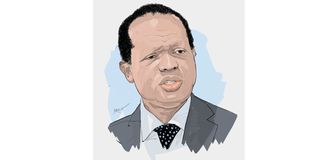
Last week, the High Court cleared the way for the East African Development Bank (EADB) to auction three properties in Karen linked to Mr Tuju, in a bid to recover a Sh1.9 billion loan advanced to his company, Dari Coffee Garden & Restaurant, about a decade ago.
The verdict, which comes after a long-winding court fight, could yet plunge Mr Tuju into financial distress, given that Dari was one of his viable businesses.
But the 67-year-old self-made billionaire, who started out humbly as a journalist in the late 1980s and early 1990s, would no doubt prefer to write a different ending to this story. And history, perhaps, may not oblige.
When other journalists — in the fashion of scribes in the early 1990s — unwound in the evenings and over the weekends, the young Tuju was often still at his desk, chasing the next story or editing scripts long after the newsroom had emptied.
At times, party-going colleagues would ask Mr Tuju, a teetotaler, to take on assignments on their behalf for a small fee. He gladly did the work, and before long, the extra income and relentless hours began to pay off.
Piece by piece, Mr Tuju started acquiring prime properties in the leafy suburbs of Karen and Upper Hill, a feat few journalists of his generation could claim. What began as the hustle of a hardworking broadcaster gradually blossomed into a formidable business empire.
Over the years, he built interests that included the Entim Sidai wellness and hospitality complex, the Dari Business Park in Karen and a portfolio of high-value real estate developments, cementing his reputation as one of the most successful figures to emerge from the country’s media fraternity.
His entry into politics as the MP for Rarieda Constituency in Siaya County years later, would push him further up the exclusive club of Kenya’s self-made billionaires.
Rising through the ranks to become one of the most influential ministers in the administrations of Mwai Kibaki and Uhuru Kenyatta, Mr Tuju gained the political stature and networks, that gave his business interests much-needed visibility and influence.
Today, however, rather than proudly watching the results of his years of sacrifice, he is fighting to save it all.
Thanks to a loan he took from the (EADB on April 10, 2015, the former Jubilee Party Secretary-General is locked in a bruising legal fight as he struggles to prevent the empire he spent decades building from crumbling.
The facility was to be given in two tranches. First, $9.3 million (Sh1.2 billion) would be used for the acquisition of a 94-year-old Victorian bungalow in Karen for a project dubbed the Karen Retirement Home. The second tranche — Sh294 million — was meant to facilitate the commencement of construction works.
The loan agreement noted how critical “the realisation of sales (of the units), especially off-plan, in the rhythm and amounts forecasted is critical to debt service.”
Projections by audit firm KPMG forecast revenues from the sale of properties at Mwitu Road and Tree Lane in Karen at around Sh2.28 billion, against a loan of Sh1.19 billion that Tuju was borrowing.
This represented an internal rate of return of 11 percent over a period of 10 years, “which is higher than the cost of loan funds at 10 percent,” reads part of the agreement.
Mr Tuju has always insisted that EADB breached the contract they had when it failed to advance the second tranche of Sh294 million for the development of 30 three-bedroom maisonettes on one property and eight five-bedroom maisonettes on another.
The lender has countered by saying it could not remit the money because the conditions for receiving it had not been met. Some of the conditions included the borrower presenting architects’ certificates of works completed within the agreed drawdown period and providing additional security — specifically Tuju’s property in Upper Hill.
What followed after the default was a vicious dispute between the politician and the lender over the defaulted Sh1.9 billion loan — a fight that has played out across multiple jurisdictions and courtrooms.
During negotiations for the facility, EADB and Mr Tuju agreed that should there be a dispute over the loan, the matter would be arbitrated in a foreign jurisdiction whose ruling would be binding in Kenya.
In December 2018, the lender invoked this clause and moved to a London court to compel Dari Ltd and the loan guarantors — Mr Tuju, his three children and their S.A.M Company — to repay the money.
Since then, Tuju’s chances of keeping his assets and businesses afloat have grown dimmer with each passing day.
When the parties returned to Kenyan courts as the lender sought enforcement of the London court’s decision, the legal battles became so numerous and tangled that keeping track of the filings became a task in itself.
Among them were petitions lodged with the Judicial Service Commission, where Mr Tuju’s team sought to have some judges recuse themselves from the matter, accusing them of bias.
The dispute eventually climbed the judicial ladder all the way to the Supreme Court of Kenya, with Mr Tuju suffering setbacks at virtually every stage.
Last week, the High Court gave EADB the green light to auction the properties, with armed police swiftly moving into Dari Hotel. Mr Tuju has since moved to the Court of Appeal.
With his back against the wall, Mr Tuju’s fightback has seen him return, in a sense, to his journalism days — when, even without the billions he has since amassed, he could still reach the hearts of millions through the power of mass media.
In the wee hours of Sunday morning, a wry Tuju, enveloped by the chilly night, looked into the camera and spoke directly to Kenyans — especially those he said found themselves in an existential battle similar to his.
In a well-scripted speech, Mr Tuju bemoaned what he described as the invasion of his Karen property by police officers without a court order, saying such actions were not law — “and if it is law, then it is the law of the jungle.”
The former Rarieda MP maintained that he was only defending his family business and urged Kenyans to stand up for their rights.
“I encourage Kenyans who are going through this kind of thing to stay steadfast and fight for their rights. And may God bless all of you,” said Mr Tuju.
Mr Tuju, who once spent time in the intensive care unit in the UK after being involved in a near-fatal accident that left him with 18 fractures, including three broken vertebrae, believes he will weather this storm.
For some reason, fate has often been kind to him, he reckons.
He says his strength comes from his mother, whom he has often referred to simply as Mary — a woman who refused to give up hope for tomorrow, despite the adversity she encountered.
Mary’s own mother died while giving birth when she was just three years old, Mr Tuju recalled in a talk he gave in January. Three years later, Mary’s father also died, leaving her an orphan.
But Mary never gave up. And the young Tuju also refused to give up on life, having been sickly while growing up to the extent that his mother — who had already lost two other children — even brought in priests to pray for him in case he died, he added in his talk.
He did not die. Years later in 2003, when he was a powerful minister in Kibaki’s government, he again survived a plane crash in Busia. The crash left a minister and the two pilots dead.
He believes even the latest predicament will not bring him down.
“Guys, I survived a plane crash. So what is this?” Mr Tuju wondered.