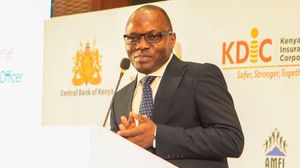
NSE CEO Frank Mwiti on the long path to revitalising the market

Frank Mwiti, the chief executive officer of the Nairobi Securities Exchange (NSE).

Photo credit: Joseph Barasa | Nation Media Group

If you speak to any financial markets expert, he or she will likely refer to a common phrase, you can’t time the market — even if the idea of it is so alluring.

But Frank Mwiti, the chief executive officer of the Nairobi Securities Exchange (NSE), who marked a year as the top head of the bourse in February, would have one assume that he really timed the market and got away with it.
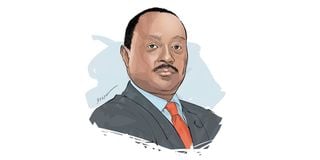
The NSE climbed by 34 percent on average in 2024, buoyed by gains in blue chip stocks as investors’ attention turned again to the exchange.

The NSE also currently sits on year-to-date gains of over 20 percent with many investors saying the B word albeit mostly in whispers- bull run.

Despite the remarkable gains for the exchange whose market capitalisation now stands over Sh2.4 trillion, the journey so far has not been a walk in the park with Mr Mwiti, occasionally having to take the beaten path.

Initial public offerings (IPOs) while appearing close, are yet to end a decade-long hiatus despite a government promise to list between six and 10 listings of State-owned enterprises more than two years ago.

The plan announced so audaciously by President William Ruto was first stopped in the tracks when the courts threw out the new Privatisation Act which envisioned to give more powers to the executive to oversee the process. This has set back the goal of IPOs from listings as the State is forced back to the drawing board- reverting to the old Privatisation Act.

The momentum to break the decade-long duck is however built, with the NSE having two separate high-profile events in back-to-back days last week.

First was Wednesday’s listing of Linzi’s Sh44 billion asset-backed securities to fund the Talanta Stadium Project, and second, Thursday's listing of Shri Kishana Overseas Limited (SKL) by introduction.

Mr Mwiti has not been shy from taking the wins, and equally, critique, as he adjusts to the scrutiny of a public seat from the safeguards of a rather private practice in his former role as a partner at Ernst and Young (EY).

“The transition into the role of NSE CEO has been both exciting and extremely demanding, and I am grateful for the strong support and guidance provided by the NSE Board and our chairman throughout this period,” he says.

“It has also been a very busy time, as I have engaged extensively with a wide range of stakeholders both here in Kenya and internationally, to deepen partnerships and build confidence in our markets.”

Seen by many as an outsider, despite what he says has been a prior long career in finance, Mr Mwiti has had to keep his head up in the face of doubts and criticism from market players, while keeping his focus on executing the NSE new 2025-2029 strategy.

He has managed to quell concerns from the very NSE Board after stockbrokers who own 20 percent of the exchange raised questions on his role as the CEO.

Despite shrugging off the concerns and seeing NSE days close with more green charts than red in the past year, Mr Mwiti does not even hint at a humble brag insisting that a long way remains to revitalising the exchange.

“In my view, the market has not reached its full potential across several critical dimensions including trading activity, valuations, liquidity, brand visibility, investor education and overall adoption,” hes says.

“There is still significant work ahead of us to revitalise the market, elevate its performance and position it as a leading stock exchange in Africa.”

Under Mr Mwiti’s guidance, the NSE has drawn up an ambitious target for its new five-year cycle at a time when many in the public spheres are shying away from making bold statements, as the public follows through on tracking lofty ambitions and calling out unfulfilled promises.

The central focus for this plan is a renewed emphasis on small and medium enterprises (SMEs) and the domestic retail investor segment.
The plan sets an ambitious target for listing 40 new companies and 50 new index funds, which are designed to create more avenues for investment and deepen market participation.

Moreover, the bourse is seeking an active retail investor base of nine million as Mr Mwiti sees individual investors as the backbone of any thriving financial ecosystem.

Retail investors have, however, been a hard constituency to please as they demand even greater concessions from market players to entice and induce their participation. One of the highlighted demands has been reviewing and even a consideration for waving some of the trading fees.

Mr Mwiti says there is a dedicated work stream to assess the current fee structure saying the concern on costs, is one he takes seriously alongside other market players.

“We have received valuable feedback from investors regarding trading fees, and I want to assure you that we are listening. We understand that for the market to grow and attract more participation, especially from retail investors, the cost of trading must be competitive and supportive of market activity.

Mr Mwiti recognises that revitalising the NSE which is still without an IPO since 2015, is a marathon not a sprint. He expects to lean on his resilience to run the entire 42.19 kilometres course and make his mark on an exchange long starved of optimal activity.

“It’s a quality that has been shaped and reinforced over the years through experience and responsibility. This role in particular, demands a high level of resilience and I have come to appreciate just how essential it is when leading a market as dynamic and complex as Kenya’s capital markets,” he says.

PAYE Tax Calculator

Note: The results are not exact but very close to the actual.