Time flies with great content! Renew in to keep enjoying all our premium content.
Prime
Shimba Hills is home to endangered species
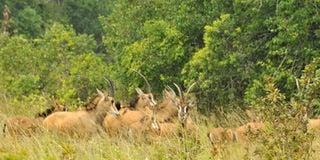
A herd of Sable Antelope at Shimba Hills National Park. This species is facing extinction due to increased poaching. Photo/Moraa Obiria.
Mid-morning we set out into the seemingly quiet Shimba Hills National Park, three kilometers south of Kwale town.
A couple of minutes inside and we are in a whole different environment. It’s a calm cool atmosphere in what are some of the remains of the coastal forest, which still boasts indigenous trees and shade us from the sun.
Shimba Hills, which sits on 129 square kilometers, offers a wide range of terrain and you can catch some wildlife. It is now a national park managed by Kenya Wildlife Service and the Kenya Forest Service.
Previously it was a reserve under the hands of the community.
Driving along the smooth graded roads, we sight a herd of sable antelopes in the open grassland.
These antelopes are one of the biggest attractions to the park. They are only found in southern Kenya and Northern Tanzania as well as as some parts of southern Africa.
They are easy to spot, and tell them apart, due to their scimitar-shaped horns - which they use to attach predators including lions.
The antelopes are very social as they walk and graze as a group. There is only one doe available in a heard of at least 15 though it does not mate with all of them. When a male antelope matures, it must fight to displace the older ones, mainly during the mating season.
“During the dry season they are packed together as many as they can to search for food unlike in the rainy season. They are very social animals. Always together,” said a scientist attached to the park, Bernard Ochieng.
They however face extinction. Hunters and poachers have been killing this animal. They are only 56 left in the park, and the country as a whole, from hundreds.
“This is worrying. This is a number that someone can clear in one day and then Shimba Hills National Park will be no more,” said conservationists from the Wild Wide Fund for Nature, Jackson Kiplagat.
Significantly, the word Shimba is derived from the local name, Shambi referring to the sable antelope among the Digo community which surrounds the park.
Their extinction will clearly disorient the strong connection the locals have for the Shambi sanctuary.
Other than the beautiful animals one can enjoy the lovely panoramic views at Shimba hill. We stopped at the Pengo Hill, located to the western side of the park, rising 448 meters above sea level.
There is a viewpoint that allows one to enjoy the panoramic view, and an ideal place for bird lovers to spot some of the rare species that call Shimba home. However, the foggy weather prevented us denied us the opportunity to enjoy the view.
On a very clear day, while standing at the hill’s highest point, one can look into the Tsavo plains and Taita hills.
It costs Sh200 for an adult to get into the park and Sh100 for a child.
Unlock a world of exclusive content today!Unlock a world of exclusive content today!