Time flies with great content! Renew in to keep enjoying all our premium content.
Prime
Group unravels the art of patchwork quilting
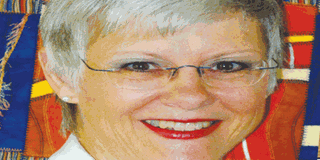
Ms Dena Crain the co-founder of the Kenya Quilt Guild.
Patchwork quilting is an art that is not well known in Kenya. But there is a renewed drive to change this as the Kenya Quilt Guild (KQG) seeks to be more in the public eye to increase membership, and most importantly, educate its members to be more professional quilters.
Such quilts are made by sewing together small patches of different fabrics to create an overall design.People have taken pride, especially women, in creating elaborate patterns that they have passed down generations.
For KQG to promote this art, they are putting an emphasis on African-themed quilts. “Our quilters are gradually gaining confidence with the African designs. We are weaning them from American- style quilting by telling them it is okay to be African,” says Dena Crain, the co-founder of the KQG.
She adds that beginner quilters look at American patchwork books because of the long tradition of the art in the US.
This realisation came to the guild in 2008 when it was invited to a show in Ailsa Craig, Canada. It was a highlight for KQG, but they had to work overtime to produce African-themed quilts.
They mounted an exhibition of 180 quilts, with some brought in from their fellow quilters in Zimbabwe.
Not to be caught in the same state of unpreparedness, KQG recently held its first African Quilt Challenge.
In 2013, they will be going back to London, Canada. The London International Quilt Festival will be a repeat of “The Quilts of East Africa” as well as have some of the members teach, lecture and sell handicrafts during the festival.
Anne Mains and Ms Crain came up with the idea in order to bring quilters together and give the art a voice. Living upcountry at the time, Ms Mains came to see Ms Crain after finding out what she was doing.
Ms Crain is a trained fashion designer, who became a quilter, specialising in wall pieces. Ms Mains has returned to Canada. “I told her it was time Kenya had a quilt guild and she had the same idea. She went back to Nairobi and called her friends together. I did the posters and applications forms,” says Ms Crain.
The KQG was registered in 1999, although it has been operating for some years as it got fully organised. Currently, the guild has 96 active members aged 30 to 80 from all over the world.
KQG has aggressively been promoting itself on the internet through its blog kenyaquiltguild.wordpress.com, Facebook page and Twitter account. It is also affiliated to the Kenya Embroidery Guild. Getting the word out is working as Kenyan women are now joining. Members pay an annual fee of Sh1,500.
They hold monthly meetings— one social and 10 for quilting. During these sessions they have a brief period of announcements, lectures or demonstrations and sales. Members also have access to library books, DVDs, and magazines on patchwork quilting.
The guild brings in teachers from abroad to upgrade upgrade members’ skills. The primary function is skills- enhancement and charitable work on obstetric fistula and assistance to AIDS orphans.
“Every 18 months we hold an exhibition for three days at the Village Market. The next one will be on May 10, 2012,” says Ms Crain. But it is a challenge to promote an art that is not fully understood.
“It is seen as foreign as well as a handicraft rather than an art,” says Ms Crain.
“Worse still, the support for the arts in Kenya is minimal. If there is any, it is for painting and sculpturing. This makes hiring exhibition space quite expensive and selling of the quilts also difficult”.
When Ms Crain first came to Kenya in the 1990s, she started a small cottage quilting industry. She would sell to tourists African-themed quilts. When the economy took a nosedive, she found herself overstocked and could not sell anything. She was forced to shut down the factory and let go of her seven employees.
Even now , there is barely any market in Kenya for quilts. To encourage commission work, the guild has just set up a request form in the blog for professional quilters.
Expensive venture
Another hurdle is access to good quality materials.
The guild recognises only two quilt shops—The Woman Shop, Sarit Centre and the Button ‘n’ Bows, Yaya Centre.
Patchwork quilting can be expensive particularly the sewing machine although it can be done by hand. Good quality fabric is expensive in Kenya especially the filler (felted polyester or cotton).
She admits that it has been a struggle, but Kenyan women are responding.
They have the imagery, sense of colour and texture. They also have the understanding of embellishment and importance of beads but what they have been lacking the technical skills to produce exceptional quality products.
“I feel that we are sitting on a threshold and the world is eager to see what Africa has to offer,” says Ms Crain.
Nevertheless, there is hope as the first African quilting convention is to be held in South Africa in 2012.