Time flies with great content! Renew in to keep enjoying all our premium content.
Prime
Jumba la Mtwana Ruins: Place of rich history and an archaeologist’s paradise
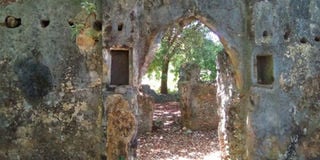
An old building at the historical site. PHOTO | DOUGLAS KIEREINI
The Swahili people originate from the Bantu inhabitants of the coast of Southeast Africa, in an area encompassing the Zanzibar archipelago, coastal Kenya, the Tanzanian seaboard and northern Mozambique.
According to archeologist Felix Chami, the presence of Bantu settlements straddling the Southeast African coast was noted as early as the beginning of the first millennium which gradually evolved from the 6th century, onwards, to accommodate an increase in trade (mainly with Arab merchants), population growth, and further centralised urbanisation developing into what would later come to be known as Swahili city-states.
This interaction with Arab merchants provided considerable cultural infusion and numerous loan words from Arabic and Persian languages into the Bantu dialects.
When the Bantu traders settling on the coast tapped into the Indian Ocean trade networks, which were controlled largely by Omani Arabs, Islam emerged as a unifying force and helped to form a unique Swahili identity.
The Swahili people brought goods from inland (mainly food crops and spices) and sold them to Arab, and later, Indian and Portuguese merchants. During the apogee of the Middle Ages, ivory and slaves became prime sources of revenue to the Swahili.
Jumba la Mtwana Ruins (“Mansion of the slaves” in Kiswahili) is one of the many ruins to be found along the Kenyan coastline.
Situated just under 20 kilometres from Mombasa Island, one kilometre north of the mouth of Mtwapa Creek, off Malindi Road, the ruins are all that remains of a small, picturesque Swahili coastal town sitting on about 12 acres of baobab forest with a frontage to a desolate beach.
Excavation of the site began in 1972 under the guidance of James Kirkman.
Archaeological evidence, mostly shreds of early blue and white porcelain with luang-chuan celadon and the absence of any later Chinese wares, suggest that the town was built during the 14th century and abandoned in the 15th century.
It is thought that the site was selected due to availability of fresh water evidenced by the presence of several wells, its fresh ocean breezes and shallow beaches protected from attacks by sea as larger vessels had to anchor far out in the ocean.
The sudden abandonment of the town could have been triggered by the water supply turning brackish or an interruption of trade.
While many of the structures have been lost to time, you can still see the Great Mosque with a panoramic view of the Indian Ocean, three smaller mosques with Mihrabs facing Mecca, tombs and houses such as House of the Cylinder, House of the Kitchen and House of Many Pools.
The architecture is of Arabic design featuring arched openings and wide use of coral blocks held together by lime mortar made out of coral in a meticulous process of heating and desalinating lasting over one year.
Several wells which provided running water for drinking, cooking and ablution facilities (separate for men and women) have been preserved. Walking through the ruins, you can almost feel the place come alive taking you back 600 years!
Arabs were great astronomers and they developed intricate astronomical charts for trade overland and on the Indian Ocean even before the birth of Christ (the three wise men following the star to Bethlehem). During the 14th century, trade routes were largely determined by what were known as trade winds.
On the Indian Ocean these winds were known as Monsoon Winds, blowing from the southwest in summer and from the northeast in winter.
Poor timing
Returning to our story about Jumba la Mtwana, sometimes the Arab traders would miss the southwest Monsoon Winds which took them back to the Arabian Gulf through misadventure or just poor timing.
In essence, this would mean they would have to wait six months to catch the wind back home, a long wait by any measure.
Fortunately for them, in typical African tradition, the men were provided with “comfort” women by the local community and due to the extended stay many of them ended up marrying these women as concubines.
Jumba la Mtwana was gazetted as a national monument in 1982 due to its historical significance. Today, the site is managed by a very knowledgeable curator, Mr Hashim Hinzano, with a compliment of seven staff including two watchmen which is hardly enough to oversee a site measuring over 12 acres.
There is a reconstructed skeleton of a sperm whale, washed ashore in 2013, outside the main exhibition hall. The facility receives between 300 and 500 visitors per month consisting mostly of school children on educational tours. It is not clearly sign-posted and it is easy to miss the turn-off from the main road.
The buildings are in need of restoration work to preserve the remains but I understand that funds are in short supply. Part of the Indian Ocean frontage has been leased to an upmarket restaurant in order to supplement income but this is hardly sufficient to carry out any meaningful work.
The Great Mosque is under the most threat as the ocean currents have seriously undermined its foundation. The problem is compounded by the presence of the Hawksbill and Green turtles which use the beach front as a nesting ground.
If a solid wall were put up to protect the Great Mosque it would block the turtles’ route to their nesting ground, posing a real threat to their continued existence. An ingenious solution would have to be found to protect both the building and the breeding ground for the turtles.
Jumba la Mtwana is an archaeologist’s paradise with a serene atmosphere. It has an arboretum, a picnic site, and a private and secure beach front. If only it were well maintained it has the capacity to become a major tourist and historical attraction.
Merry Christmas!
The author is a retired banker and motorcycle enthusiast.