Time flies with great content! Renew in to keep enjoying all our premium content.
Prime
Lake Elementaita is a weekend thrill
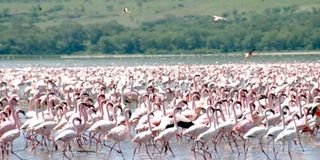
The salty lake is home to flamingoes and 350 other bird species, offering the right weekend outing. /Reuters
Some 130km from Nairobi lies Lake Elementaita.
For those who have yet to experience the beauty of this tiny lake on the floor of the Great Rift Valley, here we go.
For its peaceful environment, it remains a thrilling escape for a weekend.
Geologists say thousands of years ago, the lake was one of those that covered a huge part of the Nakuru basin. Today, Lake Naivasha remains the biggest of these lakes followed by Lake Nakuru.
Lake Elementaita is the smallest of the three.
Although the lake is famous for flamingoes, the decaying eco-system and lack of rains in the area has seen the water levels shrink.
Some flamingoes have either died or left.
But once you tour the area, one realised that the locals are coming up with initiatives to conserve the environment and promote domestic and foreign tourism.
Compared to Nakuru and Naivasha, Elementaita has now been overshadowed by the neighbouring lakes, which have attracted investors to build hotel lodges and camping sites on their shores.
But that is not to say that Lake Elementaita is bare land. In the serene and stunning landscape, the lake has camping sites, cottages and a few more lodges that local people have put up in the area.
It is also one of the places where one can enjoy a hot springs bath with the magnificent view of the lake, hills and valleys bordering the lake.
Due to the deteriorating state of the lake, most of the lodges in the area are eco-lodges which help to conserve the environment with the support of investors.
We met Francis Macharia, who owns the PinkLakeMan’s Eco-Lodge, who says the local community and the investors have for years protected the lake which is now attracting foreign investments including the Serena group of hotels to build facilities.
Visitors have a variety to pick from for fun and unwinding.
There is horse riding on the shores, bird watching to a 42km walk around the lake under the watchful eye of game ranchers from the neighbouring Soysambu and Kenya Wildlife Service personnel.
There is also the option of a hot-air balloon from one of the lodges at the shores of the lake which most tourists use to fly over the lake to the hot springs. Although it is a salt water lake, there is one species of fish known as the Tenere, which the Maasai community harvests.
The lake has a crack which every seven to 10 years drains the water into the earth’s crust which is then replenished through the hot springs.
The water levels are said to reduce immensely when there are tremors as happened two years ago when water levels went down drastically, some say to a tenth of what is there today. The lake is said to be saltier than the Indian Ocean and has attracted researchers and science students for studies.
With the flamingoes being the main attraction at the lake, residents charge entry fees to watch the over 350 bird species which is then invested in building of cottages. Pelicans from Lake Naivasha use it as breeding ground.
There is, however, great alarm on the state of the lake with decaying carcasses of flamingoes and wild animals being a common sight.
Conservation programmes To save the lake, tree planting projects have been started.
Mr William Murai, chairman of Ututu Conservancy, which is a community organisation that controls 11,000 acres of land, says measures are in place by the youth in the area to ensure the eco system is maintained to preserve its sheen for tourism.
And perhaps, Elementaita will never die.
Unlock a world of exclusive content today!Unlock a world of exclusive content today!