Lewa matriarch leaves behind a rich legacy of conservation

Delia Craig, the founder of Lewa Wildlife Conservancy, with husband David. FILE

Mama Delia Craig, who inherited a flourishing cattle ranch that she turned into the world-famed Lewa wildlife sanctuary, has died aged 90.

The conservationist lived to fulfill her dream of bequeathing Kenya and the world a place for rhinos to breed freely and helped restock other wildlife sanctuaries around the country. She left behind 128 rhinos with a place to call home at Lewa.
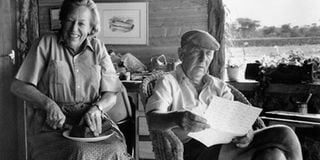

Her son Ian Craig broke the news Thursday, saying his mother quietly passed away in her home last Thursday, days after she had celebrated her birthday. Ms Craig’s father, Mr Alexander Douglas, settled at Lewa, Laikipia, in 1922 to establish a cattle ranch that he later left to his daughter.

Ms Craig promised to transform the cattle ranch into a home for wildlife with the help of her late husband David. Thursday, the Lewa Conservancy fraternity mourned her death, saying she had lived to fulfill her dream.

“The Unesco named Kenya’s Lewa Wildlife Conservancy a world heritage site. No, not because this is where Prince William chose to stay in a log cabin when he popped the question to Kate Middleton during a 2010 safari, or because celebrities such as Jimmy Stewart and Drew Barrymore have also gone on safari here, but because of 30 years of dedicated and imaginative conservation efforts, including the world’s first elephant highway underpass,” wrote Susan Hack an international journalist summing Ms Craig’s work.

The conservationist and her late husband joined hands with the late Anna Merz in 1983 after Ms Merz offered to contribute her lifetime savings towards establishment of the 5,000 acre Ngare Sergoi Rhino Sanctuary. This was later reinvented as Lewa Wildlife Conservancy in 1995 after the entire 62,000 acre ranch was exclusively reserved for wildlife.

Ms Craig’s life story was immortalised in a biography by Natasha Breed titled From Oxcart to Email.

“Of all the people who have shaped Lewa into the world-class conservation initiative it is today, Mama reserves a special place. She was bold, vivacious and loved the wildlife as much as the land it inhabited. Everyone called her Mama because she was not just our mother, but mother to the entire of Lewa,” said Mr Craig, Lewa’s co-founder and renowned conservationist.

The sanctuary holds 110 black rhinos, the biggest rhino population held on a not-for-profit basis.

Her initiative has seen neighbouring communities benefit immensely through financial assistance for education, healthcare support, water and agricultural projects, as well as a women’s micro-credit programme that reaches more than 20,000 members.

Its essence is to reduce human-wildlife conflict and increase the socio-economic benefits that local communities derive from wildlife and tourism.

Lewa has dramatic views to the south of snow-capped Mt Kenya and to the north it leads to the arid lands of Tassia and Il Ngwesi. It has many diverse habitats, from pristine forest, fertile grasslands, extensive springs and acacia woodland.

Lewa is home to 10 per cent of Kenya’s rhinos and 20 per cent of the world’s population of the Grevy zebra. The whole conservancy is fenced, and it employs more than 150 rangers.

To help elephants avoid vehicles and conflict with farmers, the conservancy organised funding and construction of a Sh87 million concrete-walled underpass beneath the Nanyuki-Meru highway, cutting through the Mt Kenya National Park and the conservancy.

A shrewd exercise lured elephants to use the underpass by laying dung trails along it thereby restoring the traditional migration path and reuniting separated herds.

The Lewa Wildlife Conservancy connects with the Mt Kenya National Park and the Ngare Ndare Forest Reserve, serving as a wildlife corridor for elephants migrating between their dry-season mountain slope feeding grounds and the surrounding grasslands of the Somali/Maasai ecosystem.

Currently, the region’s elephant populations are divided into two isolated groups of 2,000 animals in Mt Kenya and 7,500 in the Samburu-Laikipia ecosystem.

Lewa’s model of conservation has also seen communities living in northern Kenya join hands where wildlife-livestock grazing fields have been formed bringing together more than two million acres under conservation, with several community-run conservancies establishing multi-million high-end tourist resorts.

The association, the Northern Rangeland Trust-Kenya (NRT-Kenya), has since established structures for engaging communities at all levels, efforts that have seen area residents employed as rangers and women groups formed to harvest silk for sale to manufacturers at handsome prices.

NRT-Kenya has been spearheading formation of community-run conservancies that also act as buffer zones against cattle rustlers and poachers who have for decades roamed freely, making northern Kenya to become infamously known as a bandit-prone zone.

PAYE Tax Calculator

Note: The results are not exact but very close to the actual.