Time flies with great content! Renew in to keep enjoying all our premium content.
Prime
New PSV rules deal blow to graffiti artist’s business
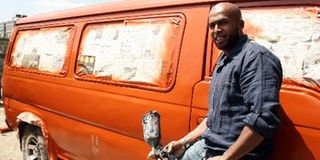
Mr Karter: The new laws have removed the value car owners attached on graffiti and quality finishing. Photo/LIZ MUTHONI
Eight years ago Mohamed Karter ventured into Nairobi’s streets with the aim of putting his talent in graffiti drawing to good use.
Mr Karter did not know how far his dream of becoming a successful graffiti graphic designer would take him.
Armed with only a bag that contained stationery, Moha, as he is popularly known by his clients and friends, solicited for assignments from clients who were mainly motorists.
“I had to make a living, especially because I needed to take care of my sisters. At the time I relied on moving from one client to another,” he said.
Gradually, Moha started witnessing growing customer numbers. From less than three clients per month, his graffiti artwork began attracting as many as 10 or more.
By 2005, the influx of customers was so heavy that it became impossible to attend to them at their stations.
His client base had expanded to as far afield as Kisumu and Mombasa.
Consequently, Moha converted his house into a part time office and the compound to a garage from where he decorated cars.
Customers had to park at his compound in shifts as space was limited.
At this point Moha realised that not only did he need a bigger parking space but he also had to consolidate his labour force.
“Working from home meant I had to hire different people for specific jobs; one to do spraying, another for straightening dents on vehicles etc — as I concentrated on the drawings,” he said. In 2006, he set up a garage at Nairobi’s Eastleigh estate to accommodate his growing business.
Different turn
Moving to a larger, central location enabled him to attend to more customers, between 10 and 15 per day, he said.
But his work has of late taken a different turn. Thanks to the public service vehicle regulations spelt out by the Transport Licensing Board two years ago that require all PSV vehicles to have a single colour — with no artistic drawings.
Though meant to improve efficiency in public transport, the Mombasa born artist said the rules were dealing his business a deadly blow.
They mark the beginning of a nightmare and an end to a career he has cherished.
In place of the 15 or more public transport vehicles parked at his garage awaiting service each day, today he receives less than five — most of them privately owned.
The few clients who go to his garage seek repair services, interior makeover, or spraying as opposed to graffiti.
In the good old days, his charges were rarely based on a single graffiti and mostly came in packages, he said.
Now, Moha sees tougher times ahead as subsidiary services such as car colour change are no longer needed by motorists.
“The regulations have removed the value car owners attached on graffiti and quality finishing. Most of the vehicles in the garage are private-owned and the demand for graffiti varies with age groups,” he said.
On average, a customer can spend as low as Sh30,000 or as high as Sh100,000 on car spraying. While combined with graffiti, such costs average Sh150,000 or more.
The new rules have not only led to dwindling incomes for the artist, but also job losses to the staff employed at the garage.
In 2008, the garage was a source of income for at least 30 people, some were trainees.
Other options
The number has since dropped to less than 10 with prospects of even further job losses as business falls with compliance to the traffic laws.
Besides the cost of running the garage, Moha’s other challenges include sourcing money for rent and electricity bills.
“I have a compressor machine, which is supposed to be changed after six months if working in a busy station. It is more than a year since I changed it, meaning I have been quite idle,” he said.
While Moha hopes that the rules will be lifted, a benefit to those in the graffiti business, he is pondering other options including relocating to countries where the graffiti businesses is still a cash cow.
They include countries like the US and South Africa where such art raked in millions in incomes due to demand by mainly private car owners.