Time flies with great content! Renew in to keep enjoying all our premium content.
Prime
Next Samosa Festival set to be bigger and better
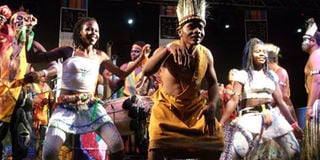
A performance at a past Samosa Festival that was held at different venues in Nairobi between September 22 and September 29, 2012. PHOTO | Margaretta was Gacheru
The Samosa Festival, running from August 23 to 31 at various Nairobi venues, is bound to be bigger and better than all the previous fetes.
Co-founders of the festival, Zarina Patel and Zahid Rajan, don’t make that claim themselves. They have simply gotten more expansive in reaching out to Kenya’s multicultural community.
And with the theme Mitazamo Yetu (Kenyan Perspectives), they have tapped into the vast talents of cultural activists and the resources of corporate supporters to design a programme which reflects their vision of a festival reflecting all facets of the country’s diverse communities.
As in previous years, the Samosa Festival will feature a range of genres, from music, film and fine art to theatre, performance and discussions focused on promoting cohesion and integration. It will also highlight various struggles and other social issues that are alive in the country today.
The format of the festival has also changed this year in that a number of activities are programmed as if they were mini-Samosa fetes.
That is one way to look at the festival’s expanded film programme, which has two phases: one coordinated with Film Africa which will show at five Kenyan universities, and the other coordinated with Hot Sun Film Productions, which will screen similar films in five informal settlements, including Kibera, Dandora, Kawangware, Mathare and Baba Dogo.
But film is only one facet of the festival. The first day will feature a community media festival organised in partnership with Kenya Community Network and several community radio stations such as Mtaani FM (Dagoretti), Koch FM (Korogocho) and Pamoja FM (Kibera).
The programme, entitled Going to the Community and which will be held at the Dagoretti Empowerment Centre, will serve as a sort of Samosa Festival in miniature since there will also be films, a photography exhibition and a discussion forum addressing both contemporary social issues as well as South Asians’ participation in Kenya’s anti-colonial struggle.
Dictatorial regime
That struggle is the subject of the photo exhibition as well as a set of graphic paintings by Zarina who took up visual art during the height of the Moi era when it was all but impossible to speak out openly against his dictatorial regime.
The music component of Samosa has also been expanded to include the last Saturday’s Concert Night, which will showcase popular local group H_Art the Band, together with Daraja, a group specialising in Afro-Asian fusion music, as well as Koogu, the guest performer from Bangalore, India. The Louis Leakey Auditorium of the National Museum will host the event.
Series of vignettes
The South Asian performing artiste look his name from a call meant to “invoke the warrior who (supposedly) resides in every human being”. Koogu is also a series of vignettes based on real events, some of which occurred in the performer’s lifetime.
On August 29, Samosa will feature Hadithi, an evening filled with music, spoken word and a hip-hop musical that will tell stories of ordinary Kenyans as they strive to pursue a life of dignity amid challenges. Youth group Stand Up Shout Out will partner with Samosa that night to bring its Verbalise Realise group to complement the hip-hop musical.
Conservation is another hot topic this year as the Hands off our Elephants campaign will screen the documentary Battle for our Elephants on Tuesday, August 26. It will be followed by discussions hosted by Dr Paula Kahumbu, the Wildlife Direct executive director, and Stand Up Shout Out.
The following day, University of Nairobi will be the venue of the Literary Colloquium in which local academics will present papers and discuss the topic of Cosmopolitanism in Kenya at 50. The theme is meant to stimulate conversations that cut across ethnic, racial, regional, religious, cultural, personal and communal differences and similarities.
A special edition of the magazine Awaaz, also co-founded by Zarina and Zahid, will focus on the colloquium and the festival as a whole.
Kuldip Songhi’s fascinating script Beach Access will be staged on the last day of the festival and the playwright will be on hand to discuss any of the controversial issues raised in his play.
TV is another new component of the festival. Julie Gichuru will interview a dozen prominent Kenyans on the theme of race, class and ethnicity matters.
Unlock a world of exclusive content today!Unlock a world of exclusive content today!