Time flies with great content! Renew in to keep enjoying all our premium content.
Prime
Touch the rainbow at Victoria Falls
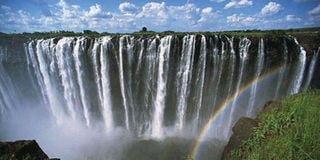
Victoria Falls is locally named Mosi au Tunya. Photo/FILE
No heavy clothing please and be ready to get soaking wet!
This is the chorus of advice that greets us we enter the gates of the world famous Victoria Falls in Livingstone, Zambia.
A few meters away, a group of visitors scramble to hire the few available raincoats and rubber sandals—ready to face the might falls.
Some of those who miss out on the raincoats choose to proceed in their under garments.
The sky above us is equally awash with activity as several helicopters and micro-lights hover above the mighty water falls—handing adventurous passengers a bird’s eye view of this wonder of nature.
“A visit to Zambia is not complete before you set foot here,” Chris Kakunta, a local says jokingly as we descend a path way that leads to the Knife Edge Bridge and overlooking the falls.
Standing on the Knife Edge Bridge one captures the magnificence of the falls as the Zambezi River cascades and thunders through the gorge.
The Knife Edge Bridge provides a fine view of the Eastern Cataract and the Main Falls as well as the Boiling Pot where the river turns and heads down the Batoka Gorge.
Other vantage points include the Falls bridge and the Lookout Tree which commands a panoramic view across the Main Falls.
The view mutates with seasonal weather changes. During the dry months of the year such as May to September it is even possible to walk along the lip of the falls themselves.
However during the rainy season the views are largely masked by the intense spray, leaving those in the periphery of the falls soaking wet.
During my visit I encounter intense spray because the water levels on River Zambezi are quite high coinciding with the rainy season in Zambia that is headed for a close.
History records that David Livingstone, a Scottish missionary and explorer, was the first European to view the Victoria Falls while on trip on Livingstone Island in Zambia.
He later named the natural spectacle Victoria Falls in honour of the Queen.
The Tonga community living around the falls however know it by the name “Mosi-oa-Tunya”—which literally translates to “ The Smoke That Thunders”.
So strong are the sentiments about the falls that the country’s only brewer—Zambia Breweries—has even named one of its beer brands “Mosi Lager”.
The River Zambezi that pours down the falls has a course characterised by numerous tree-covered islands, which increase in number as the river approaches the falls.
There are no mountains, escarpments, or deep valleys along the river’s course way—adding to the marvel of an unexpected water fall.
Ferry trips
Several hotels line up the banks of the river as it meanders towards the falls—handing residents a picturesque view of the Zambezi. Some of the hotels offer ferry trips along the river.
The falls are formed as the full width of the river plummets in a single vertical drop estimated to be 1,708 meters.
The depth of the chasm, called the First Gorge, varies from 80 metres at its western end to 108 metres in the centre.
The only outlet to the First Gorge is a 110 metres wide gap about two-thirds of the way across the width of the falls from the western end, through which the whole volume of the river pours into the Victoria Falls gorges.
Statistics showed that Victoria Falls has more Zambians and Zimbabweans visiting owing to the ease of access by train and bus unlike the game parks that are more popular with foreign visitors.
Both Zambia and Zimbabwe allow tourists to make cross-border daytrips on the Victoria Falls without the necessity of obtaining a visa in advance, but visas issued at the border are expensive, particularly upon entering Zimbabwe.
A striking feature at the falls is a naturally formed pool known as the Devil’s Pool, near the edge of the fall. It is accessed via Livingstone Island in Zambia.
“When the river flow is at a safe level, usually during the months of September and December, people can swim as close as possible to the edge of the falls within the pool without continuing over the edge and falling into the gorge,” a guide says.
This is possible due to a natural rock wall just below the water and at the very edge of the falls that stops their progress despite the current.
“At least one person dies each year at the devil’s pool,” Mr Kakunta says “It is not known why it is so but that’s it. Its not a myth,”
The number of visitors on the Zimbabwean side of the falls has traditionally remained higher over the years owing to more advanced hotel facilities.
Apart from site-seeing at the falls, there are a range of other activities such as the adrenalin pumping bungee-jumping, a gorge swing, white water rafting or jet boating below the falls.
A flight over the falls in micro-light or helicopters is also compelling.