The way Roy Kinyua, the Regional Group Chef of Serena Hotels speaks about turkeys, one would be forgiven to think he grew up farming them. Forgiven but wrong.
“The first time I had turkey,” he says, “was back in college.” This is not why he became a chef, but it’s also not why he didn't; that was due to a serendipitous encounter with a coconut cupcake. Not a romantic story, but, given his situation, perhaps a consequential one.
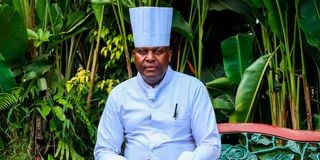
Kinyua is big and generous, in both hospitality and conversation. He’s spent his whole life proving himself. In chef school, you have to prove yourself. How you hold the knife.
How you chop. How you take on to pressure. Something about withstanding the heat in the kitchen, if you will. If you have what it takes—and it takes a lot—you move on: Chef de Partie, junior sous chef, all the way to executive chef.
Even so, great chefs make mistakes. Like, for example, that time he bought his son pink shoes. “He made us return them,” Kinyua says, “but in retrospect I understand. Pink is maybe not his colour.” Over lunch at the best table in Serena Nairobi, he serves an accoutrement tomato soup that was like clouds disappearing. Chef’s kiss, if you will.
Do you recall the moment you knew that you were going to be a chef?
Yes, I remember this when I stepped out with my uncle, and he took us somewhere where I had a very nice coconut cupcake. That was my defining moment.
What was that meal that reminded you of the holidays, and how are you recreating it now?
I grew up in the village and came to Nairobi just the other day. We have a gap in the market now, and I call that forgotten food, like say bitter tomatoes and cassava and that is very nostalgic.
There is a restaurant called Kienyeji’s, which does authentic food. That inspires me, recreating those recipes, like East African theme every Thursday at the Serena.
If you were to describe your cooking philosophy in a dish, what would that be?
It's about the flavours and a good dining experience starts from the sourcing. Where are you sourcing that product from? Who is your supplier? What's the package on the ground? So that if you say, you want this kind of a tomato, with this kind of a yield, then you get to know, do I go for wild tomato, or the greenhouse because they have different taste profiles.
What ingredient or flavour aptly captures the Christmas spirit?
Interesting question. Christmas, first of all, comes with a lot of classics, and one of the most popular classics for Christmas is turkey. And people prepare turkey in different ways but slow roasting it in the oven so it comes out very sumptuous, soft and moist. And then the accompaniment, classic sauce for any turkey, is cranberry sauce.
And then, of course, there's the filling. Locally, chapati, chicken, beef is a must stay. And nowadays, before people make a booking they want to see your menu.
Growing up, what never missed at your Christmas table?
Haha! I grew up in Meru. And you know, there's a lot of excitement at that time. The new clothes, going to church. Some chapatis have been made at home, chickens slaughtered, maybe a goat. There were no turkeys those days in Meru (chuckles). There was salad in the form of grated carrots haha! And of course, a soda.
This is a busy time for you. How do you ensure you don't miss out on the holiday spirit?
Yes, definitely, I'll be working but here we do our menus well in advance, by August which is when we start doing the sourcing based on the projection of our numbers. Then we map out the leave days, so if you have to take a break before then you can. But we also have special meals for staff, and give them days off after the festive period with some nice goodies.
You enjoy the festivities twice, at the hotel and with your family. How is that like?
You make sure that you have prepared something for them, and later in the evening, you find time to be with them. If you miss Christmas Day, then you make time in the New Year.
You mentioned turkey several times, and in Meru, there were no turkeys. How did you fall in love with turkey?
Haha! Well, turkey is a delicacy of the festive period. And even when you're in culinary school, those are some of the things we call classic, a certain period of time, like during Easter we feature lamb. Christmas time, is associated with turkey. So it's something people expect to find over Christmas.
When was the first time you had turkey?
In college, when we had a lesson about turkeys, interrogating it in terms of the taste and the flavour, compared to, say, chicken.
For this holiday period, are you usually the guest or the host?
I'm the host. Because when I'm here, I have two mindsets. It's about the guests and what we are offering.
So, you have to make sure that we take care of that in our perspective. Personally, I love when people come to my house, I like entertaining and this is key for me because it offers an opportunity to connect with people you have not seen for long.
What's the most challenging Christmas gift you've bought for someone?
I bought a pair of shoes for my son sometimes about two years back. But when I gave him, he was hesitant to take it. In retrospect, I understand why. I bought pink shoes [chuckles]. We had to return it.
The most memorable gift?
I received a cooking knife. I have used it once, in Kampala, when we had Queen Elizabeth. It is packed somewhere nicely. It was very inspiring to have somebody appreciate what you do.
Do you travel with your knives?
Sometimes, based on where you're going and what's the occasion. And I do a lot of food promotions. Not only the knives, but there are some special gadgets and equipment you have to pack nicely, but you have to declare them.
What's your way of spreading the festive cheer?
20 October is the International Chef’s Day and we get together and support needy homes or mentor young chefs here. That is when the celebration starts.
Over the festive season, we might not be doing something specifically, but it's creating that kind of mood and during our briefings, during our communication, we talk about the good things of the festive period.
What's the most unchef-like thing you do?
Haha! When I was growing up, we expected a chef to be a big, huge person; that’s how you could tell one was a chef. But I know that exposes you to health concerns.
And personally, I've lost a couple of mentors on that line in terms of, you know, the way you eat, and also their lifestyle. Because there's been this narrative that working in the kitchen, it's very stressful.
There's a lot of pressure and people end up drinking. You need to respect your career as a chef, it’s like any other career and we encourage chefs to lead a healthy life and exercise.
Personally, I jog 5KM every morning, five days a week, and that requires a lot of discipline but that gives you focus.
What then is your guilty pleasure?
[chuckles] whoof! I like going out and enjoying good music, and sometimes I can take a drink or two. I am a very good dancer, and that is my best kept secret, which is I have never taken alcohol at work, and that has safeguarded my image.
What habit have you kicked this year?
Procrastination. I was very deliberate on that. And I am happy it has taken me to a new level.
What part of yourself have you worked hardest to understand this year?
Business acumen. It is about offering the best experience and making tasty food but also are we making money? That is the key thing: how do we balance and make that money? The industry is getting more competitive, and it is up to you to be a good businessperson.
Personally, I have networked more, contacts with chefs from different regions and whatnot, to trigger a different way of thinking.
How are you different from the man you were in January 2025?
I am very excited about the journey I have walked this year. It has been challenging career-wise, but I am finishing it at a better pace.
Have you kept the promises you made to yourself?
Maybe 90 percent. We still have a few days to go, I hope I will be in a better position to finish that. It has been substantial what I have achieved.
How are you stepping into 2026?
A lot of inspiration, making it better and a big focus area for me is innovation and creativity across the board, doing more benchmarking and international food participations so you can anchor yourself into what is happening in the world.
If you were to summarise the year you’ve had with a dish or song, what would it be?
Cyndi Lauper’s ‘Time After Time’. Everything is one step after the other, ticking and isolating, time after time.
What’s your most sacred New Year's ritual?
The first Sunday of every year I have to go to church. To appreciate what has happened in the past year and to pray for the new year.
Give us your top tip for 2026?
Growth is very discomforting. It’s about sacrifice, commitment and going out of your way and most people don’t tend to resonate with that. Motivational speakers make it seem like you wake up and things happen but it is never like that. It is uncomfortable. Do you agree with me? [chuckles]
Indeed. Settle this debate—what is the difference between a chef, a cook, and a caterer?
When you graduate from college you are a cook. On the ground, after making many hours and performance, you can climb the ladder to section head who is in charge of several department in the kitchen to sous chef, an assistant to the head/executive chef who runs the kitchen to chef.
A chef leads a team and coordinates the operations of the kitchen in totality, a cook runs a section under Chef de Partie.
And a caterer?
Let’s say they come up with catering firms and enlist the services of a cook, because getting a real chef is quite expensive, but you can always get a cook who will say they are a chef but you will lack in terms of creativity, consistency, cost management et al..