Time flies with great content! Renew in to keep enjoying all our premium content.
Prime
Why developers are now turning to natural stone tiles
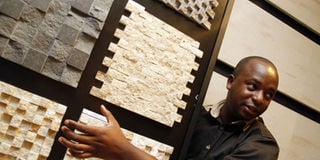
Classic Mouldings projects officer Ian Njihia explaining how natural stone tiles work at their showroom. PHOTO | DIANA NGILA | NATION MEDIA GROUP
Natural stone slabs, were a preserve of royalty as they were used to show class and glamour in castles and palaces in ancient times. Centuries later, natural stone flooring still remains reserved for the select few who are not not afraid of spending lavishly in building their dream houses.
Loved because of its beauty, uniqueness and variety, natural stone tiling remains a prime choice for individuals with a taste for luxury products.
Having been around since the ancient times, natural tiles’ classiness is incomparable with the porcelain or ceramic tiles whose beauty is time-bound and whose reliability is not guaranteed. Fitted in various areas of the house, including kitchen countertops, bathrooms, hallways, fireplaces and TV areas, these stones add value to a home and can liven up the dullest of houses to create a rich, unique atmosphere.
The strength of stone varies, so does its functionality. For instance, granite, which is considered the hardest and most scratch-resistant stone, is used in areas that experience a lot of traffic, like the kitchen, hallways and bathrooms. However, the predominantly black and gray-coloured stone tiles can also be used on countertops and fireplace surrounds.
Mostly in gold, cream and black colours, limestone tiles can be used in bathroom surfaces, kitchen floors and entry ways because it bears a lot of strength too. More absorbent than granite, marble is porous and easily scratched making it ideal for areas that are not regularly used.
It is mostly shiny white but is also available in other shades including black and yellow and can be used in flooring on condition that a sealant is applied to protect it from scratches.
Turkey
Travertine tiles can be used in bathrooms, countertops, bathroom floors because of its ant-slip finish. Mostly sourced from Turkey, the cream-coloured stone has rusty varieties like tan.
Soapstone, which we mainly see as carvings and which come from Kisii and which is relatively soft when compared to the above mentioned stones, is ideal for kitchen countertops, vanity tops, and fireplace areas.
Mombasa-mined coral stone bears a gold-like look and is mostly suitable for wall cladding.
“Coral stone is best for focal wall or fireplace surrounds to give it an attractive finish,” says Metreen Wamalwa of Classic Mouldings. “It is not suitable for flooring but looks best when put on a small area.”
Sandstone, whose hardiness depends on the quarry where it is obtained from, can be used to make a decorative wall around the bathtub or on bathroom and kitchen floors.
The above mentioned natural stones are known for quality and longevity in flooring and wall cladding. Available in different shades, each tile’s outline is distinctive, adding exclusivity and character to a home’s living space. Therefore, when deciding on the type of stone tile to install in a house, it is necessary to seek advice from an interiors expert to avoid using heavy tiles for the walls and slippery ones for the floor.
After layering the slabs or the tiles, a sealant is applied to prevent penetration of water or staining. Besides, white cement is used to influence a rich look of the stone.
These natural tiles are known to look better with age and it is, therefore, not surprising that they are a costly countertop and flooring option. To ensure that they keep their timeless lustre and beauty, they ought to be handled with care. For instance, spills should be wiped off immediately to prevent staining.
Mostly used for interiors, the tiles can also be used for exterior wall cladding of the corridors or terrace.
Pricier than tiles, split face stones available in small blocks and in mosaic, are specifically made for wall cladding exteriors. Besides bigger pieces, for instance used for kitchen countertops, are more expensive than tiles too.
Price
The availability of the type of stone determines the cost of the tiles. At Classic Mouldings, for example, the price of a square metre ranges between Sh5,300 and Sh20,000.
Commenting on why the trend of using natural stones is slowly growing, Ms Wamalwa said that natural stone tiling and wall cladding is popular with developers or home owners in search of antique finishes with a wide range of colours apart from the fact that they are unique and durable.
Additionally, besides tilling and wall cladding, modern technology and artisan craftsmanship has been used to curve unique pieces like coffee tables and bathroom sinks from stone.