Time flies with great content! Renew in to keep enjoying all our premium content.
Prime
Why you need that stove air extractor hood
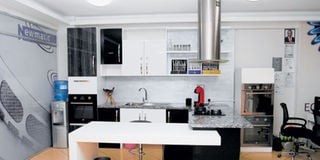
Newmatic Africa model kitchen with a highland hood on display at its Parklands showroom. PHOTO | DIANA NGILA
The kitchen remains an integral part in any house because it is the most commonly used space especially with families.
It is undeniable that a kitchen whose design is aesthetically pleasing, is an important determinant in setting apart a home from a house. Therefore, turning the kitchen into a luxurious space for cooking and living in is usually a decision to ponder over, especially for individuals with a taste for the finer things in life.
But a tasteful kitchen design does not end with perfectly-finished walls and well-installed cookers and ovens. It goes beyond the standard fittings to embrace modern technologies that make life easier for members.
One modern-day appliance that has proved indispensable in the kitchen today is the kitchen hood. The appliance, also known as a range or a vent, is a must-have kitchen appliance for any modern home.
Hazardous air
Hoods are typically installed above the cooking stove, and are used for ventilating kitchens and protecting the family by sucking in the potentially harmful fumes, odours and greases emanating from the cooking pots.
Examples of electronics companies supplying kitchen hoods in the local market are Newmatic, LG, Samsung, Hotpoint, Ariston, Phillips and Snaidero.
Hoods filter out hazardous air pollutants that come from frying and cooking, and are available in two types - duct and ductless. The duct vent comes with a blower that sucks up and carries all the pollutants out of the house.
The ductless (standalone) hoods, on the other hand, are fixed with charcoal filters that clear odours and release fresh air back into the room.
“By acting as a filter, cleaning irritating, hazardous, and even deadly pollutants, hoods offer protection to everyone in the household. Without them, everyone in the kitchen and surrounding rooms are subjected to eye, nose and throat irritations, lung damage and potential carbon monoxide poisoning,” says Behram Baluch, CEO Newmatic Africa, a kitchen appliance company.
“Most homes do not have kitchen hoods and that may be the reason why children develop unexplained allergies. The hood offers more safety benefits than almost any other appliance in the kitchen,” says Baluch.
It turns cooking time into an enjoyable session and gives people a chance to try out different recipes without making the house inhabitable for other members through all the different strong smells. It also takes out all the steam and keeps the kitchen cool.
The appliance sucks in all the grease and moisture that would have settled on the walls eventually forming a sticky film coated with dust. In this way, the hood reduces the amount of time spent in cleaning walls, and prevents the growth of bacteria and mold which can result in allergies and lung problems.
Designs
In addition, the hood acts as a lighting source when cooking, but it is advisable to settle for the models that have the option of LED lighting to save on energy.
The kitchen appliance also adds aesthetic appeal to a kitchen as it comes in different forms and shapes that vary in terms of capturing and expelling away the pollutants. Besides hoods adds more value to a home resulting in more returns to a developer.
There are a variety of kitchen hood designs, including the island range, which hangs from the ceiling and is the most expensive. Wall mount vents are fixed directly on the wall above the cooker while the under-the-cabinet hood is fixed to the bottom of the cupboard.
The pricing for hoods ranges between Sh20,000 for a simple one to Sh120,000.
They come with installation instructions to ensure maximum productivity. Usually, they are fixed above the cooking surface, but the distance between the cooktop and the hood varies with the models.
Typically, hoods are installed in the 70 to 80 cm range above the cooktop, although some may go as low as 60cm.
Movable
“Because the air polluted by cooking does not rise in a perfectly straight line, but spreads out rather aggressively, it is a good idea to position the range hood low enough to give it a good chance to capture the smoke or steam. It is also recommended to position the range at a height where the lights will be below eye level, which also keeps the control panel within easy reach and makes cleaning easier,” said Baluch.
Most hoods in the market are detachable, making them useful for people living in rented houses as they can move with their hood.
While buyers may have a set budget for a hood, it is important to buy one that covers the cook top generously to ensure that all the fumes and pollutants are trapped and expelled.
According to Woody Delp one of the two US-based Lawrence Berkeley National Laboratory scientists that did a study on residential hoods in 2012; “Even a moderately effective exhaust hood can reduce a stove user’s exposure to pollutants but using the back burners preferentially over the front burners helps reduce exposure even more,”
According to the study, the hood with the highest capture efficiency, exceeding 80 percent for front burners, was a model with a large, open hood that covered most of the front burners.
“Open hoods had higher capture efficiency than those with grease screen - and metal-covered bottoms,” the study said.
Unlock a world of exclusive content today!Unlock a world of exclusive content today!