Brokers, investment banks reap Sh1.1bn profit from NSE trade

NSE

The NSE has registered a surge in trading this year.

Photo credit: File

Increased trade in bonds and securities on the Nairobi Securities Exchange (NSE) gifted stockbrokers and investment banks a 156 percent growth in net profit to Sh1.1 billion in the half-year to June 2025, bucking a trend of poor returns that coincided with a bear run in nearly a decade.

The intermediaries draw the bulk of their earnings from commissions on bonds and securities traded in the market.
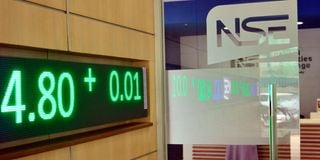
The NSE has registered a surge in trading this year, especially in the secondary bonds market, which resulted in brokerage commissions jumping by 49 percent to Sh1.46 billion, from Sh981 million in the first half of 2024.

Equity turnover at the bourse grew by 18 percent to Sh56 billion in the half-year, while bond trades rose by 78 percent to Sh1.31 trillion, a record for the six months.

Should the market activity be sustained in the second half of the year, the stockbrokers and investment banks will be on track to rake in their highest commissions since 2015, when they netted Sh3.1 billion.

Stockbrokers normally charge a commission of 0.03 percent per bond trade and between 1.5 and 1.8 percent for equities, with the NSE and the Capital Markets Authority (CMA) also taking a cut from these commissions.

Dry Associates led the sector with brokerage commissions of Sh236.7 million, followed by Standard Investment Bank (SIB) at Sh154.9 million, and Faida Investment Bank at Sh151.1 million. In terms of net profits, NCBA Investment Bank led with Sh278.2 million, thanks to earnings from fund management.

“The growth was supported by increased market activity as investors reallocated more capital to equities during the period… it also marked the first time bond turnover crossed the Sh1 trillion mark over a six-month period buoyed by increased activity in the secondary bond market,” said the NSE in a commentary on the half-year performance.

“In the second half, a stabilising interest rate environment is set to boost investor confidence, creating favourable conditions for increased activity in both the equity and debt markets. Lower volatility and improved liquidity are expected to unlock stronger capital raising, higher trading volumes, and more robust investment flows.”

The increased vibrancy of the secondary bonds market is partly a result of the increased purchases of government securities by retail investors in the primary market, backed by the introduction of the Central Bank of Kenya’s Dhow CSD digital bonds trading platform in 2023, which has made it easier to buy government securities.

Retail investors in government debt, who comprise self-help groups, private companies, individuals, Saccos, religious and educational institutions, now hold Sh844.2 billion worth of securities, up from Sh385.8 billion two years ago.

Falling interest rates on new bond issuances on the primary market have also raised the price premium in existing bonds issued in 2023 and 2024, which came with a high coupon or fixed interest rate, enticing their holders to cash in on their paper and boosting the turnover at the bourse.

In addition to trade commissions, some leading investment banks have also been diversifying their revenue by offering fund and wealth management services, as well as undertaking their own investments in the market.

NCBA Investment Bank reported fund management fees of Sh446.6 million, an increase from Sh302.7 million in June 2024, which eclipsed its earnings of Sh67.8 million from commissions and Sh54.9 million from advisory services.

Equity Investment Bank said it earned Sh172 million in profit from investments in the six months to June, compared to brokerage commissions of Sh32.8 million, while SIB netted Sh242.8 million (2024: Sh195.3 million) in financial service charges.

PAYE Tax Calculator

Note: The results are not exact but very close to the actual.