Kenya risks asset seizures over Sh44bn Talanta bond

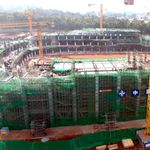
The Talanta Sports City Stadium under construction on April 15, 2025.

Photo credit: PCS

Kenya risks assets seizure over the recently listed Sh44.79 billion Talanta stadium-backed bond if the term of the Sports Fund is not extended beyond 2028.

An investor notice guiding the issuance of the bond reveals that failure to renew the term of the fund will be cited as default of the 15-year-old bond, and that the State will be required to pay the bondholders their money immediately.

The bondholders have also been allowed to seize assets linked to the Sports Fund in recovery of the investments.

The bond was oversubscribed at Sh44.7 billion and proceeds will be used to construct the 60,000-seater stadium on Ngong Road called Talanta Sports City.

Sports Fund, the issuer of the bond, has the legal responsibility to pay the investors semi-annual returns until 2040, with the total payout rising to Sh102 billion.

But the fund’s 10-year tenure lapses in August 2028, clouding the payouts given that the State is yet to issue guarantees of its renewal.

The Sports Fund is mainly funded by taxes and levies raised from the betting industry, and in the year to June 2023, received Sh10.6 billion from the gamblers.

The fund is supposed to use the betting billions to pay interest and principal on the bond.

“The failure to achieve an extension of the fund before its tenor lapses has been identified as an event of default,” says the investor notice that is known as the offering memorandum.

“A commencement of the winding up of the fund will trigger an acceleration of the notes so that all outstanding amounts are immediately due and payable from the fund. This risk is further mitigated by the notes being a priority charge on the assets of the fund.”

The assets of the fund stood at Sh5.6 billion as at June 2023, with Sh3.3 billion in cash and property, plant and equipment worth Sh2.2 billion.

Talanta belongs to a separate government agency, Sports Kenya, which is the custodian of sporting infrastructure in the country.

This means the bondholders cannot seize the mega stadium, which will be built at Sh32.3 billion, with auxiliary infrastructure around the facility taking the remaining billions. The transaction advisers were paid Sh1.4 billion.

The Fifa-standard professional stadium is currently under construction by China Road and Bridge Corporation.

It will serve as a main venue for the opening and closing ceremonies, as well as matches of the 2027 Africa Cup of Nations (Afcon).

Deal-making unit of Liason Group, Linzi FinCo, which structured the transaction, said the Treasury will be forced to step in and settle the recalled balance should the closure of the Sports Fund trigger default.

“As per the Public Finance Management Act, if the fund is dismissed, the obligations shall be absorbed by the Treasury. It is on that ground that we did not seek any further guarantees,” said the source, who is not authorised to speak to the press.

The fund will have paid Sh19 billion to the bondholders at the end of June 2028, including principal of Sh3.8 billion.

This implies the Treasury will have to pay at least Sh47 billion bullet or single payment to the bondholders should the Sports Fund be wound up.

The bond, which started trading at the Nairobi Securities Exchange (NSE) last Friday, was fully subscribed, with investors offering Sh44.875 billion against a target of Sh44.791 billion, reflecting a subscription of 100.2 percent.

The bond has a 15.04 percent rate of return, which will earn investors Sh57.6 billion in interest over the life of the bond.

The interest income from the bond is tax-exempt, giving it the same status as the government-issued infrastructure bonds.

At 15.04 percent, the bond is offering better returns compared prevailing returns of government paper of 12.35 percent.

The Public Finance Management (PFM) Act, which establishes the Sports Fund, obliges the Treasury to take up the liabilities of the fund.

“On the winding up of a national public fund, the Cabinet Secretary shall pay any deficit in the fund from funds of the national government in the National Exchequer Account with the approval of the National Assembly,” says the PFM Act.

The Talanta bond did not have a government guarantee, which dimmed its rating.

“The transaction is exposed to some operational risks, which in the absence of an explicit government guarantee, places a cap on the rating,” said the rating agency.

The bond was accorded an AA rating, which means the issuer has very strong creditworthiness.

PAYE Tax Calculator

Note: The results are not exact but very close to the actual.