The Nairobi bourse is eyeing a big boost in equities turnover this year after MPs granted its request to compel the government and Vodacom to complete the transfer of Sh204.3 billion Safaricom shares on the bourse’s block trade platform.
In its submission to the National Assembly’s committees on National Planning and Finance and Public Debt & Privatisation, the Nairobi Securities Exchange (NSE) argued that having the transaction on the large trades board would boost the market’s transparency and integrity, while aligning with international best practice.
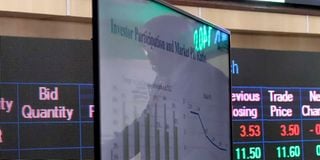
Vodacom inked an agreement in December to purchase a 15 percent stake or six billion shares in Safaricom from the government at Sh34 per share, or Sh204.3 billion in total.
The deal ranks among the largest ever at the Nairobi market, with its value just Sh10 billion shy of the NSE’s record annual turnover of Sh215.73 billion that was achieved in 2014.
Recording the transaction on the market will therefore set the bourse up for a new record high in annual traded equity value.
Previously, such transactions, which are normally carried out off-market, were not recorded as part of a day’s turnover, meaning that investors often did not have any visibility over potentially significant moves by large shareholders of their firms.
“The Cabinet Secretary for the National Treasury shall upon obtaining all regulatory approvals …undertake and complete the transaction through the Block Trade Platform of the Nairobi Securities Exchange,” the committees said in their recommendations to the House.
The market could also be set for a similarly large turnover boost should British multinational Diageo and Japanese beverage maker Asahi Holdings utilise the block trade board for Diageo’s sale of its 65 percent stake in EABL to Asahi for $2.354 billion (Sh304 billion).
This deal which was first announced on December 17, 2025 is expected to conclude later this year.
The NSE set up the block trade board in 2023 on the main market segment, saying it would handle the sale of shares whose value exceeds Sh3 billion and constitute five percent or more of an issuer’s total issued shares.
The board also hosts trades below Sh3 billion, but which constitute more than 15 percent of a company’s total issued shares. Both scenarios are subject to a maximum of 24.99 percent.
The rules however allow for greater price flexibility for block board trades, which are concluded within a 30 percent range based on the average price of the affected security for the previous one month from the date of execution.
This allows for off-market pricing negotiation for these large ticket transactions, helping the market avoid distortion that would result from such trades given that other normal board transactions are limited to price movements of 10 percent on a daily basis.
For large trades on this board, the NSE only records the turnover value, without affecting other market statistics such as the volume weighted price.
In the case of the Safaricom share sale, the National Treasury and Vodacom negotiated a price of Sh34 per share, which represented 15 percent premium above the prevailing market price of Sh28.50.
The Treasury told MPs that the transaction price was negotiated as a premium on Safaricom’s volume weighted average price of Sh27. 50 over the six months ending December 2, 2025.
However, the pricing of the shares sharply divided opinion in the country, with a section of analysts and politicians arguing that the government could have extracted a higher premium due to Safaricom’s status as a prime national asset and its stellar track record of generating high profits and dividends for shareholders.
Beyond the controversy over pricing, the transaction is set to hand market players an income boost of Sh3 billion from transaction fees.
In December, Vodacom executives told analysts in a conference call that the deal would yield transaction costs of between 200 million rands (Sh1.59 billion) and 300 million rands (Sh2.39 billion), the bulk of which will cover brokerage, regulatory and advisory fees.