Time flies with great content! Renew in to keep enjoying all our premium content.
Prime
Pyrethrum farmers eye ‘90s export glory
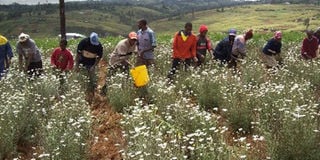
Pyrethrum farmers in Nyandarua, central Kenya. While some say pyrethrum farming in Kenya is losing its lustre, Isaac Mwangi Karanja is praising the crop he started cultivating in 1975. . File
While some say pyrethrum farming in Kenya is losing its lustre, Isaac Mwangi Karanja is praising the crop he started cultivating in 1975.
Mr Karanja is counting the gains and says no crop does not have challenges.
“When I look at my land title deed, I feel it could be betrayal if I were to abandon the crop. There is no crop production that poses no challenges to the farmer, including maize,” Mr Karanja says.
Pyrethrum, the raw material for manufacturing insecticides, is mainly grown in West Pokot, Keiyo, Koibatek and Uasin Gishu in the North Rift.
Its extract is exported to America, Europe, Asia, New Zealand, Australia, and other African countries.
Kenya consumes two per cent of the produce.
Delayed payments is no longer a hindrance, Mr Karanja says, adding that farmers were only lacking “pertinent information” on the prospects of the crop.
Crop rotation would replace use of herbicides and fertiliser, Mr Karanja, 65, told the Business Daily at his farm in Kamura Village, Koibatek in Baringo.
He sells a kilo of pyrethrum at Sh100 — the minimum price that the Pyrethrum Board of Kenya (PBK) offers for dry flowers with 0.8 percent pyrethrin content— to fellow farmers and brokers.
The board, the sole processor of the crop pays up to Sh375 for a kilo of dry pyrethrum with the highest pyrethrin content.
“I lose the generous pay given to those who deliver their produce direct to the board through the collection centres. The established farmers and brokers end up earning more than double what we earn.”
As part of the reforms, PBK is seeking tougher laws to discourage pyrethrum hawking, arguing brokers were taking advantage of farmers who migrated from the sector faulting poor and delayed payment.
The PBK managing director Isaac Mulagoli cautioned farmers against brokers who “will just exploit you when the market is full of prospects for the farmer.”
He said they were working on stiffer penalties in the laws “to discourage such people from meddling with the affairs of the industry.”
Dr Mulagoli has also ruled out liberalisation, saying the board’s priority at this stage was improving productivity of the farmers and reclaiming the country’s global share in the export market.
“To liberalise the sub-sector is not the way to go because the challenges that had affected productivity are being addressed,” he said.
Mr Geoffrey Kamau, a farmer in Uasin Gishu County, wants the government to invest more in luring farmers into pyrethrum farming, saying it is a promising crop that can be relied on to improve the economy.
Mr Kamau says payment on delivery and the creation of more collection centres have improved farmer’s profit margins.
Up to the 1990s, Kenya dominated the world market in production of pyrethrum “but the trend nosedived due to poor payment.” Farmers have been reluctant to return to growing the crop in spite of the steps taken by the board to return to glory.
Collection centres have been increased from about 1,000 two years ago to close to 6,000 and trucks pick up the produce from homes, says the PBK managing director Isaac Mulagoli.
Kenya is yet to meet the global export demand, which stands at 112 metric tonnes of refined pyrethrum flower extracts, the MD is optimistic of recapturing the highest export market share that stood at 75 per cent when the crop was at its peak.
“We export 10 metric tonnes of refined flower extracts against the demand due to insufficient dry flowers to process at our firm, which has the capacity of crushing 75 tonnes at once, but, only one per cent of that capacity is in use,” he says.
Advance payment
Up to 100 tonnes of dry flowers are accumulated for cost-effective processing. Currently it takes up to five months to collect the quantity that provides between 1.7 and two tonnes of refined flower extracts depending on the by-content, says Dr Mulagoli.
Acreage has gone up from 10,200 in 2009 to 20,000 while farmers have grown from 29,000 in June 2009 to 40,000 in July this year.
The board is negotiating with importers in Europe and America for part advance payment ton cater for farmers who need cash urgently.
Dr Mulagoli said the importers were willing to pay in advance to be assured of supply since the demand for Kenyan pyrethrum is big because of high quality.
“We pay farmers Sh100 per kg on delivery and clear the balance after processing.” Reducing the payment period has won the hearts of more farmers and the MD says there were signs of a bright future.
The board owes farmers Sh52 million for dry pyrethrum flowers delivered between August 2008 to June 2009 but Dr Mulagoli says the arrears will be cleared.
Unlock a world of exclusive content today!Unlock a world of exclusive content today!