Time flies with great content! Renew in to keep enjoying all our premium content.
Prime
Regional agricultural commodities exchange to stabilise prices
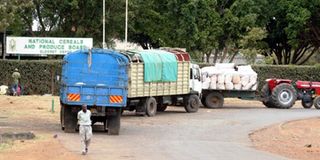
Trucks deliver maize at an NCPB depot. A government-backed commodities exchange may be in place over the next two years after the Ministry of Trade kicked off search for a consultant to oversee its establishment yesterday. FILE
A farmer in Trans Nzoia or in Laikipia sees his crop mature every season or year but has absolutely no idea whether or not he will find a market at a price that meets his production costs.
He gropes in the dark for a market that remains un-guaranteed. The State- run National Cereals and Produce Board (NCPB) might offer him some prices which often appear arbitrary, not putting into consideration the cost of production.
He may or may not sell to NCPB.
Until recently, NCPB offered Sh1,950 for a bag of dry maize but farmers continued drying their maize with no intention of selling until the price was raised to Sh2,300. Meanwhile many people were starving around the country when some areas were awash with the commodity.
Many a times a farmer has seen a bumper harvest go to waste for lack of ready market. Sometimes he is too busy harvesting. When he starts looking, its too late. There already is a glut.
That has been the lot of many farmers in Kenya for decades. Apart from coffee and tea which have auctions, other crops rely on an ad hoc spot market.
Even for coffee and tea, there is no local futures market. But this is bound to change with the planned introduction of a regional agricultural commodity exchange in the next two months.
The project, spearheaded by among others the NCPB, is meant to stabilise prices of essential commodities.
NCPB chairman, Mr Jimnah Mbaru, said introduction of a new commodities exchange was one of the pursuits that the board intends to actualise.
And at the Nairobi Stock Exchange, plans are under way to come up with modalities of introducing the commodities platform. Currently the NSE serves as a secondary market for shares and bonds.
NSE chief executive officer, Mr Peter Mwangi, told the Business Daily that the bourse was in talks with NCPB and a technical team has been set up to see how the idea of a commodities exchange can be realised.
“We need to have a credible price discovery mechanism. It is good for farmers especially in the case of maize,” said Mr Mwangi.
The futures market —the forward contracts standardised and traded at an exchange —means that a maize farmer, for example can sell a future contract on the yet to be harvested grain. This guarantees him the price he will be paid when he delivers.
This also applies to other crops that are traded at the commodities exchange, thereby protecting the farmers from unplanned price drops and the buyer from price increases.
Futures contracts are made as a way of hedging against unfavourable prices and is a method of co-operative farming where growers are insured against a poor harvest by buying such contracts in the same commodity.
Currently, no farmer knows in advance what price he will get in the market but has to sit and wait for the crop to mature. He has only a vague idea of the market in which he is going to sell his produce.
Not surprisingly, middlemen have often taken advantage of the farmers whom they only pay what meets the cost of production.
In developed and emerging market countries, the futures markets are the norm. In the US, for example, the Chicago Board of Trade, established in 1848, has played a major role in the futures market of agricultural commodities.
In the areas where such exchanges have been established, they have become effective in pushing for improvements in methods of transportation, warehousing as well as financing clearing the road for both local and international trade.
But over time, futures contracts markets have developed to the point that speculators and investors also buy and sell the contracts, not only making a profit in the process but also providing liquidity the markets.
But for a commodity market to be set up successfully, concerned parties much reach consensus on the standards of the products to be involved in terms of quantity and quality and methods of ensuring this.
This will make it possible to transact business at the exchange without having to physically or visually inspect the products involved.
One important way of doing this is having the warehouse receipts that are credible due to the standards that have been set and mutually agreed upon.
Normally, the State has to have some legislative standard or some release from liability, or insurance for a commodity market to start trading.
This would deal with, for example, fraudulent transactions where goods purported to exist in a warehouse do not exist.
NCPB has depots around the country which can be used as warehousing and storage sites for commodities and run by private businesspeople.
The Kenya Agricultural Commodities Exchange (KACE) is the only such exchange in the region and is privately run but has challenges that have prevented it from acting as a full-fledged commodities exchange.
It gives information on about 42 agricultural commodities, including livestock, crops as well as inputs such as seeds and fertilisers.
KACE chairman, Dr Adrian Mukhebi, said his organisation had been successful in providing a platform where sellers and buyers of agricultural commodities can meet and transact business as well as act as a source of market information.
The exchange was launched in 1997.
But now the east African region could have the commodities exchange running in the coming two months given the partnership between the NCPB, NSE as well as the KACE.
“Activities are at an advanced stage, aimed at launching such a commodity exchange in the next couple of months,” said Dr Mukhebi.
KACE is working in partnership with NCPB and the Eastern Africa Grain Council (EAGC) to establish an inclusive and vibrant commodity exchange not only for Kenya but also one that will serve the whole of the East African Community region that comprises Kenya, Uganda, Tanzania, Rwanda and Burundi.
Such a regional inclusive commodity exchange is expected to improve and promote agricultural trade in domestic, regional and international markets for our Kenyan commodities.
This is expected to improve agricultural growth and food security, enabling the agricultural sector to contribute more effectively to the success of Vision 2030 for the country.
Said Dr Mukhebi: “It will also be a vital instrument for the efficient and effective management of the national strategic reserves by the Government.”
He called upon the Government to put in place sound legal and regulatory frameworks in terms of a Commodities Exchange Act and a Warehouse Receipts Act to support the initiatives.
Market access He said challenges of a commodities exchange such as the existing legislative structure limited the effectiveness of KACE and its activities.
Dr Mukhebi said KACE did not have a single trading pit in one place where sellers and buyers can trade as is done for fully established commodity exchanges.
“However, we have established various Market Resource Centres (MRCs) in various parts of the country where sellers and buyers can go and trade and access market information,” said the KACE boss.
KACE market information system has been copied, replicated, adopted or adapted in several countries including Malawi and Zambia in southern Africa, Uganda and Ethiopia in eastern Africa and Nigeria and Ghana in West Africa often with consultancy provided by KACE, Dr Mukhebi said.
Because of the demand for KACE services, the organisation has embarked on franchising into MRCs to local private entrepreneurs to operate them on a commercial basis so as to improve access by poor smallholder farmers and other small and medium scale agro-enterprises to market information, market linkage and other relevant services.
It established four pilot MRCs in August, 2006, with each MRC a legally registered limited liability company operated by a CEO.
Smallholders farmers need transport brokerage services that has been noted as a major constraint in matching offers and bids by the smallholder farmers.
There is need for warehousing and storage services often for short periods of time while the produce awaits to sell at better prices the following market day.
Other constraints that need to be overcome are lack of weighing services to smallholder farmers in markets and quality control services such as testing for grain moisture using moisture metres.armers also need inputs such as fertilisers and seeds at affordable prices, which has been a major hurdle and State attempts at surmounting it has not yielded sufficient fruits.
Participation in a formal exchange should also make access to financial services for small farmers easier because they have a ready and organised market.
When such a market has a futures market, it means that a farmer is in a position to use the terms of a deal he has a clinched as security to secure funds either for harvesting or for investing in the next season or year.
Besides market information and market linkage services, KACE envisions that MRCs would be in a position to provide these types of services and even bring in IT services closer to the farmers by providing e-mail service in the remote rural areas in which they are located.
The government, through the Ministry of Agriculture has for a long time had market information service which is published in the media. There are agricultural officers stationed around the country.
But Mr Booker Owuor, a researcher at Sower Solutions Kenya, said surveys done by his organisation showed that even some of the information relayed by the government was not accurate.
“Having done research on the ground, we have noticed that there are discrepancies between the reported figures and what you find when you are on the ground,” said Mr Owuor.
Mr Zakayo Magara, deputy director at the agri-business department of the Ministry of Agriculture, said in an interview that the NCPB has a strategic plan to actualise a commodities exchange.
It is possible to use warehouse receipts for trading at the commodities exchange. It is possible for the private sector to lease silos that belong to NCPB and these are then used as warehousing facilities.
“You can use the warehouse receipts to participate and time the market,” said Mr Magara.
Dr Mukhebi said among the challenges that a commodities exchange must overcome and which KACE itself had faced, were lack of a legal and regulatory frameworks to guide the proper development and operation of agricultural exchanges as well as government interference in commodity markets, preventing the forces of supply and demand to determine fair market prices.
Unpredictable government policies, for example banning of exports or imports of certain commodities from time to time, made it risky and unprofitable for private sector to invest in agricultural markets, said the KACE boss.
Other challenges were poor infrastructure — poor roads, inadequate storage facilities— to support the marketing of agricultural commodities and the relatively high costs on ICTs to rural stakeholders, especially farmers and commodity traders.
Unlock a world of exclusive content today!Unlock a world of exclusive content today!