Time flies with great content! Renew in to keep enjoying all our premium content.
Prime
Safaricom’s historic Sh681bn market value excites investors
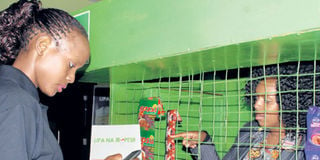
An M-Pesa customer. Analysts expect M-Pesa revenue growth to further lift Safaricom’s NSE outlook. PHOTO | FILE
Safaricom on Thursday touched a historic trading high of Sh17 on the Nairobi Securities Exchange (NSE), raising its market capitalisation by a hefty Sh41 billion compared to Monday this week.
The new high price pushed the capitalisation of the giant telecommunication firm to Sh681 billion compared to Sh640 billion on Monday, when it hit a price of Sh16.00 per share.
In terms of the average price for Thursday, the counter hit an all-time high of Sh16.45— and a capitalisation of Sh659 billion.
Compared to Monday’s average price of Sh15.90 and capitalisation of Sh637 billion. It means that over the past four days the company’s market value has grown by an average of Sh22 billion.
The latest high by Safaricom will be welcome news to shareholders including Vodafone Group and the government, who hold 40 and 35 per cent respectively in the company respectively. Retail investors hold the remaining 25 per cent in the company.
“Despite wide spread positive sentiment over the company’s financial performance for the year, it is more likely that the current demand on limited supply has sparked the share price surge. We anticipate a minor price correction in the short term before a repeated gradual rise in the run up to full year results in May,” said Genghis Capital analyst Silha Rasugu.
“Foreign investor activity has been comparatively low -meaning that demand has been driven by locals- and going by the high turnover levels, both retail and primarily institutional investors. Given the rapid rise over a short time span, I would classify the current momentum as speculative in the short term,” said Mr Rasugu.
For Safaricom shareholders, Vodafone’s stake in the telco is now worth Sh264 billion, and the government’s is worth Sh231 billion.
Two years ago, the entire worth of the company was Sh274 billion. For retail investors, the growth story of Safaricom’s share has been a source of joy and regret in equal measure.
Safaricom in 2011 fell to an all-time lows of Sh2.50, as some investors became pessimistic with the fall in net profits and exited at a loss—and are likely also counting the potential gains their exit has cost them.
Some of those who waited patiently for the counter to recover back to IPO price of Sh5 after years of trading below that level quickly cashed in once the share returned to that level in late 2012.
The investors who held onto their stock are now enjoying their share of a 230-per cent gain on the IPO price, or over Sh460 billion worth of the new wealth generated on the stock.
Investors have also been looking at the company’s dividend policy, in which it pays out above 80 per cent of net income as dividend.
According to Genghis Capital analysts, this has made the counter an increasingly attractive investment especially for foreign investors.
Safaricom paid a dividend of 31 cents a share for the year that ended on March 31, 2013, and raised the payout to 47 per share in the year through March 2014, representing 82 per cent of net income.
According to Kestrel Capital analyst Linet Muriungi, Safaricom alongside bank counters of Equity, KCB, and Cooperative Bank are poised for above average growth over the medium and long term due to strong fundamentals.
“We consider their current high valuation relative to peers not only justifiable, and likely to ease off as the companies continue to record sturdy year-on-year growth,” said Ms Muriungi in the Kestrel’s Kenya macroeconomic and equities outlook 2015.
The firm expects growth in voice, data and M-Pesa revenue arising from increased subscriber minutes, active data use and the launch of additional M-pesa products.
Unlock a world of exclusive content today!Unlock a world of exclusive content today!