High Court suspends tax-free rice imports

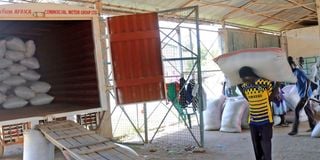
Casual workers load bags of unprocessed rice on Lorries from National Irrigation Board offices in Ahero for export to Uganda on May 10, 2017. 

Photo credit: File | Nation Media Group

The High Court has suspended the government's plan to import 500,000 tonnes of Grade 1 milled white rice following a petition by the Farmers Party, which claims the importation is harmful to local farmers and traders.

Justice Edward Muriithi, sitting at the High Court in Kerugoya, issued a conservatory order on Monday. It remains in force pending the hearing of the application filed by the political outfit.
The interim order suspends implementation of the gazette notices issued by the Cabinet Secretaries for the National Treasury (John Mbadi) and Agriculture (Mutahi Kagwe) on July 28, 2025, approving the duty-free importation.

The importation was to continue until December 31, 2025, as the State sought to cushion consumers against rising costs of food and ease pressure on the local market.

Justice Muriithi certified the case as urgent and directed the petitioners to furnish the respondents with the court papers ahead of the hearing scheduled on August 14.

The respondents include the two Cabinet Secretaries, the Agriculture and Food Authority, the Commissioner for Customs & Border Control, the Attorney General, and the Kenya National Trading Corporation (KNTC).

The petition contends that the importation would be detrimental to local farmers, retailers, and suppliers, who have the commodity in their stores and are at risk of suffering financial losses if the tax-free rice enters the market.

It argues that the importation was sanctioned without prior notice and that the same amounts to illegal control and stabilisation of food products in the absence of an emergency.

The petitioners also argue that the duty-free importation is against provisions of the Price Control (Essential Commodities) Act, 2011, and the East African Community Customs Management Act.

The petitioner also disputes the government’s explanation that the duty-free importation was aimed at addressing an “anticipated shortfall of Grade 1 rice in the Kenyan market”, which could not be satisfied by the existing local production.

“This is not true because the 2nd and 3rd respondents (CSs for Treasury and Agriculture) cannot claim famine when they have not completely mopped up and/or purchased local harvest as alleged at the paddy for three seasons,” says the petitioner.

However, it did not provide specific figures on local reserves of rice.

“Unprocessed rice is at the rice paddy. The market has an abundant supply of Grade 1 rice, which is on sale both from the farmer and the local importer. Unless the orders are urgently granted, the price of Grade 1 rice will, as an automatic consequence of the 500,000MT fall, become a loss for the farmer, importer, and retailer,” the petitioner’s lawyer Alex Musyoki argued.

He stated that the immediate importation without notice of duty-free rice has and would continue to drive down the cost per kilogram of rice at the shop’s counter to the detriment of farmers.

The petitioner further contended that the importation may render the last previous harvests covering July 2024 to July 2025 a loss and affect the livelihoods of thousands of rice farmers and traders across the Country.

“The current tonnage of unsold stock of both imported and locally produced rice at the firm, granary and private silos is not completely mopped and consequently there is no evidence to demonstrate sharp price variation in Grade 1 rice as alleged by the Cabinet Secretaries between January and July 2025 to limit low income households from accessing the said grade of rice,” said the lawyer.

He claimed the duty-free importation was unlawful and harmful to local farmers and traders.

“The Respondents continue to perpetuate Constitutional infractions and procedural improprieties against well laid down laws against the rice farmers of Kenya to the benefit of a few individual suppliers,” says Mr Musyoki.

The alleged violations include unsanctioned and unjustified discrimination against the local rice farmer with respect to constitutional economic rights, and especially the right to livelihood.

The petitioner warned that the government’s action would cause unnecessary and imprudent use of public funds to not only import duty-free funds through the KNTC in favour of a few companies but also the denial of much-needed revenue.

The petition is pending hearing and determination.

PAYE Tax Calculator

Note: The results are not exact but very close to the actual.