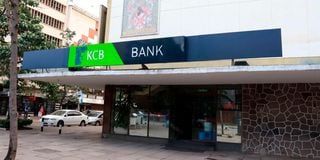
KCB Group has paid $6.405 billion (Sh829.04 billion at current exchange rates) worth of Letters of Credit (LCs) for fuel supplied to Kenya on credit, making it the single biggest lender backing the deal that started two years ago.
This is based on disclosures tabled before Parliament, which show that seven banks, including KCB Group, have paid LCs worth $10.9 billion (Sh1.41 trillion at prevailing rates) to the three Gulf firms supplying Kenya with fuel since April 2023.
LCs are financial instruments whereby banks commit to settle a buyer’s payment to the supplier of a good or service at an agreed time, thus offering much-needed comfort to the seller.
The buyer, in this case Kenyan local oil firms, then pay the seven banks the equivalent value of each LC upon selling fuel to their customers.
Saudi Aramco, Abu Dhabi National Oil Company (Adnoc), and Emirates National Oil Company (Enoc) have been supplying Kenya with refined fuel on a 180-day credit window since April 2023.
“The total value of Letters of Credit (LCs) issued is $12.34 billion (Sh1.59 trillion), out of which LCs worth $10.91 billion (Sh1.41 trillion) have been settled with no default,” Energy CS Opiyo Wandayi told lawmakers on Tuesday.
MCB of Pakistan has cleared the second biggest value of LCs at $1.94 billion (Sh251.51 billion), followed by I&M Bank at $1.054 billion (Sh136.53 billion), while Diamond Trust Bank has paid the fourth biggest value of LCs at $801.62 million (Sh103.74 billion).
Under the scheme, oil marketers importing fuel from their Gulf counterparts are expected to make deposits equivalent to the value of cargoes with the bank issuing the LCs. The lender is in turn tasked with sourcing the equivalent dollars, which are then used to pay the three Gulf oil firms.
KCB Group was the only lender issuing the LCs when the deal was rolled out in 2023, as other banks kept off amid fears that the deal might not work, largely due to the dollar crunch that faced Kenya at the time.
Most of the six local banks entered the scheme last year as market jitters eased. The lenders earn commissions for issuing the LCs.
The government-backed deal replaced the Open Tender System and has helped Kenya import petrol, diesel, and jet fuel without triggering a rush for dollars every month.
The fuel importation arrangement was designed to end the monthly demand for an estimated $500 million that oil marketers previously needed to pay for their cargoes. Easing the rush for dollars has been key in propping up the shilling, which had taken a beating and hit record lows in late 2022.
Gulf Energy, Galana Energies, and Oryx Energies were initially handpicked by the Gulf firms at the start of the deal.