Kenya still has lower tariffs compared to its textile-producing Asian competitors in exports to the US, despite failing to cut a new deal with President Donald Trump to cut or drop its 10 percent charge, which took effect on Friday.
This means that the country, whose bulk exports to the United States are textiles and apparel, remains competitive, even though the Asian countries have negotiated lower initial tariff charges.
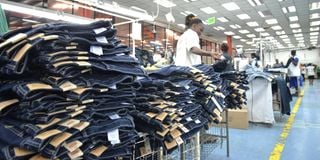
Bangladesh has, for instance, cut its tariff rate from 37 percent to 20 percent, while Vietnam, another textile heavyweight, has seen its effective tariff rate fall to a similar rate from 46 percent previously.
Cambodia has, meanwhile, seen its tariff rate fall to 19 percent from an initially proposed 46 percent, and the southern African country of Lesotho will pay a tariff of 15 percent down from 50 percent — the highest charge slapped on any country on April 2, the day President Trump first announced global tariffs, dubbing it 'Liberation Day'.
Other countries to earn a reprieve from the US after trade talks include India and Pakistan, whose effective tariff rates have fallen to 25 percent and 19 percent respectively, down from 26 percent and 29 percent.
Economists state that this margin of competitiveness could be exploited to maintain Kenya’s access to the US market, where 85 percent of exports comprise textiles.
'Breathing space'
Kenya’s 10 percent tariff came into effect on Friday, following President Trump’s 90-day suspension of initial tariffs.
These blanket tariffs on all exports to the US mean that Kenya will face additional taxes on its textile and apparel exports for the first time since the enactment of the African Growth Opportunity Act (Agoa) in 2000.
Previously, only 15 percent of exports to the US, including blended tea, coffee and horticultural products, were subject to tariffs, but these were mostly lower than 10 percent.
Local manufacturers, while highlighting the advantage of being on a lower tariff rate than Asian competitors, say the industry might require further incentives to maintain its competitiveness and retain access to the US market.
The majority of Kenya’s exports to the US are produced in export processing zones (EPZs), which already enjoy various tax incentives and concessions.
“The margin difference gives us a bit of some breathing space or competitive edge. We would have wanted zero tariffs, but 10 percent is much better than 20 or 30 percent,” said the Kenya Association of Manufacturers (KAM) chief executive officer Tobias Alando.
“We need to find a way of taking advantage of the margin we have, even if it means asking for another incentive from the government to even cover the 10 percent tariff. To me, however, the 10 percent tariff is still better than losing access to the US market.”
Negotiation window
Kenya was among 180 countries labelled for tariffs on April 2 after Washington said it was ending decades of America being taken advantage of in international trade.
A report by the US Trade Representative (USTR) Jamieson Greer listed unfair trade practices by other countries, which influenced President Trump’s decision to apply the 10 percent tariff to Kenya.
The US noted that Kenya places high special tax rates on some textiles, milk products, corn/maize flour and sugar imported from the US, putting American producers at a disadvantage.
“When deemed necessary, the Kenyan government has temporarily waived agricultural tariffs to stabilise prices when domestic agricultural prices exceed certain levels. When the Kenyan government has taken such action, it has applied for and regularly received from the EAC (East African Community) an exemption from the common external tariff (CET),” the USTR report said.
Kenya still has a window to negotiate its 10 percent tariff as President Trump continues to sign new trade deals into August.
None of the countries that have engaged the US so far have negotiated to eliminate the tariff charge or lower it below 10 percent with the rate being seen as the tentative benchmark tariff rate.
The development means that Kenya is unlikely to negotiate for a tariff rate below the current 10 percent.
Ministry of Investments, Trade and Industry (MITI) Cabinet Secretary Lee Kinyanjui said Kenya was keen on pursuing a deal with the Trump administration to push for ‘normalcy’ in tariffs on exports to the US.
“Our wish is that there will be normalcy, but the call will come from the Americans. However, 10 percent is the lowest anyone has gotten, and so there is no cause for alarm whatsoever,” he said.
Last year, Kenya exported goods worth Sh88.8 billion to the US, a rise from Sh64.2 billion in 2023.
US exports to Kenya were, meanwhile, higher at Sh155.6 billion from Sh112.7 billion a year prior, showing that the balance of trade is in favour of the Americans.