Time flies with great content! Renew in to keep enjoying all our premium content.
Prime
State woos investors with 21-year renewable leases for Bura sugarcane farming
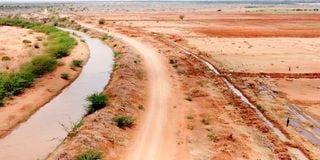
An aerial view of the trenches dug by the National Irrigation Authority to prevent livestock from accessing farms under production at the Bura Irrigation Scheme in Tana River County.
The State has dangled 21-year renewable leases as it races to woo investors to take up 25,000 acres of land within the Bura Irrigation Scheme for commercial sugarcane production, as part of a wider strategy to generate revenue from idle public assets.
The Bura scheme has a total of 296,000 acres, of which 12,000 acres have been developed, and 6,000 acres are actively under production for rice and maize.
The National Irrigation Authority (NIA) said it has opened up 25,000 acres for sugarcane production in Bura under lease terms.
“This lease will be for a period of 21 years, renewable once, subject to performance,” said the NIA.
Sugarcane is currently mainly produced in western Kenya, although the activity has come under increasing pressure due to land subdivision and redistribution, prompting reconsideration of alternative locations to improve production.
“In terms of land potential, sugar production could expand to the Tana Delta areas, but it requires irrigation. The Tana Delta has fertile loam soils that hold water much better than the sands found in Ramisi,” said NIA.
“Due to the hot climate, cane varieties that mature at 10-12 months are possible, and unpublished reports indicate that yields can be as high as 200 tonnes per hectare. However, water scarcity is a major challenge, and is one of the reasons the potential has not been exploited.”
The NIA, in June this year, disclosed that it has opened up 110,000 acres of land within the Bura Irrigation Scheme for commercial leases with an eye on the production of rice, maize, cotton, sugarcane, fruits, and pasture farming.
A blueprint released by the State agency in June showed that the government plans to place 45,000 acres of idle land in the Bura scheme under rice farming, and 50,000 acres under sugar cane farming, while maize farming and pasture and fodder crops will occupy 10,000 acres.
A part of the partnership, the government will provide lessees with bulk irrigation water off-take from the main canal at the head of the farm, but they will be responsible for irrigation distribution on the farm, land preparation, and development of suitable infrastructure.
“The National Irrigation Authority has recently commissioned a gravity conveyance canal and expanded potential for immediate irrigation of up to 145,000 acres. The scheme will be expanded progressively to the entire irrigation scheme by use of run-of-the-river and ultimately supported by an upstream water storage dam,” the State agency said.
The planned Bura leases are part of a land commercialisation initiative (LCI) by the State that targets to lease up to 500,000 acres of idle land countrywide and attract at least Sh65 billion in agricultural investments.
The initiative also targets to reduce the staple food deficit by at least 50 percent, create 1.1 million jobs, increase farmers’ incomes, and promote value addition. For example, the Agriculture and Livestock Ministry recently opened up 21,000 acres of idle land belonging to the National Youth Service (NYS) and Tana and Athi Rivers Development Authority for commercial leases in a bid to boost food security.
The State said it would lease out 20,000 acres of land in the Samburu Kirimun field unit held by NYS, which is dedicated to livestock production, wildlife conservancy, and tree plantations.
Other tracts of public land identified for the LCI project include Egerton University, where 200 acres have been set apart for an Agro-science Park, 10,000 acres at the Galana Kulalu Irrigation Scheme, and 25,000 acres of the Bura Irrigation Scheme.
Additionally, the Tana Delta Irrigation Project has 10,000 acres for rice production, while Kiambere in Embu has 1,000 acres for fruit and vegetable production.
Cash-strained Moi University has also opened up 1,500 acres of land at its main Kesses campus in Eldoret for farming leases. The institution said investors would take up the land for 60 months, preferably for maize farming.