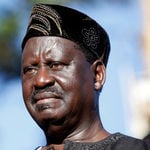
On a chilly morning of October 15, 2007, opposition leader Raila Odinga hastily organised a visit to the Nairobi bourse.
The firebrand politician was not seeking to buy shares, but rather to calm the market after his earlier comments about the bourse being used for money laundering had spooked investors.
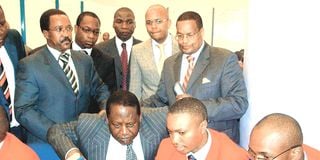
At the time, market players reckoned that the Nairobi bourse was losing Sh5 billion daily and told Raila that he stood accused” of contributing to the meltdown.
Coincidentally, Raila died in India exactly 18 years, after he graced the NSE trading floor to calm investors.
In Kenya, politics and the economy are never wholly separate. But few public figures embodied that fusion better than Raila, whose calls sometimes were viewed as the unofficial economic barometer.
For decades, when he spoke, markets and boardrooms listened—and sometimes paused. And even in death, Kenya's most influential political figure dictated the nation’s heartbeat as unexpectedly large crowds awaiting his body from India, brought business to a standstill and a two-hour shutdown of the airport.
His pronouncements and actions amid five unsuccessful presidential bids influenced the direction of the shilling against the dollar, the stock market and Eurobond yields as foreign investors factored in his activities ahead of deploying capital
His call in 2017 for supporters to boycott three major companies, including Safaricom, arguing they had benefited from ties to the government of former President Uhuru Kenyatta, who had just won the election, sent shockwaves through the business community.
In a matter of months, Safaricom began losing share after boycott calls, with Raila accusing the telecom of playing a role in August 2017 presidential vote, whose outcome he successfully challenged in court. Safaricom rejected the allegations, describing them as “callous and unnecessary.”
The losses were sustained by aggressive competition from Airtel, the second biggest operator in the country. Airtel Kenya’s subscriber market share jumped to 23.4 percent at the end of December 2018, from 14.9 percent in September 2017.
Before this, there was the stock market. One such case was in the build-up to the 2007 General Election, when his comments that the NSE was being used to clean proceeds from money laundering, saw the market start shedding at least Sh5 billion daily.
The then NSE vice-chairman James Wangunyu said Raila’s comments had triggered a daily Sh5 billion fall in share values, warning that investors risked closing the year as “church mouse.” It took Raila’s visit to the NSE to calm the market.
“Raila’s visit has really regained investors’ confidence,” said Mr Wangunyu, adding that the market had gained Sh12 billion a day after his visit on October 15, 2007.
The Nairobi bourse is just one of the many occasions when the economy danced to Raila’s beat. To many, he was the unofficial barometer of confidence and risk.
The Central Bank of Kenya (CBK) said in a statement following Raila’s death that his contribution to the country’s history, economy and society was “immense” and that he “shaped the affairs” of the country.
His influence was felt beyond Kenya, with international investors paying attention to his words.
In 2016, when Raila questioned the handling of proceeds from Kenya’s first Eurobond and warned that such future issuances could be termed odious, saw yields rise as investors adopted a wait-and-see stance.
Similarly, during election seasons, his calls for demonstrations or economic boycotts could tilt the balance of confidence. His threats of product boycotts against firms perceived as government-aligned—especially after the contentious 2017 election temporarily dented consumer confidence and sales.
For instance, his boycott calls on Safaricom saw the firm's valuation dip by Sh20 billion in a week, even as the Communication Authority (CA) of Kenya warned of job losses. The CA report that followed showed Airtel had gained 1.2 million new subscribers, while Safaricom’s market share dropped from 71.9 to 69.1 percent.
His legacy also includes structural influence. Under the Grand Coalition, Raila institutionalised a Prime Minister’s Roundtable with the private sector in 2010, offering a channel for public–private dialogue. The Kenya Private Sector Alliance (Kepsa) hailed this in its tribute following his death.
“This forum established a critical, high-level mechanism for collaboration between government and industry, directly addressing bottlenecks and shaping policy for a better investment climate,” said Kepsa.
On Wednesday morning, when news broke that Raila had died, the country itself seemed to stop, even as President William Ruto declared seven days of mourning to a “statesman without equal.”
Shutters of many shops within major towns stayed down. In Nairobi's central business district, many who had closed for the day hurriedly shut as swarms of people filled the streets in mourning. Among the corridors of power, civil services went under constrained operations.
Many corporations postponed their events, while some schools closed for the Third Term earlier than initially planned. Among the events postponed are CA’s National Cybersecurity Conference, Africa Trade Policy and Media Summit and Teachers Service Commission teacher promotion interviews.
Even in death, the man whose voice had for decades dictated the nation’s heartbeat, once again set the rhythm of its economy.
The arrival of Raila’s body into the country forced Kenya to close Jomo Kenyatta International Airport for two hours as mourners thronged the airport, disrupting landing and take-off schedules.
The State’s programme to lay his body in Parliament for public viewing was scuttled due to the logistical nightmare of handling thousands of his supporters. And even the rerouting of the event to Kasarani Stadium posed the same challenge as thousands filled the venue even before the arrival of the body.
The government plans to hold a State funeral for Raila today (Friday), which has been declared a public holiday to honour the man who served as Kenya’s second Prime Minister. His body will then be airlifted to Kisumu for public viewing then to his home in Bondo, Siaya County for burial on Sunday.