Time flies with great content! Renew in to keep enjoying all our premium content.
Prime
Treasury runs on overdraft as cash shortage persists
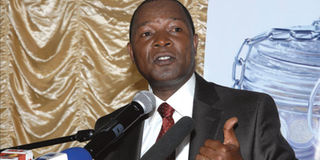
Central Bank Governor Njuguna Ndung’u. He has warned the Treasury against exceeding the borrowing limit. The government is under pressure to raise money to fill the gap in revenue collection. File
Treasury continued to run an overdraft at the Central Bank of Kenya (CBK) for the fifth consecutive month in November, indicating difficult times for the government due to slow revenue collection.
As at the end of the month, the State had over-drawn Sh25.4 billion from its account with the CBK, which is the highest amount it is allowed to draw as per the 2012-13 financial year limit set by law.
Treasury data shows the government was running a funding deficit of as much as Sh49.4 billion as at the end of first quarter of the financial year ended September 30.
The cash crunch is made worse by strict budget rules that restrict the Treasury from shifting money between different ministries.
“Some ministries have money and others don’t, necessitating borrowing. The government has money but this cannot move from a ministry that is not spending to the one in immediate need to spend,” said Alexander Muiruri, a fixed income trader at African Alliance Investment Bank. The pressure on the Treasury’s finances was reflected at the end of the first quarter’s financial report which showed tax collection alone was behind target by Sh31.7 billion, ministerial collections (appropriations-in-aid) were below target by Sh13.5 billion while grants from international donors failed to meet the mark by Sh4.2 billion.
The overdraft is supposed to be repaid by the end of each financial year, but occasions have arisen when the government has failed to settle, leading to an overdrawn account.
Domestic borrowing through Treasury bills and bonds has been slow as the government has sometimes rejected bids at the auctions as a way to ensure interest rates do not rise at a time when the Central Bank is keen on keeping them low to power the soft economic growth.
The actual total domestic borrowing target for this financial year is set at Sh277.2 billion, which includes redemptions — money raised but used to pay back maturing debt. However, the total net borrowing — excluding redemptions — for this financial year is Sh106.7 billion.
Analysts say the State is trying to seek relatively big amounts in weekly auctions to raise more cash than initially planned to fill the gap left by low revenue collection.
“The government has been trying to raise more cash from the domestic market ahead of schedule because it has been running short,” said Mr Muiruri.
The Treasury is currently implementing the single account system of managing public finances, which ensures that funds are centrally located at the CBK, rather than each ministry keeping its own funds, some of it idle.
The centrally-stored funds can then be allocated to each ministry as need arises.
However, the single account system is not yet in place because majority of ministries have not installed the Integrated Financial Management Information System (IFMIS) software required to run the single account.
By law, the State is allowed to over-draw from its CBL account up to five per cent of total revenues collected as shown in its latest audited accounts, but has in some cases overshot the limit.
In the year ending June 2012, CBK data shows the State overshot the overdraft limit by Sh7.6 billion, while in the previous financial year it had overshot the same limit by Sh800 million.
In its annual Financial Sector Stability released in October, the CBK warned the Treasury of exceeding borrowing as had happened in the previous year. CBK governor Njuguna Ndung’u said the perpetual borrowing was tantamount to printing cash, which fuels inflation.
“Accelerated (government) borrowing from the Central Bank is inflationary as it is equated to printing of money and, therefore, leads to macroeconomic instability through inflationary pressures,” Prof Ndung’u wrote in the report.