Kenya as modern-day US-China imperial

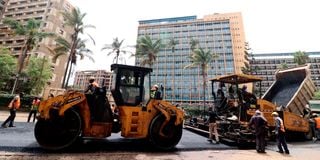
Workers recarpet a section of Ngong Road on May 3, 2022. 

Photo credit: File | Nation Media Group

Modern-day imperialism? An escalation in superpower rivalry? These were the questions in my mind when I first heard the news that the US Congress is reviewing Kenya’s ties with China.

Chinese construction companies now control a disproportionately large share of Kenya’s infrastructure market. We no longer have a substantial domestic construction sector to speak of.
A random count of the largest infrastructure projects executed in Kenya over the past decade confirms that Chinese firms have been ruling the roost.

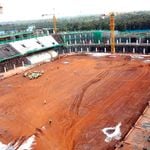
The Standard Gauge Railway (SGR), the Nairobi bypasses, Thika Superhighway, Nairobi Expressway, Lamu Port, and Thwake Dam—these are just a few of the marquee projects bearing the Chinese imprint. Currently, China Roads and Bridges Corporation (CRBC) is building the 60,000-seater Talanta Stadium in Nairobi.

Another Chinese company, Shandong and CRBC, have emerged as frontrunners in the battle to clinch the Sh60 billion Nairobi–Mau Summit road, to be implemented under a public private partnership (PPP) model. Another large project lined up for China is the extension of the SGR to Malaba.

In the energy sector, Chinese influence is also visible. The China National Electric Engineering Corporation (CNEEC) is negotiating a power purchase agreement with Kenya Power to put up a game-changing 40 megawatt (MW) waste-to-energy plant in Nairobi, also under a PPP framework.

The Chinese are equally prominent in geothermal. In February, the Chinese Kashian Group was granted approval under a specially permitted procurement arrangement to build a plant at Olkaria that will purchase steam from KenGen to generate power, green ammonia, and fertiliser.

The company has tabled a corporate strategy targeting a capacity of 1,500MW and 500MWh of storage.

Clearly, the elephant in the room in Washington’s review of Kenya’s ties with Beijing is the growing influence of China in Africa—and the stranglehold Chinese EPC contractors have over major infrastructure projects in East Africa. This surge has coincided with dwindling clout and visibility of American companies in Kenya.

Take Bechtel, the US construction giant, for instance. In July 2015, it signed a government-to-government deal with Nairobi, followed in August 2021 by a commercial agreement with KeNHA. Environmental assessments and public consultations were completed. Yet the deal stalled because Treasury rejected the financing proposal on the table.

The Americans stuck to the traditional model: guarantees from US and European export-import banks and borrowing from international capital markets—financing that would ultimately sit on Kenya’s books.

Bechtel’s proposal, estimated at $3.5 billion, leaned heavily on credit agencies such as US Exim, OPIC, and the UK’s UKEF. The government balked.

Nairobi insisted on the Nairobi Expressway model, where CRBC funded construction from its own balance sheet, sparing the State contingent liabilities.

Unlike the Chinese, the Americans remain cautious with their capital. Even OPIC (now DFC) and IDFC only step in with guarantees when significant American goods and services are embedded in the contract.

Another US-backed bid, by Everstrong LLC, to finance the Nairobi–Mombasa Expressway, also collapsed. The government terminated the project in July after one of the consortium partners, a Portuguese contractor, withdrew.

The retreat has not been confined to infrastructure. In energy, one of the largest American investors, Ormat International, sold its stake to the Chinese Kashian Group. In agriculture, US agribusiness giant Del Monte was pressured by former Kiambu governor Ferdinand Waititu to cede 690 acres of land. After the deal, Murang’a County began agitating for a share of Del Monte’s land as well.

When the US Congress sits to review Kenya’s relationship with China, these are the hard realities it must confront.

The fact is that Chinese companies have entrenched themselves as indispensable players in Kenya’s development story.

American firms, by contrast, continue to operate within financial frameworks that make them unattractive partners for a debt-burdened government wary of new liabilities.

What is unfolding here is more than just a debate on foreign policy. It is a new theatre of modern-day imperialism, where global influence is measured not in rhetoric, but in roads, ports, power plants, and stadiums.

If you asked to name one place where partnership with China’s partnership with Kenya has made the greatest impact I would name the geothermal sector. We forget that until that Chinese company known as Great Wall Drilling Company arrived in Kenya in 2005, no serious geothermal activity was happening in Kenya.

Yes, KenGen, with funding from the World Bank UNDP and JICA, was drilling geothermal wells but activity was limited in scale, slow and expensive. It was the Chinese that took us to the next level. Today, the geothermal sector is the single largest electricity source in Kenya’s energy mix. We owe a gratitude to the ‘dragon’ for this.

The writer is a former Managing Editor for The EastAfrican

PAYE Tax Calculator

Note: The results are not exact but very close to the actual.