Leveraging AfCFTA to soften shock of Agoa termination in Africa

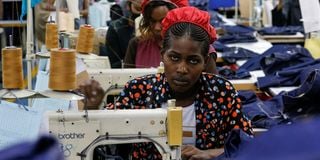
Kenyan workers prepare garments for export at a factory in Ruaraka, Nairobi, operating under the US African Growth and Opportunity Act (Agoa).

Photo credit: Reuters

The expiry of the African Growth and Opportunity Act (Agoa) on September 30, 2025, closed a chapter in US–Africa trade relations that began in 2000. For 25 years, Agoa functioned as a preferential market access gateway to the US for qualifying sub-Saharan African countries.

Its termination, abrupt in its immediate effects and uncertain in its future trajectory, has triggered alarm across governments, exporters and workers whose businesses were built around duty-free access to the vast US market.
At the same time, the African Continental Free Trade Area (AfCFTA), the continent’s flagship integration project, is still trying to find its operational stride. The intersecting forces of Agoa’s end and AfCFTA’s slow start create both short-term shocks and long-term opportunities.

News reports and government statements in the last days of September 2025 warned of potential job losses in the tens to hundreds of thousands, particularly in concentrated apparel hubs. Employers facing sudden demand contraction may cut shifts, lay off workers, or close facilities altogether.

The termination raises the business risk premium for investors considering African light manufacturing. Importers that rely on secure, long-run preferences may shift production to countries with more predictable access, accentuating capital flight or investment freezes.

The aggregate macro effect could be lower export earnings, higher unemployment in affected towns, and a weakening of nascent domestic industrial linkages that had begun to form around export hubs.

If Agoa’s end is a shock, the AfCFTA that has been formally operational since 2021 and ratified by over 50 African states is the continent’s most credible platform for a collective response. Five years into implementation, AfCFTA’s results are mixed. Why has it had a slow start?

Africa’s transport and logistics networks are fragmented and expensive. Poor roads, congested ports, slow border procedures, and weak customs cooperation hamper intra-African shipping and raise transaction costs, undermining trade even where tariffs have been reduced.

Overlapping regional blocs, divergent standards, and differing national regulations create unpredictable trade friction. Companies attempting cross-border trade encounter dozens of different procedures and certifications.

Negotiated phasing, special treatment for sensitive sectors, and long transition periods for some member countries mean that full tariff liberalisation is slow because many products remain on exclusion lists or protected schedules.

Many countries lack sufficient upstream producers, finance, and standards compliance to support cross-border value chains. Without firms that can source inputs regionally, tariff liberalisation alone will not spark rapid intra-African trade.

Implementing AfCFTA requires harmonised customs systems, dispute settlement, rules of origin frameworks, and enforcement. This is a heavy coordination task for 55 states with different capacities and priorities. Progress is uneven and often dependent on donor-funded technical assistance.

These obstacles explain how AfCFTA, despite wide ratification, still sees intra-African trade levels well below the intra-EU or intra-ASEAN comparatives thereby leaving a gap that Agoa has helped to fill for some exporters.

However, it can be leveraged purposefully to soften the Agoa shock and create more resilient, African-centered value chains. Going forward there are a few practical proposals.

Encourage apparel and agro-processors to re-source inputs regionally so that margins are captured inside Africa. The AfCFTA Guided Trade Initiative has already piloted tariff concessions for selected products and scaling this could create viable intra-African supply webs that substitute some lost US demand.

Complex or lengthened rules of origin hamper firms that previously relied on Agoa’s simpler regimes. AfCFTA institutions should prioritise simplified, predictable rules for sectors displaced by Agoa’s end and coordinate mutual recognition of standards.

African institutions, notably regional development banks and national export-promotion agencies, should provide bridge financing, export credits and working capital to affected factories to avoid mass layoffs while firms retool for regional markets. Public procurement can also be used to guarantee demand during transition.

Investment in ports, rail corridors, and single-window customs systems reduces trade costs. Donor programmes and public-private partnerships must be redirected to fast-close critical bottlenecks that make intra-continental trade commercially viable.

Exporters need help upgrading to meet regionally harmonised standards. Technical assistance for factory modernisation, quality labs and workforce skilling will raise the competitiveness of African manufacturers across African markets and beyond.

African negotiators should pursue reciprocal, rules-based agreements with major partners not to replicate Agoa but to secure access that is more predictable over the medium term. While AfCFTA builds continental market capacity, parallel diplomatic efforts can stabilise external demand as industries transition.

Political economy: windows of urgency and opportunity

AGOA’s expiry is a political inflection point. For governments, private sector actors and multilateral partners, the question is how quickly Africa can convert short-term emergency responses into durable industrial strategy.

AfCFTA offers the institutional architecture but only if its operational deficits are treated with urgency and financed at scale. The alternative is prolonged deindustrialisation in places that had just begun to industrialise.

Agoa’s termination is a shock, not the end of Africa’s trade story. The continent must not treat the loss of US preferences as solely a diplomatic challenge; it is a policy design, industrial strategy and infrastructure challenge.

AfCFTA will not fully substitute the US market overnight, but it is the most powerful endogenous mechanism Africa has to create larger, denser regional markets that can absorb productive capacity, build value chains, and reduce vulnerability to unilateral preference shifts.

Success demands accelerated AfCFTA implementation from simplified rules and targeted finance to hard logistics investment and urgent international cooperation to ensure a soft transition for workers and exporters.

If African governments and partners respond with coherent, well-funded strategies, the end of Agoa could become the painful catalyst for a more self-reliant, regionally integrated industrialisation.

The writer is the CEO of Miradi Capital.

PAYE Tax Calculator

Note: The results are not exact but very close to the actual.