Shilling versus dollar: IMF story quoted me out of context

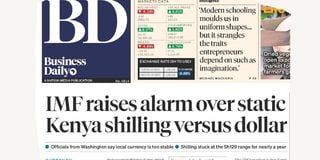
A section of the Business Daily front page on October 30, 2025.

Photo credit: Nation Media Group

Today’s edition of the Business Daily carried a lead story on what the author reported was the IMF’s view of the exchange rate of the Kenyan shilling to the US dollar. The story quoted my comments in a panel discussion at a forum last Friday out of context and was misleading.

The fact is that the exchange rate is a price. In fact, it is multiple prices, reflecting the demand for various currencies. That demand arises because we are buying goods and services in the currencies in question.
In addition, we get inflows such as remittances, an eventuality that increases the supply of various currencies. Those who buy our goods and services, in turn, require Kenya shillings to pay us. It is these market conditions— forces, if you like—that determine the shilling versus dollar exchange!

The panel discussion on the total tax contribution of the financial sector raised the question that Kenya’s tax to gross domestic product (GDP) ratio is lower than the 25 percent the IMF recommends.

I responded that the ratio is a rule of thumb that should not be regarded as gospel truth, or implemented dogmatically, and that when looking at comparator countries, we should correlate like for like. Understood within that trajectory, the author of the offending content quoted me out of context. 

During the said forum, I explained that buoyed by the economic model that informs the Vision 2030, Kenya has over the years invested heavily in infrastructure. That has grown the GDP, thus raising the denominator in the tax to GDP ratio calculation.

However, infrastructure does not yield taxes directly, so the numerator does not increase immediately. Rather, it enables production, which by extension creates incomes and therefore taxes.  

Therefore, I said, we should not get hot under the collar just now, worried that the tax to GDP ratio is low. Once private sector activity picks up pace and “sweats” the infrastructure to create incomes, the ratio will recover. In any case, I continued, many economists including myself, do not always agree with the Fund’s policy prescriptions. 

To take those comments out of the context in which they were made and seek to give them life as a reflection of what the Fund believes or doesn’t on the exchange rate or any other matter, is stretching the bounds of journalism beyond the safe shores. 

Fact and accuracy are the hallmarks of good content!

@NdirituMuriithi is an economist.

PAYE Tax Calculator

Note: The results are not exact but very close to the actual.