Each February, hotel rates in Nairobi firm up. International broadcast crews book production space. Charter flights arrive with players and technical teams. Caddies, hospitality staff, and temporary event workers secure short-term contracts. For four days, foreign spending flows into the city in concentrated form. Then it subsides.
Kenya has grown comfortable describing the Magical Kenya Open as a successful tournament. That framing understates what the tournament has become. Since joining the DP World Tour in 2019, the event has evolved into an export infrastructure. The debate still treats it as a sport. The economics suggest otherwise.
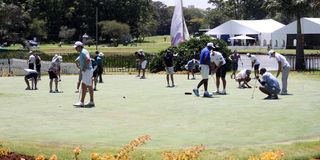
The 2026 edition, scheduled for February 19-22 at the Karen Country Club, carries a prize purse of $ 2.7 million. The increase matters less for prestige than for signalling calendar stability to global rights holders and sponsors. In a circuit where host destinations are constantly reviewed, predictability is currency.
The 2025 tournament reached more than 544 million households and generated a net sponsorship value of $65.3 million across 2,723 hours of coverage. The government realised roughly $8 million in brand exposure through the Magical Kenya tourism label, and the Ministry of Youth Affairs, Creative Economy, and Sports.
An estimated $7 million flowed directly into the local economy through hospitality, transport, and event services.
Those figures are cited as proof of success. The more relevant question is whether they are treated as recurring export earnings or as annual windfalls.
Golf tourism differs from mass tourism. Travellers in this segment spend more, stay longer, and move in groups.
For a country under pressure to grow foreign exchange inflows without overloading infrastructure, that profile matters. A single high-yield visitor offsets multiple low spend arrivals. The tournament compresses that dynamic into a predictable window.
The second-order effects are less visible but more important. International broadcasts do not simply show fairways. They display roads, hospitality standards, and event management capability. In capital markets, perception shapes risk pricing.
A country that consistently delivers a global broadcast product lowers reputational friction. That extends beyond tourism.
At the firm level, the mechanics are direct. A Nairobi hotel group locking in tournament week occupancy at premium rates improves margins. An airline aligning capacity with the event captures incremental traffic. A logistics provider handling broadcast equipment builds credentials that travel beyond the tournament.
The risk lies in complacency. Retention on the DP World Tour calendar is not automatic. Competing destinations in North Africa and the Middle East are investing aggressively in golf as part of wider capital attraction strategies. If funding signals weaken or organisational standards slip, the slot moves. The exposure moves with it.
There is also a development question. The 2026 field will feature 144 players from more than 25 countries. Qualification pathways through the Professional Golfers of Kenya, the Safari Tour, the Sunshine Development Tour East African Swing, and the CIO Classic in Nigeria are creating progression routes for local and regional professionals. Hosting without strengthening the talent pipeline limits long-term return.
Infrastructure alignment matters. Kenya has invested in tourism branding and sports facilities. The test is utilisation. Corporate hospitality, investor meetings, and sector roundtables can be structured around tournament week, converting sporting traffic into commercial engagement. Without that integration, part of the potential remains idle.
The implication is measured. Policymakers should treat the Magical Kenya Open as part of the export portfolio, with multi-year funding visibility tied to tourism yield and foreign exchange impact.
Financiers and sponsors should view it as a platform for client acquisition and regional positioning. Business leaders in hospitality, aviation, and logistics should plan capacity around it with the discipline applied to peak seasons.
Kenya has shown it can host a world-class tournament. The strategic question is whether it will fund and integrate it like the export asset it has become. In a competitive global calendar, events treated as sentiment fade. Those treated as economic infrastructure endure.
Patrick Obath is the Chairman, Kenya Open Golf Limited (KOGL)