Time flies with great content! Renew in to keep enjoying all our premium content.
Prime
Falling trade raises protectionism fears
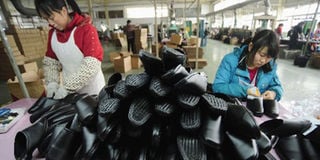
Workers at a shoe factory in China. In a downturn, WTO members could resort to anti-dumping or safeguard tariffs to protect domestic producers. Reuters
Commentators are focused on the risk countries will respond to the worldwide slump in demand by resorting to protectionist measures (either competitive devaluations, tariff rises or other trade barriers) in a mutually self-defeating attempt to reserve what remains of shrinking demand for domestic industries—leading to trade wars, a reversal in the trend towards global integration and a fall in living standards.
Parallels with the 1930s abound. But the tariff wars of the 1930s belong to a vanished world of fixed exchange rates, militarism and failed multilateralism. The tariff history of the 1930s is not a good parallel for today’s world.
The real risk is a more insidious undeclared trade conflict based on rises in applied rates, non-tariff barriers, bad faith, and an upsurge in trade defences as countries try to “allocate” scarce demand and placate industries and workers under particular pressure.
Each World Trade Organisation (WTO) member has a schedule of commitments in which it has agreed to “bind” the duty levied on particular items at no more than a specified rate.
The tariff binding is a maximum; applied rates are often below it, in some cases by a substantial margin.
The differential between applied rates and bound rates is a measure of how far countries could raise their tariffs in practice without violating their WTO commitments. Advanced economies generally have very low bindings on most tariff items (no more than 0-5 per cent) so the risk is not high.
But emerging economies often have relatively high bound rates and actually apply rates at considerably lower levels so they have scope to raise tariffs within the WTO framework.
The risk is greater for long-standing members of the GATT (such as India) or relatively unimportant countries in the trading system, since they did not start to come under pressure to bring them down as part of multilateral negotiations until the 1970s and 1980s and still have relatively high bindings.
There is less risk for new members, such as China, because other WTO members drove hard bargains during the accession negotiations during the 1990s, and bindings usually cover a much wider range of items at lower levels.The WTO agreements go to great lengths to restrict the use of health, safety and other technical standards to ensure they are not used as covert trade barriers.
But this is a complex and very grey area. Lobbies for domestic producers are skilled at proposing government regulations which appear to be neutral in theory between the domestic industry and importers but which discriminate in practice.The WTO system relies to a considerable extent on the good-faith of its member countries. Treaties are concluded between sovereign entities so they differ from ordinary private contracts particularly in their enforcement mechanisms.
In general, states are assumed to be honour bound to observe their obligations and do nothing to undermine the spirit or operation of the treaty. Most treaties do contain some arbitral mechanism for settling disputes, but it is often quite a weak one.
The WTO provides a fixed and fairly tough timetable for settling disputes (and hearing appeals) designed to prevent parties spinning out the proceedings. Even so, it can take two-three years to obtain a definitive ruling.
Once the ruling is definitive, the defaulting state is given a grace period to come into compliance.
Only if it fails, are “sanctions” applied. But such sanctions are prospective (affecting future trade). There is no retroactive compensation for any trade lost during the previous period of non-compliance.
The system is vulnerable to being “gamed”. A dishonest state might introduce trade restrictions (especially non-tariff barriers or trade defences) that it knows or suspects will be found non-compliant, knowing it can gain the benefit of the added protection for two to three years before having to change, and suffer no penalty for the benefit it has dishonestly obtained.
Has this ever happened? Trade lawyers are paid very large sums of money to come up with convincing arguments for all sorts of protective measures designed to make them seem WTO compliant. But there have certainly been a few instances over the last 25 years in which states have pushed the envelop and imposed measures that were highly dubious and seemed prepared to spin out the dispute settlement system to satisfy domestic audiences, knowing there would be no penalty for being found non-compliant at some future date.
So far, most countries in most cases have acted in good faith. But as trade tensions escalate, there is really nothing to prevent more countries in more disputes acting in bad faith, introducing various non-tariff barriers, gaining two-three years worth of protection, and worrying about whether they are WTO compliant in 2012-2013, when the crisis might hopefully be past.
WTO obligations appear to be tightly binding, but in fact the system contains a number of built in “safety valves” designed to allow countries to reintroduce higher tariffs well above the bound rates on a selective basis against imports from selected countries.
These “trade defences” include anti-dumping duties, countervailing duties against foreign subsidies, and safeguard measures designed to protect domestic producers from a sudden and unforeseen surge in imports while they restructure to meet the competition.
Anti-dumping and countervailing duty actions were seen as the rich world’s way to block painful imports from low-cost emerging markets, particularly those with export-led growth strategies. The number of AD and CVD actions has been proliferating rapidly in recent years, and many actions are now launched by developing countries against one another, or even against imports from the advanced countries.
The risk is that in a downturn, with exchange rates shifting substantially and altering relative competitiveness, WTO members could increasingly resort to anti-dumping and countervailing duties or safeguard tariffs to offer a measure of protection to domestic producers under pressure.
As with the non-tariff barriers, there may also be a temptation for countries to impose duties now and worry about proving WTO compliance later.
Mr Kemp is a Reuters columnist.
Unlock a world of exclusive content today!Unlock a world of exclusive content today!