Time flies with great content! Renew in to keep enjoying all our premium content.
Prime
Why we should connect with our roots
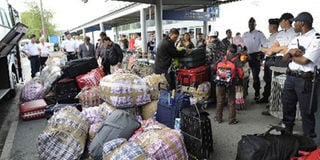
Members of Roma community at the Roissy Charles de Gaulle airport, outside Paris in 2010 prior to taking a flight to the Romanian capital, Bucharest. My most recent trip to Romania was in 2003, to introduce my Kenyan wife to my roots. AFP
Regular readers of mine know that from time to time, together with my colleague Frank Kretzschmar, I run what we call “Leaders Circles”. Each event has its own theme, and for our last one we chose ‘Connecting with my Roots’ – conscious that a river which forgets its source will dry up.
Before our fellow participants gather, Frank and I always pore over quotes we have gathered on the subject are about to explore, selecting those that are most appropriate. Some are obvious candidates, some are more marginal, and we indulge in great debates over the latter.
Our favourites this time included this one by Hodding Carter: “There are two lasting bequests we can give our children — one is roots, the other is wings.”
And we loved Victor Hugo’s “Change your opinions, keep to your principles; changes your leaves, keep intact your roots.” Frank Howard Clark tells us that “Criticism, like rain, should be gentle enough to nourish a man’s growth without destroying his roots”.
While Alex Haley’s fondest hope was that his book Roots “may start black, brown red, yellow people digging back for their own roots. Man, that would make me feel 90 feet tall.” And closer to home, Joe Wanjui dedicated his book, My Native Roots, by stating proudly: “All that I am, my mother Elizabeth Wanjiru made me.”
As always, the gathered leaders shared personal stories on the theme of the day. We were from very diverse backgrounds, and we all spoke of our parents and our grandparents and how they influenced our lives. Many of our ancestors had migrated great distances: from India to Kenya; from Czechoslovakia to Germany; and (mine) from Romania through Israel to England. A wide spread of religions was also on display: Anglican and Catholic, Hindu and Jain, and Jewish, each with its significant influence.
We talked about our childhood, about the languages we heard, the schools we attended…and the mischief that some of us got up to.
From our earliest years we noticed in our environment here a talent for business, there a heart for giving; here a strict teacher and there a permissive parent.
In several (not including me!) leadership potential was spotted at an early age, as a result of which the care of siblings was entrusted to them.
For some, a first visit to the land of their ancestors proved a powerful connector. So it was for me when I went to Romania in the mid-1960s.
My group travelled by train, and after engaging with the deadly serious Hungarian border officers, the first Romanian official we encountered made this unexpected proposal: “Give me some of your biro pens and I’ll give you a bunch of grapes.” Typical of the Latin happy-go-lucky style of most Romanians!
The train stopped at a station, and I leaned out of the window to view the crowded platform.
To my utter amazement a wave of Romanian assaulted my ears – a language I had only previously heard at home – and I was overcome by the most intense emotions.
My most recent trip to Romania was in 2003, to introduce my Kenyan wife to my roots. We were there with my mother, my aunt and my sister, and for my mother it was her first visit to Romania since she and her family fled in 1941.
On our last day in Bucharest our driver led us on a journey of exploration, to find the house where my mother last lived. Despite multiple changes of street names we made it.
Precious tour
Having served as the East German Embassy, it was then being converted into offices and as we went from room to room my mother told us who slept where, and how some of the other spaces were used.
This precious tour provided me a unique opportunity to connect with my history – a very dignified and sophisticated one, I saw. No wonder they used to call Bucharest ‘The Paris of the East’.
In our session I also talked about my father and me. He went to the London School of Economics in the 1920s, fitting a long Romanian salami diagonally into his suitcase. I attended LSE in the 1960s, partly as a result of his encouragement to study economics.
He was a great painter, but maybe because I knew I could never match him I took to photography and later to writing – to painting with words. Like the parents of others at our Leaders Circlemy father was frugal, hard-working and honest, and I’d like to think that these values have lived on with me.
When he was my age my father was doing exactly the kind of consulting I do now. But when we arrived in London from Haifa in 1948 he had to re-launch his career with Shell, the company for whom he had already worked for quite some years.
It was a very “White Anglo-Saxon Protestant” organisation then, and this Romanian Jew with a long nose and a funny accent stuck out like a sore thumb. But he did really well, rising to be head of management training worldwide.
Shortly before he died I sat with him in his study, the last time we were together as it turns out, and he handed over all his books and papers on management. It was an emotional moment, mingled with unusually explicit expressions of mutual love and respect.
As the leaders concluded the story-telling we worried that our children, never mind our grandchildren, are inevitably becoming less and less connected to their roots – not least because they can’t speak their ancestral languages.
But we were overwhelmingly comforted by the fact that just as we had absorbed the values of those who had gone before us, succeeding generations have also held dear to them. Finally, we realised that despite our great diversity we shared deeply common values, and this thanks to our roots.