Time flies with great content! Renew in to keep enjoying all our premium content.
Prime
New pyrethrum authority chief faces uphill task
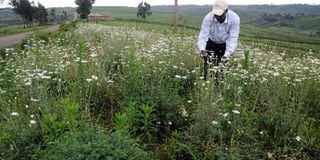
A man tending to his pyrethrum farm. Pyrethrum farming is under a new minister, the old Pyrethrum Board is gone, replaced by the Pyrethrum Regulatory Authority (PRA), and a new chief executive, Alfred Busolo, is now in charge promising a new lease of life to the troubled sector. Photo/FILE
Because of limited supplies, the price of pyrethrum keeps rising. However, the sub-sector is on its knees after years of challenges and possible neglect, making it difficult for the farmer to gain from the juicy offers.
Before the industry lost its shine, Kenya supplied up to 70 per cent of the total world demand.
Today, while the total annual world demand stands at 8,000 metric tonnes, Kenya’s production is only a sprinkling, crushing, in two years, a paltry 500 metric tonnes.
Corruption and poor management top the list of woes affecting the sector that is now hardly noticeable.
The sector’s chances of survival in the entire farming business was also compromised by the fact that other crops were attracting the attention of farmers through prompt payments. They migrated.
Workers did the same when Rwanda that used to supply Nakuru-based factory upgraded its facilities in protest to the age-old problem of delayed payments.
New strategy
However, three things have happened that may help to reinvigorate the industry and give it new energy.
Farming is under a new minister, the old Pyrethrum Board is gone, replaced, last year, by the Pyrethrum Regulatory Authority (PRA), and a new chief executive is now in charge.
Alfred Busolo, the new managing director, is promising a new lease of life to the troubled sector.
“We are coming in with a new strategy that will reclaim the glory of the pyrethrum industry by making it as profitable as it were,” Mr Busolo said.
Enough supply of flowers tops Mr Busolo’s turnaround list.
The Authority owes farmers Sh48 million while workers are also claiming unpaid salaries, running into millions.
While the government recently injected Sh50 million to jump-start the activities, no independent or government studies have been conducted to ascertain the cost of turning the industry around.
Agriculture cabinet secretary Felix Koskei promises the government’s determination in ensuring the plant is fully operational, saying it was a key driver of the economy.
“We will be giving PRA additional Sh250 million this week to ensure that the factory starts working in the next few months,” Mr Koskei said. He said the government will settle farmers’ debts and pay the salary arrears in the next three months.
Said the MD: “The agreement that the PRA has had with farmers over the years is an advance payment of Sh100 per kilogramme while the balance should be cleared once the flowers have been crushed.”
Normal capacity
The second payment is determined by quality of the crop, he said, adding that the Treasury has released Sh10 million for the advance.
“By so doing, we are quite certain of receiving flowers from the farmers and within a few months, we will be crushing at our normal daily capacity.”
Last year, the factory processed 300 metric tonnes of flowers but, the MD said, they are eyeing to crush 500 metric tonnes before the year ends.
Starting next year, this should rise to 4,000 metric tonnes annually, he said.
For five months the factory was silent until last week when it roared again, attracting the attention of pyrethrene buyers, who made orders, says Mr Busolo, adding that farmers partly pad on Tuesday had also supplied 10 metric tonnes.
“The response that we have received so far from farmers is an assurance that we will get enough flowers that will guarantee constant crushing, giving us room for enjoying economies of scale.”
Farmers the Business Daily interviewed last week were cautiously optimistic.
“These changes were long overdue, we just believe that it will not be a mere talk but rather a move that will return the sector to its former self,” said Mr John Chetodom, a pyrethrum farmer in Lelan, West Pokot County.
Mr Chetodom said farmers were waiting for tangible steps to see whether or not they can expand acreage under the crop.
The Authority has dispatched extension officers to advise farmers on better plant husbandry and quality that guarantee better returns.
Apart from the farmers’ woes, the agency is locked in court battles to recover some of its assets that it says were grabbed.
Some of the assets have not been put to productive use, including the 352 housing units that former staff have been occupying without paying rent for the past year.
Following the enactment of the Pyrethrum Act 2013, the board of directors was disbanded in line with the requirements of the PRA. The new MD is banking on the calibre of board members to drive the turnaround and growth agenda.
“A board to be appointed will be a strong one that will play a crucial oversight role to boost the growth of the company,” he said.
The minister says that the board of directors will be appointed as soon as the plant will be fully operational, without giving a specific date.
The board will be a team of 14, including principal secretaries from the Treasury, Land and Agriculture and growers’ representatives.
Mr Busolo says he will be collecting flowers from the field by deploying officers to lock out brokers, whom he accuse of exploiting farmers. By paying farmers in time, he says, the brokers would be kept at bay as the board will offer farmers “a good price” compared to what they earn from middlemen.
Going private
He says brokers are buying the flowers from farmers then selling it to some Chinese business people who sell the flowers outside the country after extracting content.
“We are investigating this claim. Pyrethrum is a scheduled crop and only the PRA is mandated by law to process it,” he said.
Mr Koskei says plans are under way to liberalise the sector once the plant is up and running to enable investors who might have interest in the sector to start the processing business.
“Once we bring it back on its feet, we have no doubt that we shall liberalise it,” said Mr Koskei. However, if the difficulties persist, the minister says the industry will be privatised.
“We will leave the sector in the hands of the private investors if it fails to pick up and the government will only regulate while the commercial wing will be left to farmers and other investors.”