Time flies with great content! Renew in to keep enjoying all our premium content.
Prime
Crocodile attacks take toll on Lake Victoria’s fishing communities
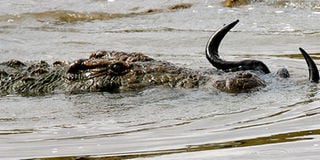
A crocodile attacks a wildebeest as it crosses the Mara river during a migration in Masaai Mara game reserve, 270 km (165 miles) southwest of capital Nairobi, July 28, 2009. Fishermen at Lake Victoria live in constant fear of what lurks in the waters Photo/REUTERS
In Kanyijowi sub-location, Kisumu County, Lillian Odhiambo forlonly sits in front of her mud house nursing her youngest child as she tells us when she last saw her husband alive.
She routinely woke up at 1am to prepare breakfast for her husband George Odhiambo, a fisherman, before helping him prepare for another day of fishing on Lake Victoria. The 24- year-old mother of three then bid her husband farewell. It was at 2 am.
Shortly after, Lillian was woken up by frantic villagers knocking on her door. Her husband’s fishing crew had been attacked by a crocodile and George was missing.
“They said the crocodile was lurking in a patch of mangroves and attacked the fishermen as they were casting their net, seizing George who was at the front of the boat and dragging him away,” she recalls. George is one of the victims of a human-wildlife conflict on the shores of Lake Victoria as strategic fishing grounds diminish and residents turn to dangerous spots.
In the last three weeks alone, Kenya Wildlife Service rangers have been called in on two separate occasions after hippos wandered into the main land.
James Akumu is the secretary- general of Kaloka Beach Management Unit in Kaloka Beach, an area which is considered by KWS as one of the hot spots for hippo and crocodile attacks.
According to Mr Akumu, though attacks like the recent one are sporadic, fishermen live in constant fear of what lurks in the waters . “Every time we go out into the water there are always sightings of hippos or crocodiles but they do not always interfere with our fishing and we give them a wide berth”, he says.
“But when fish in the lake becomes scarce like it is currently, the animals come closer to our fishing grounds and that is when incidents like the recent one occur.”
Mr Akumu says cases of conflict make it increasingly difficult for fishermen on the lake to earn their daily bread.
“We depend entirely on the lake and fishing is what sustains the majority of homes in this area,” he says.
“Fishing is a relatively low entry profession and given the proximity to the lake resource, this is our most viable economic activity. With the current unemployment rate, abandoning the practice is out of the question .”
The situation is made worse by the fact that the number of fishermen in the lake is increasing. More fishermen in the water means increased competition for strategic fishing grounds and in the process of getting ahead of their peers, some fishermen venture into the animals’ breeding grounds leading to further conflict.
The fishermen accuse the government of being complacent and even uncaring in the face of complaints arising from human-animal conflicts.
Sylvester Aloka, who is lucky to have survived a crocodile attack two years ago while fishing, claims that he is yet to receive any compensation from the government.
“I was attacked while fishing and I almost lost my legs but three years later I am yet to see any form of compensation”, he says. “KWS took me to the hospital and dumped me there where I stayed for three whole days without treatment.”
Sylvester says it took the intervention of local politicians to compel the hospital to attend to him.
“The hospital bill was Sh52, 000 and I waited for some compensation from KWS but nothing was forthcoming,” he says. “I was forced to foot the whole bill myself and had to sell my piece of land to do so.”
The father of four who is not fully recovered cannot return to fishing and now relies on handouts from relatives and well-wishers for food and other necessities.
“I used to earn between Sh500 and up to Sh2, 500 on good days and I was saving to build a house but all of it has now gone into treatment.”
While KWS admits that there have been reported cases of human-wildlife conflict on the lake, they say their frequency and severity is often exaggerated by the residents.
“In these parts of Nyanza and the lake region there have been some minor cases of human-wildlife conflict reported but the severe cases are far between”, says Robert Otieno, KWS deputy warden based in Kisumu.
“Hippos sometimes invade the farms of the people living around the lake and as for the fishermen, the major cases of crocodile and hippo attacks occur when humans go into the animals’ breeding grounds.”
Mr Otieno says the cause of human-wildlife conflict in the lake region is as a result of changing farming habits and the tussle over fish.
“In the recent past there has been a burst of horticultural activity by some residents and these new crops are enticing to the hippos hence increased invasion of farmland,” he says.
“In the water, hippos and crocodiles like breeding where there are a lot of fish and since the fishermen are always after the big catch, they normally stray into the animals’ breeding grounds.”
But Mr Otieno says most of the victims often lie about their encounter for fear of voiding their compensation.
“The government gives Sh200, 000 for death and Sh30,000 for injuries as compensation but in a draft policy we are planning to revise this to Sh1 million and Sh50,000 respectively,” he says.
“Our jurisdiction, however, only covers the shore and a limited distance into the water and past this we are not liable for what happens,” he explains. For this reason, some victims claim that they were attacked on the shore but when we investigate we discover that they were out of our jurisdiction when the attack happened.”
In addition to this, KWS claims that some residents carry out their socio-economic activities close to the lake in blatant disregarded to safety regulations.
Animal species
“According to the law, people should not farm within 200 metres of the lake yet if you go round the coastline you will find farms and people tiling the land almost up to the water’s edge.”
One thing that both the community and the government agree on is that they must find a way of reducing the human-wildlife conflict. None of the species is going anywhere any time soon and in fact, the opposite is happening.
The government is trying to build up the number of the animal species on Impala Park, Hippo Point and Ndere National Park to promote tourism around the lake .
On the other hand, the human population on land keeps on increasing and subsequently socio-economic activities both on land and in the lake are ever rising. “Fencing is out of the question because the area we are talking about is vast and most of it is private,” says Mr Otieno. “We cannot also canvass the entire coastline because our resources are limited.”
One option that the government is trying to advice the local communities to adopt is to set up wildlife conservancies and in the process protect themselves and earn some revenue.
“All they have to do is set aside a particular area where the animals breed and work with KWS to have that area declared protected,” says Mr Timothy Ikime, a KWS resident scientist at Ndere National Park.
“KWS will then come and inspect the area and study its feasibility to sustain the different types of wildlife that live in the ecosystem and the community’s ability to manage the wildlife conservancy.”
In addition to this, the community shall receive technical support and expert consultations to help get establish the resource into profitability.
“We can also give them a grant and give them animals to boost their population in the initial stages and all the while the community remains in full control of the conservancy,” says Mr.Ikime.
“They can market it as a tourist site and charge visitors some money. Other support industries can also be set up around the conservancy like tourism agencies, car hire services and eco-lodges” Data from the KWS shows that the tourism sector is starting to reap the benefits of an ambitious campaign by the government to increase the level of domestic tourists.
Spurred by a burgeoning national middle class, Kenyan visitors to national parks has risen by 55 per cent over the past five years and now stands at 64 per cent of the tourist population.
Unlock a world of exclusive content today!Unlock a world of exclusive content today!