Time flies with great content! Renew in to keep enjoying all our premium content.
Prime
Work cut out for Safaricom chief as firm posts Sh7.6 bn profit
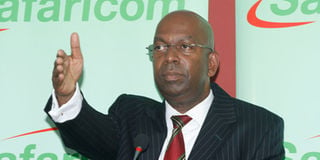
Safaricom Chief Executive Bob Collymore. The company announced a 15.1 per cent growth in net profits to Sh7.6 billion in the first half of the company’s financial year. Fredrick Onyango
New Safaricom chief executive Bob Collymore put on a brave face on Wednesday as he predicted that growth in customer numbers and new income streams from M-Pesa and internet services will cushion Kenya’s most profitable company from the vicious price wars eroding earnings among telecommunications companies.
The company announced a 15.1 per cent growth in net profits to Sh7.6 billion in the first half of the company’s financial year, which ended in September.
It was the first time that Safaricom was announcing financial performance results since calling charges tumbled 50 per cent in August, triggered by a deep price cut by the its main rival, Zain. With end of the company’s first half of the financial year coming just a month after onset of the price war, the results announced Wednesday are largely a reflection of the previous calling charges, but Mr Collymore offered a glimpse of the company’s survival strategy. “As we anticipated, data is proving to be the next frontier, delivering significant benefits,” he said.
Powered by a 55.5 per cent growth in earnings from SMS, M-Pesa and internet services, Safaricom’s total income grew 15.9 per cent to Sh47.1 billion.
Earnings from data as a proportion of total revenue increased to 23.8 per cent (Sh11.2 billion) from 17.7 per cent last year, with the main revenue earner for the company—airtime sales—growing by a weak three per cent to Sh32.5 billion.
The company’s internet sales accounted for 4.7 per cent of total revenues, as voice contribution remained king at 69 per cent.
In a mark of initial impacts of the heightening competition and unfolding price war with competitors Zain, Telkom Kenya and Yu, the company’s market share declined to 76.7 per cent from 78.3 per cent.
Total customer numbers increased by 15.2 per cent to 16.7 million subscribers, but the average revenue per user (ARPU) dropped by Sh49 to Sh321, reflecting the dilutive effect of new subscribers who tend to have less spending power.
“The future growth in the number of customers and the recently reduced voice tariffs is expected to result in a further decline in voice ARPU and total contribution of voice revenues,” said Mr Collymore. “However, the continued growth of in data is anticipated to partially alleviate the declining voice ARPU.”
In an interview earlier this week with NTV, Mr Collymore said Safaricom’s revenues could drop “by between Sh20-30 billion” due to the price cuts.
Mr Eric Musau, a research analyst at African Alliance Investment Bank, said the company’s best chance of weathering the voice revenue erosion lay in coming up with new products, and especially going all out in the data market.
“My estimate is that voice revenue will record a flat growth in the full year, supported only by increase in the number of subscribers,” said Mr Musau.
Kenya’s mobile phone penetration rate is projected to increase to between 60 to 70 per cent in the next three years, from the current levels of over 50 per cent.
“The bulk of growth will be delivered by data and M-Pesa,” said Mr Musau. M-Pesa customers now stand at 13.5 million, accounting for 81 per cent of Safaricom’s total customer base.
To win new internet customers and consolidate its market share in the data market, Safaricom has shipped in more than 8,000 subsidised laptops, 45,000 data modems and 400,000 data enabled handsets in the past six months.
But as the voice contribution to the business remains dominant, investor reaction for the company’s performance has tended to focus on long-term prospects, with its share price at the Nairobi Stock Exchange still below the IPO price of Sh5.
On Wednesday Safaricom closed trading at Sh4.70, a drop from Tuesday’s level of Sh4.75.
In a research note to investors on the eve of announcement of the results, African Alliance put a “buy” recommendation for the stock, predicting that its price will climb to Sh6.07 in the next one year.
Safaricom is both Kenya’s biggest tax-payer and also a prized state asset in which the government has a 35 per cent shareholding interest, and a drop in its performance is likely to deal a double blow to treasury.
The company has estimated the retail price reductions will result in aggregated tax losses to government of Sh5 billion as a result of fall in excise duty collection, VAT and corporation tax.
It is a figure that will unsettle the Kenya Revenue Authority (KRA), which is already grappling with the headache of how to plug Kenya’s biggest budget deficit ever of over Sh160 billion.
Dividends paid to treasury may also come down. On Wednesday Mr Collymore said the company would not announce interim dividend payments.
Mr Collymore said the figures are based on “original revenue projections” Increased mobile penetration is however known to have a spurring effect on overall economic growth, which may offset initial revenue reduction.
“I wouldn’t say there is a massive trade off and Treasury should have a hard look at its figures if these projections materialize,” said Robert Shaw, an independent economic analyst.