Std 8 dropout earns millions fabricating water bowsers

Mr Nicholas Biego at his workshop at Chebole, Bomet County. PHOTO | VITALIS KIMUTAI | NMG

Din of hammers hitting heavy sheets of iron reverberates in the neighbourhood as a man wearing protective eye gear directs blazing fire from a wielding machine at a curved iron sheet as he expertly works on it

The cacophony of sounds from the open air workshop drown shouts of a tall casually-dressed man issuing directives at workers in dust coats tainted with paints, oil and grease, performing various tasks.
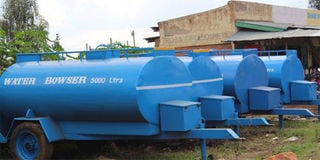

The instructor is Nicholas Biego at his workshop at Chebole trading centre in Sotik, Bomet County, on a hot Saturday afternoon.

The workers at the work station known as C Keiyot Chebole are undertaking manual tasks including meticulously cutting iron sheets, measuring iron bars, curving and welding them together, and finally scrubbing and painting them.

Mr Biego’s story is that of a man who dared to dream and with unshakeable focus scaled the heights of the greasy pole of success, without allowing his education background to stand in his way.

He started off with a scrap metal business, investing Sh5,000 savings. Gradually he built the business into a thriving enterprise before venturing into his current trade of fabricating water bowsers and trailers as well as other metallic products, for clients not only in Bomet but also neighbouring counties of Kericho, Narok, Nakuru, Nyamira, Kisii, Siaya and the Western region.

On average, he sells seven tanks in a month with a 4,000-litre one retailing at Sh230,000 while that of 10,000 litres goes for Sh650,0000. He sells on average five trailers monthly, retailing for about Sh240,000 each.

It takes a week to fabricate a tank or trailer at the workshop.

Mr Biego fabricated the first trailer in 2015 and made a profit of Sh25,000.

He believes that a good idea is the key foundation of success in business.

“When it comes to business, it is neither the amount of money that one has nor the education background that matters the most. A brilliant idea, a clear plan on how to see it through and consistency are the best investments for an enterprising businessman,” says Mr Biego.

Mr Biego, who hails from Simboiyon village in Subukia, Nakuru County, dropped out of school after sitting the Kenya Certificate of Primary Education (KCPE) at Olmanyata primary school in 1998 to pursue business, starting off as a mason, a maize trader and then a scrap metal dealer.

He is the eldest in a family of eight children, but unlike him, his siblings having attained secondary school education.

His business acumen started when he was an apprentice at his father’s workshop. During school holidays and weekends, he used to assist his father, Joseph Borborei in his masonry work back in the village. His father became his teacher, a role model and employer of sorts.

Mr Biego became his own man after gaining enough experience from his father.

“From money earned from my masonry work, I engaged in trading in maize before relocating to Chebole in 2008 where I started masonry and scrap metal business,” says Mr Biego.

Despite the odds, he now runs a rapidly growing enterprise with clients streaming in from all corners.

Mr Beigei says his work “is all about weights and measures.” Luckily for him, he has an aptitude for maths.

“Getting correct measurements and angles in the fabrication enterprise has never been a challenge since maths was my favourite subject,” beams Mr Biego.

The entrepreneur is hands-on and most of the time he makes the water tanks and trailers himself.

He started off with one helping hand, but has since increased the number of employees to the current eight, some having been with him since 2015.

He has been able to retain his workers for long because of “good and prompt pay”.

“Employees like their employers have financial and family obligations to meet. There is no reason why they cannot get their dues on time. Even when we are experiencing a slump in business, I ensure salaries are paid,” says Mr Biego.

In a country where prospective employers are obsessed with hiring university graduates, all the employees here have gone into formal training and have gained and sharpened their skills on the job.

The work of painting the tanks is a preserve for local youths who have perfected the art in what the entrepreneur says is a means of creating job opportunities. All the materials used at the workshop on the Bomet-Kaplong highway is also sourced from local hardware shops.

Mr Biego gets most of his customers through referrals.

“I am in a few WhatsApp groups where members place orders and link me up with prospective clients. But mostly we rely on referrals from clients who have done business with us,” says Mr Biego.

But running the business is not a bed of roses through and through.

For starters, he pays on average Sh50,000 monthly for electricity supply to the workshop. Like in other economic sectors and especially the manufacturing, the high cost of electricity is passed on to the consumer.

“The government should provide subsidies specifically tailored for cottage industries so that workshops like ours can pay less for electricity to spur economic growth and create employment. Generally, a conducive environment for informal sectors to flourish should be created,” notes Mr Biego.

Another challenge for him is getting practical skills as youths have shunned technical colleges.

“A number of youths armed with college diplomas and certificates have been here to seek for employment and since this is a purely practical job, we give them our tools of trade to test their competencies, but they rarely last for a week as they cannot cope with the work. Their colourful academic papers do not match their skills,” says Mr Biego.

Dealing with customers who place orders, make a down payment and fail to remit the balance within the stipulated timelines has been a major setback to his expansion plans.

“Once we receive down payment, we proceed to order material and start fabrication but many a times after completing the work, customers take several weeks and months before remitting the balance. This ties up the money from being reinvested in the business,” says Mr Biego.

During the interview, several customers came to pick their orders.

“I am ordering my second tank, as I have not had any problems with the one I bought three years ago. It is quite an impressive work they do,” says Irene Bett, a client.

Mr Biego has big dreams for his business, starting with upgrading his tools of trade.

“We are slowly looking into ways and means of acquiring machines to make work easier and faster. As for now, everything we do here is manual. In the next three to four years, we hope to have up-scaled our operations by adopting use of machines,” says Mr Biego.

PAYE Tax Calculator

Note: The results are not exact but very close to the actual.