Kemri Ebola candidate vaccine passes Phase One trials

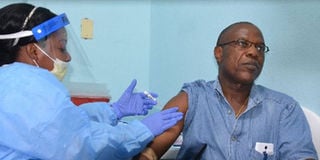
Dr Francis Kateh (right) volunteers to receive a trial vaccine against Ebola at Redemption Hospital on the outskirts of Monrovia, Liberia, in February. PHOTO | AFP

Initial results from Phase One trials of an Ebola candidate vaccine known as rVSV ZEBOV have shown that the vaccine is safe and generates an immune response against the deadly Ebola virus.

The trials began in December 2014 in Kilifi County and three other sites in Switzerland, Germany and Gabon.

“The results show that the vaccine is safe and has the potential to offer protection against the disease,” said Prof Solomon Mpoke, director at the Kenya Medical Research Institute (Kemri) which conducted the trials at Kilifi.

The candidate vaccine was given to 138 volunteers across the four sites.  Some of them experienced fever a few days after the vaccination while others developed transient pain or swelling of their joints.

Aside from these mild symptoms, no serious side effects of rVSV ZEBOV were observed among the volunteers.

The results of these trials, which have been published in the current New England Journal of Medicine, also show that the candidate vaccine was able to raise antibody responses that neutralised Ebola-like virus particles in the laboratory.

Breakthroughs

Despite these breakthroughs, the researchers are yet to ascertain whether the vaccine can prevent a person from becoming infected with Ebola.

As such, the vaccine will be further tested in a Phase Three ring vaccination study in Guinea — one of the countries affected by the Ebola outbreak — to see if it protects those at risk of infection from the disease.

Although there are no cases of Ebola reported in Kenya, Kemri had earlier noted that demonstrating the safety and immunogenicity of the candidate vaccine among the Kenyan population, would facilitate its use in the country whenever necessary.

The experimental Ebola vaccine was developed by scientists at the Canadian National Microbiology Laboratory and was cleared for clinical trials last year by the World Health Organisation (WHO).

The researchers noted that giving volunteers the vaccine cannot cause them to become infected with the virus.

The WHO notes that the ongoing Ebola outbreak in West Africa is unprecedented in scope and duration. Even though the outbreak is slowly coming to an end, health experts fear that until specific treatments or vaccines targeting the virus are developed and licensed for use, the world will continue to be under-prepared for subsequent Ebola outbreaks.

Latest WHO statistics show that there have been approximately 25,000 cases and more than 10,000 reported Ebola Virus Disease deaths in Guinea, Liberia and Sierra Leone.

PAYE Tax Calculator

Note: The results are not exact but very close to the actual.