Time flies with great content! Renew in to keep enjoying all our premium content.
Prime
Towards a national art gallery of Kenya
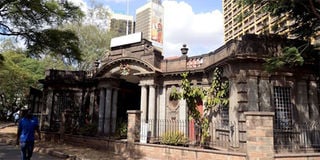
The old PCs’ building at the junction of Kenyatta Avenue and Uhuru Highway in Nairobi, which is home to some of the late Joseph Murumbi’s artefacts. PHOTO | SALATON NJAU | NMG
Is there a need for a national art gallery of Kenya? The story of the ever-elusive national art gallery is almost as old as the country itself. The Late Joseph Zuzarte Murumbi, Kenya’s second Vice-President and an ardent collector, is known to have pushed for its set up during his tenure in 1965–1966, a dream he never saw come alive by the time of his death in 1990.
For decades, artists have made attempts to establish a space or a platform to collectively push their agendas and preserve their creations for future generations.
Among the very first was Chemi-Chemi Cultural Centre in the 1960s, followed closely by the establishment of the Paa ya Paa Arts Centre. A decade later, the ‘Sisi Kwa Sisi’ artists’ movement took root with a fiery goal to use art to highlight and create awareness about political and social issues.
From the 1980s, donor-driven organisations took centre stage in the art scene. Most of these attempts were short-lived. To date the dream of a national art gallery remains elusive.
Art is an integral part of a nation’s identity, culture and cohesion, yet often not fully accorded its rightful place in policy frameworks and development agendas. Notwithstanding, patriotic citizens, artists, policymakers, art and heritage promoters, development partners and patrons responsible for bringing art in Kenya to the world stage, continue to engage in critical discourse on the need for provision of enabling structures necessary for the facilitation of art research, documentation, collection, preservation and exhibition.
Kenya has come a long way. The arts have not always been aligned with the National Agenda or engrained in the Constitution. Kenya’s first development plan (1964-69) had no culture component. It was included later in the second plan (1970-74). Today, efforts continue towards reviewing and operationalising existing cultural policies and Bills.
In a series of articles, written from the perspective of heritage management and museum practice, we shall attempt to express the various thoughts and processes towards the establishment of a national art gallery.
This first article forms an overview of the topic; how important is a national art gallery to Kenya’s national agenda, who will it benefit, where will it be situated, how will it be funded, who will managed it, and most significantly, what will be exhibited in it?
There is no question that Africa and Kenya for that matter, is endowed with artistic diversity, from painting, sculpture, architecture, literature, music, performing and film.
The earliest records of art making in Africa are abstract engravings on rock that are scientifically dated as being 77,000 years old, making them the oldest in the world. African collecting institutions have a central role to play in protecting the continent's creative heritage.
The depth and wealth of Kenya’s art history is immense and unique. A significant collection of art is archived in public and private institutions.
Sadly, the Kenyan public does not get to access these collections and the stories that define their history; stories of how humans have used creative expression to record their rich cultural heritage and inform their posterity.
Best art
How can we ease public accessibility to art? A national art gallery would provide an opportunity to discover the country’s best art. It would provide accountability for the evolution of art history in Kenya.
Clearly, it would be the first of its kind nationally, perhaps internationally, as it would envisage defying and deconstructing the colonial perception and categorisation of our art.
Perhaps one may question that Kenya already has a National Museum, so what difference would a national gallery of art make? Why spend national revenue that may run into billions of shillings on a national art gallery?
The National Museums of Kenya may exhibit art but it is not an art museum; rather it is a general museum of cultural, historical and natural heritage.
If we consider that on average the National Museum in Nairobi alone attracts a minimum 300,000 visitors annually, it would not be overly visionary to imagine that a national art gallery would net in double or triple this number, significantly augmenting the country’s GDP.
We invite your engagement on why Kenya needs to realise the elusive dream of establishing a national art gallery and its socio-economic impact on the country’s national agenda.
Unlock a world of exclusive content today!Unlock a world of exclusive content today!