Time flies with great content! Renew in to keep enjoying all our premium content.
Prime
Rich pickings for farmer who turned to strawberry growing
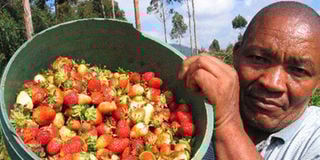
Mr George Muturi carries strawberries from his farm at Iganjo village in Mathira, Nyeri. Photo/Joseph Kanyi
After many years of incurring losses and taking loans to maintain his vegetable farming business, George Muturi is now earning handsome returns, thanks to a friend who introduced him to strawberry farming four years ago.
The big change in strategy has not only benefited Mr Muturi, but also several families in Iganjo village of Mathira East who are now growing the fruit commercially.
According to the 45-year-old farmer, growing cabbages never earned him as much as he is currently making with the strawberries that he grows on his one-and-a-half acre piece of land.
“I used to make a profit of Sh10,000 to Sh15,000 after every harvest of my cabbages. When you compare this to what I make from strawberries, there is a big difference,” he says, even as he urges more farmers to take up the agribusiness.
The father of four says he started growing strawberries after his friend explained the benefits of the fruit over the cabbages. He decided to give the idea a try.
There are basically three types of strawberries; June bearing, Everbearing and Day Neutral.
After his first harvest, he planted more of the Everbearing variety and now he says that he will never go back to vegetable farming unless it is meant for consumption by his family.
Mr Muturi, with the help of four labourers that he hires every day at a cost of Sh200 per person, starts picking the red-ripe berries at noon and by 4pm, they start packing them in small pallets before again packing them in cartons ready to be transported to market.
“We normally harvest them everyday since they ripen very quickly and you can harvest them continuously for three years before uprooting them and planting new ones. But as for the cabbages, they are seasonal as one needs to wait for three months or so to harvest,” he says.
On daily basis, Mr Muturi and his crew make sure that they harvest and pack 300-500 pallets of strawberries. He sells each pallet at Sh50 but during the dry spell, he adds Sh10 per pallet because he uses more water to irrigate them unlike the wet season when he relies on rain.
Every month, Mr Muturi says, he earns more than Sh30,000 as profit.
After harvesting and packing the fruit, Mr Muturi who relies on public transport starts his journey to Nairobi to sell the fruit. He gets to the city by 3am.
This, as he says, allows him to reach supermarkets where he sells his produce on time and when his goods are still fresh. This also gives him enough time to return to his farm and plan for the next trip.
He sells a kilogramme of the berries at Sh150 and on good days, he can sell 200 kilos out of which 120 kilos are from his own farm. To bridge the gap, Mr Muturi buys more berries from about 20 farmers in his neighbourhood.
Peter Njogu is one of the farmers who sell his daily 30kg berries harvest to Mr Muturi and he says were it not that he has a small shamba that he acquired from his father, he will grow straw berries even in more than five acres.
“Am one person who believed in cabbage and carrot farming, but when I was convinced by Mr Muturi to plant the berries, I have seen a great change,” he says.
According to Mr Muturi, the demand for straw berries in the country by various supermarkets, green groceries and factories that make juice is high but the supply is low.
“There is good market if one can manage to export, however, one needs to have tonnes of berries to conduct such a business,” he acknowledges.
He says that his friend who introduced him to this kind of farming had tried to export his produce once but he was unable to satisfy the demand.
Strawberry farming requires cool and wet climate with loam soil being the best.
When planted, a farmer is required to remove suckers every time they germinate. The suckers can be transplanted to other part of the farm.
A grower is also advised to add manure frequently since the crop requires fertile soil.
When harvesting, says Mr Muturi, only the red berries are picked while the green ones are left to ripen.
Also when packing, berries are placed in the pallets carefully to avoid crashing and squeezing the juice out of them.
The farmer now says that his great challenge is lack of a refrigerated truck and due to this, he is compelled to take his produce to the market early.
Even as he urges more farmers in the region to change for straw berry farming, he says the big challenge is to buy a refrigerated truck which is quite expensive.
But he is optimistic juice manufacturing companies that are now on high campaign in urging framers to plant fruits will visit their village and probably start collecting the berries straight from farmers.