Zain shakes telecoms market with rock-bottom call tariffs
Zain Managing Director Rene Meza launches the Sh3 tariff during a Press briefing at the Hotel InterContinental, Nairobi on August 18, 2010. Zain lowered its calling charges across all networks. Photo/FREDRICK ONYANGO
The new face of telecom wars emerged on Wednesday after Kenya’s second largest operator Zain halved its voice call tariffs and cut the price of text messaging by 80 per cent across all networks.
Zain consumers can now make calls across all networks at Sh3 per minute tariff from Sh6 and send text messages at the rock bottom price of Sh1 from Sh3 (Zain to Zain) and Sh3.50 to other operators.
The move is being seen as Indian telecoms giant Bharti Airtel’s first salvo in the Kenyan market following its takeover of Zain’s Africa business two months ago.
The new tariffs leave Zain as the cheapest network in Kenya and signals Airtel’s intention not only to replicate its high volume and low margins business model that has defined its success in India but also the game-changing arsenal in the operator’s stable.
Analysts said the biggest statement Airtel is making with the new tariffs is to move mobile telephony from the high-tech services market and make it accessible to the masses.
The deep cut in tariffs is particularly being seen as Zain’s most lethal competitive advantage that its rivals Safaricom, Essar and Telkom Kenya will find hard to match.
Should Zain’s rivals pick the gauntlet and follow with similar tariff cuts, consumers’ monthly phone budgets will drop by half bringing down with it the average revenue per user (ARPU) across the industry and ultimately impact on the profitability of telecom firms.
Staying put in a price sensitive market such as Kenya is not an option either because it leaves Zain’s rivals with the threat of losing subscribers to the low cost service provider that insiders say has prepared a long term battle plan for East Africa’s most profitable telecoms market.
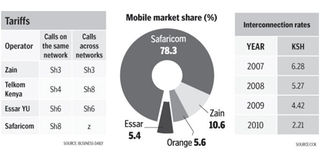
By setting its tariff at Sh3 per minute, Zain has positioned itself below Telkom’s Orange brand which charges Sh4 per minute for calls made within its network, Essar (YU) which charges Sh6 per minute and the market leader Safaricom’s Sh8 per minute.
Mr Rene Meza, the managing director of Zain Kenya, said the rock bottom tariffs are aimed at growing the subscriber base and market share, adding that it has been made possible by the drop in interconnection rates.
The interconnection rates — fees that operators pay their rivals for calls terminating in their networks — are expected to drop to Sh2.10 from Sh4.42 beginning next month giving the service providers headroom to adjust cross network tariffs.
Cutting cross network tariff by Sh5 compared to the Sh2.32 drop in the interconnection charges is the clearest signal yet that Zain is keen on a price war, especially with market leader Safaricom.
“We don’t foresee Safaricom cutting its tariffs close to what we have done but if they do it we will cut ours further,” said Mr Meza.
In an apparent jibe at Safaricom, Zain’s new tariffs were introduced to consumers with a declaration that “Going green is not always the better option. . .”
Safaricom’s marketing slogan is “the better option and its official colour is green.”
Safaricom, Orange and Yu expressed their intention to cut tariffs further, setting the stage for a vicious price war that might see the telecoms budgets come down tumbling and leave some money in consumers’ pockets to buy other goods.
“We have to give value to our shareholders and that means retaining a certain margin, but the rates may go down in future,” said Michael Joseph, the Safaricom CEO.
Mr Atul Chaturvedi, the chief executive at Yu, expressed similar intention but cautioned that the action would hurt profits.
“We are working on something new for our customers and if necessary will move to Zain’s level or even lower, but the cuts are not healthy for the industry’s profitability,” he said.
This is Zain’s boldest attempt to change the market structure that has remained heavily tilted in favour of Safaricom an endeavour that may benefit from number portability set to be introduced in October, allowing subscribers to switch networks without changing their phone numbers.
Zain hopes that the tariffs will make it easy to tap its rival’s subscriber base and prevent its customers from defecting to other networks as it seeks to move to the profit zone.
Previous attempts to tap Safaricom’s subscribers using a flat tariff of Sh8 per minute across all networks proved costly for Zain by deeply cutting into its revenues without a significant rise in the number of users.
Safaricom is the dominant player in Kenya’s telecoms scene with 78.3 per cent of the market. Zain has 10.6 per cent, Orange 5.6 per cent while Yu trails with 5.4 per cent, according to industry estimates.
This means that for every 10 calls made from Zain’s network about eight go to the competition, notably Safaricom.
Cross-network tariffs have been a key battleground for service providers in a market where subscriber growth is slowing down and the average revenue per user (ARPU) -- a critical measure of profitability in the telecoms sector -- is falling.
More recently, Safaricom’s rivals have accused the listed firm of using interconnection rates and high cross network charges to ring-fence its subscribers, a move that prompted Yu, Telkom and Zain to seek the regulator’s intervention.
That has seen the Communication Commission of Kenya (CCK) introduce tough competition rules that among other things required the regulator to set and approve tariffs for the dominant operator.
The CCK rules indicated that an operator would be considered dominant in a particular segment of the market if its gross revenues exceeded 25 per cent of the total revenues of all licensees.
Safaricom protested and the rules set for review the definition of the dominant player based on the 25 per cent set for removal.
Safaricom rivals say it has made it more expensive for their subscribers to call other networks or for calls originating from other providers to terminate in their networks, helping it migration of customers to rivals networks despite the reduced tariff it offers for within network calls.
Safaricom charges Sh12 per minute for calls heading to rival’s network.
Orange charges Sh8 and YU (Sh6).
While the rivals are still struggling with losses, Safaricom has been posting double digit growth in profits helped by its growing subscriber base.
Safaricom posted a 36 per cent increase in net profits to Sh20.9 billion for the year ended March 2010 on revenues of Sh83.9 billion.
Telkom Kenya generated Sh11 billion in revenues last year, while Zain returned $118 million (then Sh8.8 billion) for the nine months to September 2009.
Analysts reckon that the tariff cuts look set to slow down the profit momentum on reduced ARPU.
“The industry is poised for lower tariff and this will reduce the earnings momentum of the voice business,” said Erick Musau, an analyst at African Alliance. Safaricom’s ARPU has dropped from Sh816 in 2006 to Sh459 in 2010.
He said that Zain is betting on volumes to drive revenues and gain market share, warning that the model would help Zain gain market share but not profits in the short term.
The low-tariff, mass-market model has been the preferred model for India’s Bharti—which bought Zain Africa’s operation for $10 billion in June.
“It is a positive step, but Zain must rollout value addition services to be able to compete with Safaricom effectively,” added Mr Musau.
“The last time Zain cut rates, Safaricom profits reduced but the rest of players’ moved into losses.”
In 2008, Zain cut its cross network tariff to Sh8 from Sh12—which saw the company sink deeper into the loss-making territory despite growing the number of its subscribers by more than a million.
It withdrew the rates months later.
“With the business model we have adopted and the right mind set of the current partners I don’t see why we should not be able to sustain this tariff” said Mr Rene “It is going to be long and tough but our partners are aware of this.”
PAYE Tax Calculator
Note: The results are not exact but very close to the actual.