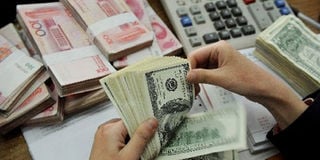
A bank teller counts dollars and yuan notes. It may prove difficult to intervene and support the weakening shilling. AFP
Going by the current foreign exchange (forex) supply and demand imbalance, Kenya has limited options to the headache.
Our economy may not be earning, leave alone saving, enough dollars to meet emergency forex requirements as recently prompted by high oil prices and unscheduled food imports.
Without a healthy positive balance of trade (and payments) it may prove difficult to intervene to support the weakening shilling.
Time may be ripe for economic planners to start formulating medium and long term policies on how to sustainably increase forex inflows to enable the country meet its critical import requirements, including foreign debt obligations.
If oil prices remain above $100 per barrel, which is the most likely case, it will no longer be business as usual as we have to make or save many more dollars to meet our energy requirements.
Recent happenings suggest that we are confronted by a forex reserves problem. First, we heard of Treasury’s unwillingness to provide sovereign guarantees to power projects investors for fear of weakening the forex reserves account.
Secondly, the International Monetary Fund sought to see sufficient forex cover as a condition for budgetary support. Thirdly, forex injection into the market to prop up the shilling has been avoided due, probably, to forex shortage.
Healthy balance
At independence, the Kenya pound (Sh20) was at par with the Sterling pound except in 1966 when the Sterling pound devalued to Sh17, making it weaker than the Kenya currency. The dollar was buying at Sh7 for most of the 1960s and 1970s.
The current exchange rates of Sh153 to the UK pound and Sh93 to the dollar is an indication of how far the shilling has drifted from the two western currencies since independence.
Lessons learned from Kenya’s exchange rate history indicate that strong forex reserves keep the shilling strong. The exchange rates mentioned above remained virtually at the same levels throughout the 60s and 70s because the country had a healthy balance of payments, backed mainly by strong agricultural exports (coffee, tea, pyrethrum, cotton, sisal etc). Tourism was strong and donor fund inflows kept coming. Kenya did not need to import any supplementary foods as food security was not a major concern.
When crude oil prices suddenly rose from about $3 per barrel to $11 in 1973/74, the coffee exports “boom” of the mid 1970s was able to counter-balance impacts of increased oil prices on the exchange rate.
The foreign exchange control regime at the time also monitored and prioritised use of forex to ensure a healthy balance.
Local manufacturing in the 1960s and 1970s was relentlessly promoted to support imports substitution through specific institutions such as the Industrial and Commercial Development Corporation (ICDC), the Industrial Development Bank (IDB), and the Kenya Industrial Estates (KIE). Policy interventions also ensured that only items not produced in Kenya could be imported, and insisted on some element of “local content” for foreign industries like vehicle assemblies.
In the 1980s and 1990s, the forex discipline went down the drain and capacity to defend the shilling went down with it. Agricultural exports irretrievably collapsed; Foreign Direct Investment inflows reduced due to diminished level of governance; stewardship of local manufacturing collapsed; while a number of key multinational manufacturers relocated to Zimbabwe and later to South Africa.
To make the situation worse, the country had also to contend with the impact of a sharp increase in oil prices in the 1980s which resulted in a massive balance of payment gap that also weakened the shilling.
Sizeable proportions of donor forex inflows in the 1980s and 1990s were diverted by corrupt bureaucrats and leaders to overseas accounts, and the country is today still paying for these “abused” forex loans which did not fully benefit citizens. Because of these reasons, the shilling rapidly weakened as inflation became commonplace.
Where are we today? Relaxation of foreign exchange controls in the 1990s set in motion a “free for all” situation on forex movements, which has so far worked well for Kenya.
The big question is: What happens in future situations when dollar inflows are less than outflows? This question should lead our economic planners to re-examine how the country will sustainably meet its net forex obligations
Going forward, attention will need to be given to promoting and protecting economic sectors that are critical to forex generation i.e agriculture, manufacturing, mining, fishing, tourism, and forex generating services.
Imported goods
When one walks into Nairobi’s supermarkets and notices the high percentage of imported goods, including food items, one acknowledges that it will not be an easy task to re-establish a strong forex balance because Kenya has developed a strong appetite for imported goods.
Unless protected, local manufacturing and agriculture will find it difficult to compete with imports. As a principle, we should be producing more than we consume and export the balance. This is the only sure way of meaningfully growing our economy and steadying our currency.
In the short term, we need to focus attention on the 35 per cent of “imported” electricity, which I call imported because it is made using imported petroleum, by foreign firms that repatriate dollar profits.
Treasury, despite forex reserves problems, should find ways of guaranteeing investment in power plants to generate power from alternative sources such as wind and geothermal.
Secondly, politicians should manage their affairs prudently to avoid dollar flight and Diaspora inflows scare.
Economic planners and the political leadership will need to internalise and verbalise the message of exports generation, imports substitution, and forex conservation.
This way, we shall ensure that the shilling is protected by a healthy balance of payments and that inflation will be checked.
Wachira is the director, Petroleum Focus Consultants. [email protected]
PAYE Tax Calculator
Note: The results are not exact but very close to the actual.