It’s referred to as the “Davos of Education” and this year it was hosting a sitting president, seven former heads of State and government, more than 40 education ministers, more than 2,500 delegates and over 200 media entities represented. The Global Education & Skills Forum brought together leaders from the public, private and social sectors seeking solutions to achieving education, equity and employment for all.
In one session, former Nigerian president Olusegun Obasanjo at 85 years of age talked about artificial intelligence and robotics asking if Africa is ready for the modern approach of technology application relating it with a conversation he had with Africa’s richest man Aliko Dangote who had advertised for 200 drivers but received more than 1,000 applications with six being PhD holders.
The most striking thing to him was when the person said that the issue isn’t about PhD holders applying for a driver’s job but in the coming years, the six PhD holders will not even have the opportunity to apply for half of those jobs because they will have been taken up by self-driving cars.
At another session, Harvard cognitive scientist Steve Pinker gave a keynote speech explaining how human progress consists of using knowledge to solve problems and explaining that people’s lives are longer, safer, richer, happier and healthier but the world’s media has become more negative partly down to human cognition.
Former Colombia President and Nobel Laureate Juan Manuel Santos spoke about how collaborative learning can improve the quality of educational development.
I bumped into Simon, an education researcher with the World Bank leading the Middle East & North Africa team. His family once lived in Westlands many years back but he couldn’t recognise the place when he visited recently.
He shared quick facts that Dubai is the only country in the world with 17 education systems ad that Djibouti borrowed Kenya’s refugee education system.
That is what the “Davos of Education” is all about, a balm of knowledge where various stakeholders come to partake and benchmark.
The forum was then crowned by the prestigious Global Teachers Prize award that saw Kenyan teacher Peter Tabichi win out of more than 10.000 applicants.
Countries around the world are increasingly recognising the need to improve student learning outcomes as well as the power of technology to support that goal.
And this recognition has driven education leaders to undertake a range of efforts to integrate EdTech into their education systems, schools, and classrooms.
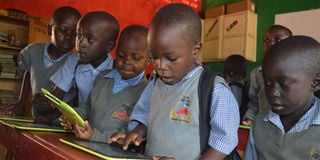
The EdTech market is estimated to have reached over $9 billion and one thing we agree on with Simon is that many countries risks being caught in a “tech trance” where education leaders and policy makers are undertaking efforts of integrating technology into education like the “One Laptop per Child” initiative but have little to show and demonstrate about its success.
In developing nations, there is dire lack of access to better quality of schools, quality of teacher’s training and a rigorous curriculum to leverage on the “One Laptop per Child” policy.
But even where education infrastructure is of high-quality, policies such as the “One Laptop per Child” can only be enabled by ubiquitous access and personalisation when rolling out education technology.
This is according to a report by Omidyar Network’s Education Initiative named “Scaling Access and Impact, Realising the power of EdTech” made public in the forum.
The report attempts to bring a different angle into the conversation by talking about “Equitable EdTech”, defining it as the promise of technology to be a great equaliser in improving education for learners.
One thing Kenya can learn is that there is no “one-size-fits-all” approach to scaling education technology.
In Chile and US, its largely school-based computer labs and classroom devices whilst in China and Indonesia they heavily rely on mobile technology and affordable mobile data promoting large-scale use of EdTech.
Unlock a world of exclusive content today!Unlock a world of exclusive content today!