Time flies with great content! Renew in to keep enjoying all our premium content.
Prime
Prof Othieno-Abinya: What I’ve learned after 40 years as a cancer doctor
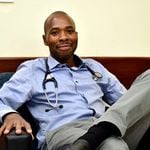
Prof Nicholas Othieno-Abinya, a medical oncologist and haematologist at the Nairobi Hospital Cancer Centre, poses for a photo at his office on February 4, 2026.
The truth is, scores of us will get cancer. And scores of us won't. Some of us who get cancer will die. Others will survive. However, the ones who survive will eventually die too. Same as those who didn't get cancer. Which makes the undeniable truth very unrevealing and boring, even that we will all die. Of something. And we all know this unavoidable fact of life, just like we know the inevitability of taxes.
To hear Prof Nicholas Othieno-Abinya say it, a well-regarded consultant medical oncologist with close to 40 years of experience in cancer study and treatment, neither offers comfort nor makes it more dire. It simply is.
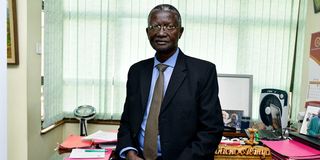
Prof Abinya was a professor of medicine at the University of Nairobi, where he was director of the Medical Oncology Fellowship Programme and Head of Haematology/Oncology at Kenyatta National Hospital. He has published widely on malignant haematology and breast cancer, and founded the Kenya Society of Haematology and Oncology, of which he was the first chair and remains patron.
He got into cancer medicine because not many students wanted to, on account of poor outcomes. People didn’t survive much. “Why would you want to go into an area where people just die? Well, because that is exactly why a doctor should go into that area.” The second reason was a book, Cancer Ward, by Aleksandr Solzhenitsyn, which he read in high school. He still keeps the original copy in his office drawer, yellowed with age, its sleeve covered in a clear polythene sheet.
Now 75 and retired since 2022, Prof Abinya still sees patients at the Nairobi Hospital Cancer Centre. He controls his own timetable now. His advice to patients who’ve completed treatment remains simple: live your life. Go on living. What fascinates him now isn’t life and death, it’s the universe—all those planets and stars out there. How far does it go? “It's endless out there,” he says.
Prof, what important questions should we be asking about cancer?
Cost. That’s the central question. Cancer treatment is expensive everywhere, and there is very little preparedness among insurers, governments, or even prescribers to deal with that cost.
We live in an unequal world: Kenya is low–middle income, Europe and North America are high income, and countries like India sit somewhere in between.
Most cancer research is done in high-income countries, so treatments are priced for those economies. In the US, insurance pays once a drug is approved. Locally, insurance—public or private—doesn’t have that capacity. Incomes are simply lower.
We then adopt these new treatments quickly. They do have advantages, but the benefit-to-cost ratio is often poor. Take breast cancer: here, chemotherapy costing about Sh50,000 every three weeks gives good results. Abroad, you may spend five times more for an improvement of around 5 per cent in outcomes.
In metastatic cancer, treatment here may give a patient 11 to 12 more months. Newer drugs abroad may extend that to 15 or 16 months, but at enormous cost. The benefit exists, but it is small relative to the money spent.
If the best treatment in Nairobi cannot cure you, the chance that treatment outside Kenya will cure you is maybe 5 percent. The rest will also not cure you, only at a much higher cost. Many people don’t know this.
India illustrates this well. They have strong facilities, but they use the same medicines we do. They don’t develop their own cancer drugs; they manufacture generics. That’s why treatment there is cheaper. We don’t do that locally—and that’s part of the problem.
You have been doing this for decades. Does it get boring?
It doesn’t get boring because every day someone comes with something new—either a new disease, a new presentation, or a treatment that worked. And there are many that work. You cure people, and you’re happy. Then you forget them.
Just last year, we treated a Dutchman. His treatment started in South Africa, and we completed it here. He worked for the United Nations. Years later, from the Netherlands, he sent a woman he knew back then who had developed cancer and told her, “Go and see him. He treated me and cured me.”
Prof Nicholas Othieno-Abinya, a medical oncologist and haematologist at the Nairobi Hospital Cancer Centre, poses for a photo at his office on February 4, 2026.
Photo credit: File | Nation Media Group
You treat many people. A lot are cured. Many also fail. That’s what people don’t see. When treatment fails, you don’t just sit there and say there’s nothing else to do. You have to go out of your way and try other options. You start with first-line treatment. It works, patients stay well, then they relapse. You move to second-line treatment. The benefit is shorter. You look for something else. As long as a patient is still strong, you don’t let them go. You want them alive—able to work, to function, to sustain themselves.
What’s the impact of that on you—being so close to someone’s recovery, or not?
You don’t really think of it as having someone’s life in your hands. You think of it as responsibility—your responsibility to make sure they’re still around. The lady who just walked out of here.
You don’t know her, so it won’t mean much to you. She has breast cancer. There was some fiddling before the diagnosis, so by the time she came, it was a bit advanced. She is 41. We thought, ‘let’s try our best to cure her.’ We treated her with everything. After a year, she relapsed.
There are some free medications we get through a foundation called Max Access Solutions, and we treat a number of patients here using that support. We got approval for her. But she became anxious and went to India, where they started her on medication that turned out to be generics. What we have here is the original drug. We give it for free. It costs about Sh300,000 a month.
Today, she came back to start the original medication. She looks well. And that’s the point. You want people working while they’re on treatment. You don’t want patients crawling with side effects. There are many people on cancer treatment who are working. People don’t know that. They think if you’re being treated for cancer, you’re dying in your mind. That’s not how it has to be.
What stays in your mind is this: will this person survive? Will their children stay in school? Will fees be paid? That’s what matters. I must try my best so this person stays on treatment and takes care of their children, for as long as possible.
Because you know so much, do you worry less or more for yourself and your family?
Interesting. I wrote a book about my work. In there, I try to address this question. Cancer is not a nice diagnosis. It’s not. And cancers are different. There are some you hear about, and you almost feel dizzy—they’re not nice at all. But there are others where you hear the diagnosis and you think, ‘we’ll give this the best shot.’Breast cancer. Prostate cancer. Lymphomas. Cervical cancer.
Unless they are very advanced, many of these are manageable. Cure rates are high. We cure a lot of them. But if cancer comes back, that's a big trouble. Cancer that has been treated and then comes back is extremely troublesome.
A furious cancer.
Yes. But you never lose faith. If cancer comes, face it. Go through the treatment that’s there. And once doctors say you’ve completed it, live your life. Go on living.
Don’t obsess if it will come back, doing more tests every few months. It’s a waste of time and money—it doesn’t change anything. If it comes back, it comes back, and we fight again. Because catching it early after the first treatment rarely changes survival in a meaningful way. So live your life. Do your things.
If one day you feel symptoms, get checked and get treated then. Constantly looking for recurrence won’t make you live longer. And remember this: you are human. People are born, people live, and people die. And when your time comes, you are gone.
This is a nice segue into death; what are your thoughts on death, seeing as you work closely with it?
[Chuckles] I work against it. Death is there. Sudden death is not a good thing, but if you have a disease that you know will end up killing you, then you should accept that a time will come. And when it comes, there isn’t much you can do about it.
I remember in 1978, when Jomo Kenyatta died and Daniel arap Moi had just taken over. I was a university student doing a project in Kisumu.
Moi came to the stadium, and he said something that stayed with me: siku ya mwisho iki fika imefika. Whatever you do, however much money you spend, when that day has come, it has come. So you accept that it is time to go. Other people will survive, and one day they will also follow you.
What's the last thing that really scared you?
[Long pause] I don’t know. [Pause] I don’t know what scares me anymore. I’ve been unwell before. And when I am unwell, I tell myself: if it doesn’t last, then this is the last.
After all, I’ve been lucky to have lived all these years. There are people who die much younger. I look at the war in Ukraine, and I see the numbers; young people are dying every day. And you realise that if you die, yours is not the only death the world has ever seen. Death comes. Big people have died. Small people have died. So if you are dying,who are you? The world will not stop because someone is dying today.
How old are you now?
75.
Would you look back and say you’ve had a good life?
Yes, good in the sense that I have done what I wanted to do. And I have enjoyed doing what I do.
Up there, amongst your awards and certificates is a plaque for Best Father Award. Great validation, yes?
That was from my daughter, who was in the US. She passed on.
Oh goodness! I’m sorry.
Yeah. Anyway, some of those plaques are from my mentors, like Professor Ogada, who was a very good teacher. He was also in cancer medicine. He started coaching me when I was an undergraduate and guided me all the way into that field.
What’s been your best decade?
I think this is my best decade, my retirement, which happened in 2022. Because now I can control my own timetable. During working life, you have many things to look after—and many people giving you instructions.
Prof Nicholas Othieno-Abinya, a medical oncologist and haematologist at the Nairobi Hospital Cancer Centre, poses for a photo at his office on February 4, 2026.
Photo credit: File | Nation Media Group
You start one thing, then another instruction comes. You realise you don’t control your own time. Now I wake up in the morning and do my work. But nobody forces me to wake up.
So you’re not necessarily working for money anymore—your children are grown?
[Laughs] I still work for money. I sometimes maintain my children.
How old are they?
My children are grown. They are working. But once in a while, when someone needs support, you support them. One of them is an oncologist.
The youngest is a gynaecological oncologist. I’m a medical oncologist. So my children are all working. One is in the US. One is in business here in Kenya. The one who died in the US was a banker.
You must think about her a lot?
She died in 2023, so that’s the other day. It’s still fresh. [Pause] But death is there…death is there. Once somebody is dead, they are dead. As much as you loved them, that is the end of the story. They have died. You will not bring them back.
So, struggling endlessly over it does nothing. If you destroy yourself in the process, then all that happens is that there is another death. That is not an answer.
Are you busier now in retirement than you were, or has it slowed down a bit?
Just as busy as I was. It’s simply that I decide what I want to do. I’m still treating people. I still want to do some research. I don’t just sit there like a block. And I enjoy it because I plan it myself.
Nobody is planning it on my behalf. I also exercise, I do a lot of walking, and I also watch what I eat, as everybody should, because now I have high blood pressure and diabetes, so it’s key.
Do you have other interests outside medicine? Like, I don't know, gardening, golf, travelling?
No, nothing. I used to watch football when I was younger. Then you go to the stadium and you meet hooliganism. Sometimes your life is at risk. So I stopped.
I switched to watching TV. Then you watch a big tournament—the World Cup—and it starts to feel like referees are deciding who wins and who doesn’t. I said, this is not real. This is rigged. So when I saw how much rigging there was in football, I eased off on it.
So, what are you most curious about now in this season of your life?
The universe. How far does it go? What structures are there, and how are they arranged? That’s what’s intriguing. The planets, the stars—the ones we’re only now realising are there.
You discover that a star is surrounded by planets we didn’t know about before. It’s endless out there. And to me, that is extremely intriguing.
Do you think God put them there? Do you believe in God? The more people like you study science, the less they believe in God.
I believe in God, yes. But you are right, mostly that’s true. But these things just didn’t happen. They didn’t just appear. I know there are people who believe they did and try to explain it physically, but to me, it doesn’t add up.
What I understand as creation is a continuous process. Take the human being: what humans could do a thousand years ago, what they can do today, and what they will do tomorrow—that, to me, is part of creation. And the ability to keep doing it is controlled.
And to me, that is God’s work. Not the work of human beings. God’s work.
Do you believe in miracles? Do they sometimes happen to desperate patients?
You’re really asking about faith healing. Yes, I believe there is faith healing. But not in the way people make it look. It’s not as simple as going somewhere, people falling down, throwing away crutches, throwing crosses, and suddenly everything is fine. No.
That, to me, has nothing to do with it. The prophets of today who claim to heal people all over the place—I don’t believe in that. What I believe is this: some people can be healed by faith. Not many, but some.
Treatment is given, yes. And their faith is added to it. They go through very difficult diseases, very difficult treatments, and they come out of it. There are a few, but they exist.