Individuals who will shape the Kenyan economy in 2026

New Content Item (1)

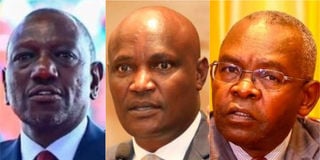
From left: President William Ruto, National Treasury Cabinet Secretary John Mbadi and Central Bank of Kenya (CBK) Governor Kamau Thugge.

Photo credit: File | Nation Media Group

As Kenya enters 2026, the economy will be shaped less by a small group of individuals whose decisions sit at the intersection of politics, capital, regulation and corporate power.

With the 2027 General Election looming, economic policymaking will increasingly be filtered through political urgency, even as fiscal space tightens and public patience wears thin.
The government is under pressure to deliver growth, tame the cost of living and revive job creation while servicing heavy debt obligations.

At the same time, regulators are being forced to make consequential calls in telecoms, infrastructure and finance, while corporate leaders are navigating ownership changes that could redefine entire sectors—from alcohol and cement to pensions, gaming and digital services.

From how pension money is invested, to how toll roads are rolled out, to whether mobile call charges fall further, the choices made in 2026 will have long-lasting implications. The individuals profiled below sit at the centre of these shifts.

Some wield executive power, others control vast pools of capital or dominate strategic industries. Together, they will influence how money is raised, spent and regulated—and who ultimately bears the cost.

William Ruto — President of Kenya

President William Ruto’s economic imprint in 2026 will be shaped by the political reality of an approaching election. Facing voter fatigue over taxes, inflation and weak job creation, he is expected to prioritise policies that deliver visible economic relief while sustaining a long-term reform narrative.

He has lately been framing his ambition around turning Kenya into “another Singapore,” signalling a renewed focus on infrastructure, logistics, manufacturing and private capital.

Central to that vision is the Sh5 trillion National Infrastructure Fund, unveiled as a vehicle to mobilise pension money, private capital and development finance to fund roads, housing, energy and urban infrastructure.

The fund marks a shift away from heavy reliance on the exchequer at a time when public debt and interest costs are crowding out development spending.

In 2026, Dr Ruto will push to operationalise the fund and fast-track flagship projects to demonstrate momentum ahead of the polls. But the balancing act will be delicate. Populist pressure for tax relief and spending will collide with the country’s commitments on austerity, which includes collecting more tax revenues and cutting spending.

How convincingly Dr Ruto aligns his Singapore-style growth narrative with tangible outcomes—without destabilising public finances—will shape both investor confidence and his re-election prospects.

 John Mbadi — Cabinet Secretary, National Treasury

John Mbadi will sit at the heart of Kenya’s economic trade-offs in 2026. As custodian of the public purse, he must navigate shrinking fiscal space, rising debt repayments and intense political pressure to ease the tax burden on households and businesses.

His decisions on PAYE bands, VAT exemptions, fuel levies and borrowing will directly influence inflation, disposable incomes and consumption.

At the same time, Mr Mbadi must maintain credibility with lenders, including the IMF and the World Bank, as Kenya seeks to roll over debt and rebuild buffers without triggering fiscal slippage. He will craft a budget and Finance that seeks to avoid youth-led protests and places an eye on voters in an election year.

Privatisation, public-private partnerships and state asset sales are likely to feature prominently as Treasury searches for non-tax revenue.

How Mbadi handles these politically sensitive choices—especially a year to the general elections—will determine whether Kenya stabilises its finances or drifts into policy inconsistency. Markets will be watching closely.

 Kamau Thugge — Governor, Central Bank of Kenya (CBK)

Kamau Thugge’s influence on the economy in 2026 will be felt primarily through monetary stability.

With the rollout of the Kenya Shilling Overnight Index Average (KESONIA)—a risk-free reference interest rate—and mounting climate-related inflation risks, including failed short rains, the CBK governor faces the delicate task of balancing growth with price stability.

Political pressure to ease credit conditions is expected to intensify as the country edges closer to the 2027 General Election. Cheaper loans will put cash in consumers’ pockets, triggering corporate demand, expensing plans and hiring.

However, premature loosening of monetary policy risks weakening the shilling and reigniting inflation at a time when food prices remain vulnerable to weather shocks. Dr Thugge’s credibility with markets will be critical in anchoring expectations, stabilising the currency and maintaining investor confidence.

Beyond headline policy rates, attention will increasingly shift to transmission. Markets will be watching closely to see whether banks pass on the benefits of lower interest rates to borrowers—something the sector has struggled with for years, often citing weak transmission mechanisms.

While most lenders have already reduced their base lending rates, the real test will come if the CBK makes further cuts to its benchmark rate in 2026. Whether easier monetary conditions translate into cheaper credit for households and businesses will shape economic activity, investment and job creation in the year ahead.

 Davis Koross — CEO, NSSF

With higher mandatory contributions swelling inflows, Davis Koross will oversee one of Kenya’s largest pools of capital.

He will join a tiny exclusive club with an annual funding war-chest of over Sh100 billion.

This is the product of increase in the monthly contribution to National Social Security Fund (NSSF) from Sh200 per worker in 2022 to the current maximum of Sh4, 320 and Sh6, 480 in February.

His investment decisions—whether into toll roads, real estate, infrastructure or capital markets—will shape long-term growth and how Kenya deals with the growing old age poverty.

Old-age poverty has significant social implications in a country where the traditional patterns of the young caring for the old are changing.

Analysts point out that the relatively low number of Kenyans saving for pension and the value of payouts at retirement have compelled many retirees or those approaching the legal retirement age of 60, to continue working.

Kenya also suffers from low pension coverage with more than 70 percent of Kenyans retiring without a pension.

The mandatory NSSF could be a game changer, with the burden resting on Mr Koros.

The risk lies in governance. Aggressive expansion could accelerate development; poor allocation could politicise pensions and expose workers’ savings to risk.

Already, the decision to use NSFF cash to build the Nairobi-Nakuru-Mau Summit toll road has put the fund in the spotlight.

Luke Kimeli — Acting Director-General, KeNHA

Luke Kimeli will test Kenya’s shift toward user-pay infrastructure as the Kenya National Highways Authority (KeNHA) begins implementing the National Tolling Policy.

The framework is designed to allow private capital to finance, build and operate major highways, with investors recovering costs directly from users rather than the exchequer.

Highways such as the Nairobi–Nakuru–Mau Summit road are expected to anchor the programme.

Despite the legal, economic and political challenges surrounding the project, the road is intended to decongest a critical node in the Northern Corridor, strengthening Kenya’s bid to remain the preferred trade route for landlocked neighbours such as Uganda, Rwanda and South Sudan.

With public finances under strain, tolling is increasingly viewed as the only viable way to fund such large-scale infrastructure.

The project is also deeply political. Its completion has been tied to the election calendar, with President William Ruto insisting the road must be finished by the end of 2027, ahead of the next General Election.

Mr Kimeli, who is acting, appreciates the enormity of the task. He knows how highly charged the office can be.

His predecessor, Eng Kungu Ndung’u, left the agency in an unexpected resignation in July 2025, and the Kenya Urban Roads Authority’s director-general, Silas Kinoti, faced swirling rumours (since denied) of departure—pointing to how politically and operationally sensitive this office is

How Mr Kimeli handles pricing, exemptions and public consultation will determine whether tolling gains legitimacy or triggers renewed resistance.

His performance—whether it is in appeasing the political leaders or simply carrying out his job well—will determine if he be confirmed as the Director General.

David Mugonyi — Director-General, Communications Authority of Kenya

With mobile termination rates (MTRs) set to expire in February 2026, David Mugonyi will be at the centre of one of the most consequential regulatory decisions in Kenya’s telecoms sector.

The pending review opens the door for further cuts to interconnect fees, a move that could reshape call pricing, competition and returns in the industry.

For subscribers, lower MTRs would likely translate into cheaper calls, particularly off-net calls between rival networks.

Termination rates are a key influence on the cost of calls across Safaricom, Airtel and Telkom.

When a customer on one network calls a user on another, the originating operator pays the termination fee to the receiving network.

High MTRs significantly disadvantage smaller telcos by increasing their operational costs, reinforcing the market dominance of larger operators and creating a barrier to competition.

Smaller players argue that high termination charges limit their ability to compete aggressively on price.

Already, pressure for deeper cuts is now building from outside the sector. The World Bank in November said the country lags regional peers in adopting cost-oriented, pro-competitive termination rates.

The existing MTRs, set by the Communications Authority of Kenya (CA), took effect on March 1, 2024 and are due to lapse on February 28, 2026.

They cap both mobile and fixed termination rate at Sh0.41 per minute, after CA cut it from the previous Sh0.58 per minute.

A reduction would therefore support affordability and consumer welfare.

The same move, however, would be unwelcome news for investors in Safaricom, the market leader and net beneficiary of termination fees.

Safaricom has for years reckoned that MTRs must reflect the cost of rivals riding on its extensive network, given its dominant market share in voice traffic.

Scrapping or sharply reducing the fees would erode a steady revenue stream, lowering returns on assets and compressing margins.

On the other side, Airtel Kenya and Telkom Kenya contend that high MTRs entrench Safaricom’s dominance by penalising smaller networks whose customers make more off-net calls.

They argue that lower charges would level the playing field and stimulate competition.

Joe Sang — CEO, Kenya Pipeline Company

Joe Sang’s defining task in 2026 is to deliver a credible initial public offering (IPO) for the Kenya Pipeline Company (KPC) and steer the firm from a state monopoly into a partly private, market-driven operator — a process the government now hopes will raise Sh100 billion.

The Privatisation Commission has set a hard deadline of March 31, 2026 for the listing, a time-bound target that compresses advisory, valuation and marketing work into a brief window. The deadline also represents a delay from an earlier target President William Ruto mentioned for September 2025, underscoring the transaction’s complexity.

Officials are signalling that as much as 65 percent of KPC could be sold, with the State retaining a minority stake — a structure intended both to unlock large proceeds and to transfer operational discipline to private owners. Transaction advisers and lead banks are being lined up to prepare the offer.

Beyond raising cash, the IPO has been pitched as part of the beginning of the renaissance of the Nairobi Securities Exchange (NSE), ending a long listing drought at the Nairobi bourse, providing a sizeable new large-cap stock and acting as a catalyst for the exchange’s broader strategy to attract fresh listings and retail investors.

For Joe Sang, success means a well-priced, transparent offering and a post-IPO KPC that balances commercial discipline with national energy-security responsibilities; failure risks denting investor confidence and setting back the wider privatisation agenda.

Edha Nahdi — CEO, Amsons Group

Tanzanian tycoon Edha Nahdi is set to shape Kenya’s construction and industrial economy following Amsons Group’s acquisition of Bamburi Cement and East African Portland Cement.

The outsized deals, multi-billion shilling investments, cross-ownership and dominance in the cement market will be closely watched by consumers, regulators and rival billioniares.

After a prolonged slowdown, the construction sector has regained momentum, buoyed by rising cement consumption driven by President Ruto’s Affordable Housing Programme and renewed public investment in roads, housing and other infrastructure.

It is into this resurgent but still fragile market that Mr Nahdi has made his entry—one likely to unsettle established players such as National Cement. Backed by a strong balance sheet and regional ambitions, Amsons is expected to pursue an aggressive expansion strategy, seeking a larger slice of a market that is becoming increasingly competitive as demand recovers.

Still, the opportunity comes with notable challenges. Mr Nahdi will have to rationalise assets inherited from legacy producers, streamline operations and improve efficiency in plants that have struggled with high costs and weak margins. He will also need to defend market share in a sector where construction activity remains uneven and highly sensitive to government spending cycles.

PAYE Tax Calculator

Note: The results are not exact but very close to the actual.