Isuzu’s Rita Kavashe on the drive towards e-mobility amid EV battery charge fears

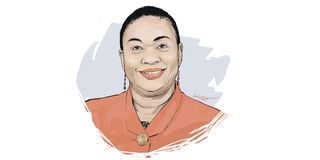
Rita Kavashe, board Chairperson and Managing Director of Isuzu East Africa.

Photo credit: Joseph Barasa | Nation Media Group

Is range anxiety holding back the transition to e-mobility? There is a deafening silence around electric cars despite them being very silent.

With the buzz around such models, the biggest challenge has been on their battery life and charging infrastructure.

Range anxiety is the fear or worry that an electric vehicle (EV)'s battery will run out of charge before reaching a destination or charging station.

It's a common concern for potential EV buyers, particularly those new to electric vehicles or those who frequently drive long distances.

Isuzu East Africa is piloting an electric truck to test the market readiness in the next few months without making promises.

Rita Kavashe, the board chairperson and managing director of Isuzu East Africa, spoke to the Business Daily on their sample electric truck, the e-mobility industry and the firm’s growth strategy.

Between the United States and Japan, what alternatives does Kenya have for EV?

We have been testing EV in Japan and in the United States. So we decided to test in very mature markets, because with the lessons we get there, we will now replicate in other markets. But we will use different technologies for different markets.

Tanzania, for instance, has a lot of natural gas. So should we push Tanzania to use electric vehicles? Or can we use Compressed Natural Gas (CNG) for the Tanzanian market?

Why is Kenya ripe for EV?

We have invested money in different technologies and alternatives. We will introduce our first vehicle which will come to Kenya in 2025, a truck for testing.

This is a truck for testing with our customers, collect data before we can roll out as we are studying, which markets require what type of alternative propulsion technology.

What is the biggest hurdle for EV growth?

The battery life is what we are struggling to get. We don't want our customers to come from town and reach the expressway when the battery life is over or it is depleted and needs charging. So already we are testing this to ensure we address this challenge.


Which segment is Isuzu eyeing for EV market?

We are dealing with commercial vehicles. The investment is done in HQ, in Isuzu Japan itself. It's a lot of money, a lot of partnerships, collaboration.

We figure out who's going to supply what component, from what market? How can we leverage other players? In the global scheme of things, we do a lot of collaboration with other car makers such as Volvo.

We are working together on some of these technologies. Cummins too, we signed a partnership with Cummins. What can Cummins supply to us in this space?

Besides EV, what else is Isuzu doing for growth?

We are expanding around export. Export is big, like this particular vehicle, [the Isuzu NMR 85H] that we are delivering right now to SGA Security. We are going into our export market.

In the last five years, we've been spending money in export.

We've been spending money in upgrade of our plant and facilities, we are spending money in expansion. One is our parts distribution centre that we are building on Mombasa Road worth Sh1.5 billion.

So, you want to centralise your nerve at the Sh1.5 billion facility?

That distribution centre will serve the entire of the East African market. We are expanding our footprint in the after-sales space so that our customers can access our services.

And one challenge is in the sense that if I'm in Nakuru, I don't want you to tell me to go for my service in Nairobi.

I want you to bring service to Nakuru because I am in Nakuru. I don't want to go to my neighbours for this and that has opened up quite a bit of these service centres. So we are expanding our footprint in Kenya, as well as our dealers and our distributors in export.

It seems like your game plan is changing from importing ready made cars?

We are bringing in new production. For instance, in November, we are starting to produce this car [the Isuzu MU-X, a seven seater Sport Utility Vehicle (SUV)]. It's called the MU-X.

We're going to produce it here in Kenya. Today we are importing it from Thailand. So if you go to our factory, we have already started doing the work of the plant upgrade to create the line for this vehicle.

We Will be competing here because why would you want to buy a second-hand car or something for Sh7 million when you can buy a brand-new seven-seater MU-X for Sh8.5 million? We want Kenyans to drive new cars.

Is your assembly fully local?

There are some components that come knocked down. Because for you to go into full-fledged manufacturing, some things must be done right.

Egypt is doing full manufacturing. I think South Africa is doing full manufacturing because the volumes and the scale is there, and because there are no second hand cars coming in from somewhere else.

With the production of less than 30,000 vehicles per annum in the entire ecosystem, it does not make business sense to do a hundred percent.

However, there are some vehicles that the local component is quite significant, like buses and some of the trucks, because we buy quite a lot locally to put the bus body behind the chassis and all that. So the local content is at about 60 percent or 70 percent.

Some are still low, like a single car pickup because most of the parts, we just put them together and ship that out.

PAYE Tax Calculator

Note: The results are not exact but very close to the actual.