More than three-fifths of Kenya’s bank branches are concentrated in six counties, a reflection of wealth and income inequality across the 47 devolved units.
The Central Bank of Kenya (CBK) data shows that the six counties had 931 branches or 62 percent of Kenya’s 1,511 banking outlets.
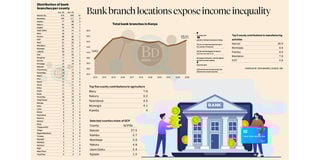
The fact that more than 60 percent of banks are concentrated in just a few counties underscores the economic inequality facing the country where centres far from manufacturing and agricultural hubs are underserved by financial institutions.
The move by commercial banks to prioritise commercial activities leaves the remaining 41 counties to scramble for 580 branches.
Data from the 2023 Gross County Product (GCP) report indicated counties such as Marsabit, Mandera, Isiolo, Tana River and Kajiado as among the top five in terms of economic growth.
However, these regions had the least number of banks despite emerging as top economic growth hubs. For instance, Mandera has only four bank branches, Isiolo (nine), Tana River (three) and Marsabit (six).
The GCP report notes, “Other than Nairobi City, counties with relatively small economies, such as Marsabit, Mandera, Isiolo, Tana River, and Busia, grew much faster than their counterparts with larger economies.
Notably 17 counties had less than 10 bank branches each despite national growth of bank branches by 36 last year.
The increase to 1,511 from 1,475 in 2022 comes at a time when banks have been increasing their digital footprint via various products that offer banking on the go.
The annual Bank supervision Report by CBK notes, “The increase in bank branches is mainly attributed to opening of new branches by some commercial banks in emerging and new growth areas.”
Nairobi was the biggest recipient of new outlets, adding 15 units to wind the year with 588 branches.
Samburu and Tana River, which had the lowest county share of GCP at 0.3 percent each, also had the smallest number of bank branches in 2023 of four and three respectively.