Hospitals in Kenya risk a shortage of essential medicines following funding cuts by the United States government, pushing millions of patients to the brink, according to a review by the University of Nairobi.
An analysis by the University of Nairobi’s Centre for Epidemiological Modelling (CEMA) shows the country is facing a critical shortage of essential medicines worth Sh34.7 billion, a gap that threatens to leave hospitals without key commodities.
“For commodities, the funding gap across HIV, TB, malaria, vaccines and nutrition is estimated at Sh34.7 billion in the financial year 2025/26, excluding the overfunded Reproductive, Maternal, Newborn and Child Health (RMNCH) programme,” the centre said in its assessment report.
The RMNCH programme is jointly run by the Health Ministry, the World Health Organisation, Unicef, UNAids, UNFPA and UN Women, and focuses on reducing high maternal and child mortality rates in underserved counties.
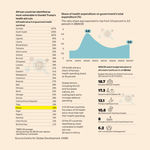
The report attributes the shortfall to a sharp decline in external health funding, which fell by Sh71.69 billion from Sh126.09 billion in 2024/25 to Sh54.40 billion in 2025/26.
Donor pullback
The decline stems largely from reduced funding from foreign donors, particularly the United States, which has historically financed most of Kenya’s essential medicines.
Despite the reduction, the Kenyan government has not fully stepped in to cover the shortfall, leaving the medical supply system struggling to maintain stocks of life-saving drugs.
For the past two decades, foreign donors — especially the US government through programmes such as the President’s Emergency Plan for AIDS Relief — have paid for most of Kenya’s HIV drugs, tuberculosis medicines and disease control programmes.
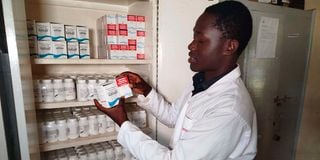
A pharmacist arranging antiretroviral medication at Homa Bay Teaching and Referral Hospital.
Photo credit: Sam Doe I Nation Media Group
This funding came in two forms. Some passed through the Treasury as official development assistance and appeared in government budgets, while the majority was off-budget, flowing directly to health programmes. This created a parallel health system alongside government facilities.
Off-budget funding has now dropped from Sh87.37 billion in 2024/25 to Sh26.46 billion in 2025/26, a decline of nearly 70 percent. The funds had paid for medicines, laboratory equipment, health workers’ salaries and drug distribution to rural clinics.
On-budget external funding also declined, from Sh39 billion to Sh28 billion over the same period. The largest reductions came from the Global Fund, down Sh11.6 billion, and the World Bank, down Sh1 billion.
David Khaoya, lead author at CEMA, said external funding has long played a significant role in Kenya’s health sector but remains unpredictable and unsustainable.
“This funding shock is a wake-up call. Kenya and other African countries now have an opportunity to rethink how health systems are financed and build long-term resilience,” Dr Khaoya said.
Disease burden
The timing of the funding shortfall is particularly worrying, coming as about 1.4 million Kenyans live with HIV, representing an adult prevalence rate of 4.9 percent.
Kenya also records about 140,000 new tuberculosis cases annually, with the disease claiming roughly 23,000 lives each year.
Malaria remains endemic, with an estimated 3.5 million cases reported annually and about 70 percent of the population living in areas at risk of transmission.
The analysis shows that five categories face the largest funding gaps, with serious public health implications. HIV drugs face the biggest shortfall, estimated at Sh14.47 billion.
These antiretroviral medicines are taken daily by more than 1.2 million Kenyans to suppress the virus and maintain normal, productive lives.
Without adequate supplies, treatment interruptions could occur, increasing the risk of drug resistance and the spread of HIV.
Winnie Byanyima, Executive Director of the Joint United Nations Programme on HIV/AIDS, warned that the funding crisis threatens hard-won gains.
“Behind every data point in this report are people — babies and children missed for HIV screening or early diagnosis, young women cut off from prevention support, and communities suddenly left without services and care,” she said.
Closely linked to the HIV crisis is a Sh13.81 billion shortfall in tuberculosis medicines. TB and HIV often occur together, with people living with HIV up to 18 times more likely to develop active TB.
TB treatment requires strict adherence to daily medication for six to nine months. Interruptions can lead to drug-resistant TB, a more dangerous and costly form of the disease.
The report warns that supply disruptions could reverse years of progress and potentially increase the estimated 23,000 TB deaths recorded annually.
Vaccine risks
Childhood vaccines face a Sh3.09 billion funding gap, threatening Kenya’s relatively strong immunisation coverage.
The shortfall affects vaccines against pneumonia, diarrhoea, polio, measles and other deadly diseases. About 86 percent of Kenyan children currently receive basic vaccines.
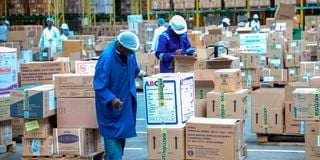
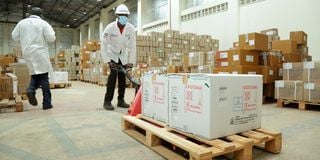
Kenya Medical Supply Authority (Kemsa) transfer cartons containing vaccine doses into a cold storage facility at their warehouse in Kisumu on March 4, 2021.
Photo credit: File | Nation Media Group
Patrick Amoth, Director General for Health, has previously described vaccination campaigns as “more than a health intervention; it’s a bold commitment to our children’s future and a shared investment in Kenya’s prosperity”.
However, reduced funding could delay immunisation, raising the risk of outbreaks in areas where coverage falls below herd immunity thresholds.
Malaria programmes face a Sh410 million funding gap. Funding for malaria fell sharply after the Global Fund allocated Sh1.53 billion for 2025/26, down from Sh4.25 billion the previous year.
The disease still causes an estimated 3.5 million cases and about 10,700 deaths annually, most of them children under five.
The cuts mean fewer mosquito nets, reduced indoor spraying and lower stocks of malaria medicines and testing kits. Unlike HIV, malaria cases can rebound quickly when control efforts weaken.
Budget pressure
“Budgets for all three strategic disease programmes have declined due to reduced external funding and lower domestic allocations, raising serious risks of reversal in hard-won gains in incidence, treatment coverage and mortality,” the report said.
Kenya’s health sector is funded mainly by the government, which provides 53 percent, followed by the private sector at 23 percent and external funders at 18 percent, according to the 2018/19 national health accounts.
In that year, the United States contributed more than 60 percent of all external health funding. Strategic diseases such as HIV, TB and malaria remain heavily dependent on donor support.
External funders financed 62 percent of HIV health expenditure in 2018/19 and paid for 86 percent of antiretroviral drugs, with half coming from the US government.
Although Kenya allocated Sh138.1 billion to health in the 2025/26 budget — an 8.7 percent increase from the previous year — this remains below the Abuja Declaration target of 15 percent of total government spending.
“The current domestic budget response in the financial year 2025/26 is not sufficient to bridge the gaps created by donor withdrawal, raising immediate risks for service continuity and longer-term risks for health outcomes and financial protection,” the report said.