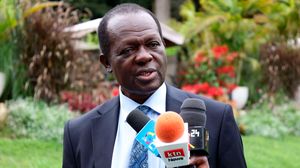
Nobody forgets their first time. The first time they flew. Their first salary. Jackson Kiplagat, the CEO of World Wide Fund for Nature (WWF) Kenya, remembers the first time he left his village.
“In a lorry hired by the school,” he says.
He was heading to Nakuru for the Agricultural Society of Kenya show because, even then, farming was his first love: obsessive, deeply rooted, but profound.
He remembers growing up on a farm in Uasin Gishu County and making money from that same land. In the small spaces between work, he cultivated dreams, that unbreakable habit of the young.
Now he is a big shot in the city, but the past still taps at his door. Like the running career he never quite pursued.
“I could have been a runner, you know,” he says, more to convince himself than me.
How has your life been lately?
Very good. A little bit of catching up with my new role as the CEO of WWF Kenya. But I have an advantage because I have been with the organisation for about 16 years, so it was easy for me to pick up and run with the role. I have also had very good support from our former CEO and the board.
What’s bringing excitement to your life now?
I like experimenting with what we teach in conservation. I grew up in Elgeyo-Marakwet County, but I live in Uasin Gishu County.
Traditionally, in December, after people harvest maize — the most popular crop in the county — they wait for the next planting season in March or April.
But for a few years now, I have been experimenting with crops that do not require much rainfall because it is a dry period. I have been growing sunflowers for the last three years.
Sunflowers?
Yes, and now it is catching on. I am seeing my neighbours, and even county governments and the national government have started distributing seeds to farmers. I use it as feed for my dairy cows.
Which part of your personality has farming brought out?
Patience. Farming is a very challenging sector where you have to mix skill and passion to make money. I also keep sheep and often slaughter them for home consumption. I rarely buy meat from a butchery.
What’s the best part about being you?
I am built on resilience and honesty. Resilience in the sense that I grew up in the village. The farthest I went was to the Nakuru ASK Show in a lorry hired by the school. The first time I came to Nairobi was when I was going to Kenyatta University for an undergraduate degree in Arts.
Initially, I was to do economics, but the class was full. I met Professor Wellington Nguya Wamicha, then chair of environmental science, who advised me to consider joining the environmental course.
What did you know about money then that has helped you till today?
[Chuckles] Money is very sweet, and you can easily lose your direction if you don’t have ideals for managing it. There are those of us who cannot spend the night in the same house with money. But I am not that kind. I have no problem with money. If I know what that money is for, I don’t bother with it.
My late grandfather taught me never to take what is not mine, and I use that as a principle. I can sleep in my house without worrying that somebody will come for their money.
What do you spend your money on?
I have a family, so I meet their needs. I also grow my few investments here and there on the farm, and properties here and there. And of course, the day-to-day consumables.
You don’t spend on yourself?
My family accuses me that whenever we go into a shop with a hardware section, that’s where we part ways. They say, “We know where you are going.”
I will want to see what is available — spanners, wrenches. If there is something I can fix, I try to do it before getting someone else.
You are a handyman.
I am a handyman [chuckles]. I will not be beaten. But what requires professionals, yes. Certain things I can do, and I will always do them.
Which part of your life feels underutilised the most?
People tell me that I am a public speaker. Maybe I haven’t utilised that skill well. They say I have a voice that captures attention and that I could use it more.
What habit are you trying to kick?
For the last two years, I have been trying to reduce my sugar consumption. I have continued to fail, but I have made progress this year. I used to take two spoonfuls. Now I do three-quarters, half, or none.
What used to make you happy but doesn’t anymore?
Travelling. I used to travel a lot for work. These days, I don’t want to travel, especially globally.
What happened?
It’s just changing priorities. I like being around my children. One is in university, another in high school, and the other in primary school.
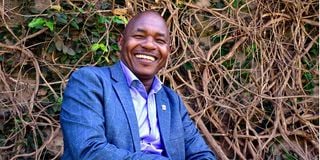
WWF Kenya CEO Jackson Kiplagat poses for a picture after the interview at his office on January 29, 2026.
Photo credit: Francis Nderitu | Nation Media Group
Do you recall a moment when you were happiest in your life?
One was when I got admitted to university. My father struggled to pay school fees, and I was the firstborn in a family of eight. Going to university reshaped how the family thinks.
Most of my siblings are now degree holders. The one who follows me has a PhD.
My grandfather once said, “You guys have gone to university on my behalf.” He gave us a piece of land as a gift — a reward for going to university on his behalf. That is where I live.
Do you ever feel the pressure of being the firstborn?
That is obvious. I have always been the guardian of my younger brothers. My father retired from civil service in 1997, and those still in school became my responsibility.
Being firstborn comes with responsibility, pressure and expectation. When I was in high school, I planned to be a doctor, but it didn’t materialise.
One of my happiest moments later was when my daughter became a medical student.
What’s the hardest boundary for a firstborn to draw?
Psychological and social. Where we come from, it is family and beyond. There is an expectation that you support everyone. Social capital depends on extended family relationships. That is why people never miss weddings or dowry negotiations — because you were there for them. Even the dowry negotiations in marriages are not necessarily run by the immediate family, but by others.
Do you think being a firstborn took away some part of your childhood?
No. As young people, we were not treated as firstborns. Our parents allowed us to be children.
What do you miss about your younger self?
Haha! Freestyle without responsibility. You could do anything, and someone else took responsibility. Now it’s the opposite. Choices have consequences now, haha!
At university, I would put the radio on the window and blast loud music, haha! You cannot do that now.
What is Kiplagat insecure about?
Preparing well for retirement so I can enjoy the same life I have now. My former boss, Mohamed Awer, challenged us on this. I want to retire without worrying about supporting myself, my immediate family and my extended family.
Does that sense of duty sometimes feel like a burden?
It is not easy, but you do what you can. If I can make someone else’s life better, that gives me pleasure.
Which part of your life is a work in progress?
Not carrying burdens from the past, and not reminding myself of the good things I have done for others.
What is the soundtrack of your life now?
My motto is: “Tomorrow is a better day than today.” Despite today’s challenges, tomorrow will be better.
What has been the gift of your life?
Family. I have a supportive wife and well-brought-up, respectful children. That allows me to focus on other things.
What would surprise me about how you spend your weekends?
People expect I’m an athlete because of where I grew up, but I’m not [chuckles]. I am very active, though. I can climb trees or trucks if necessary, haha! Have I told you I deworm my own animals? [chuckles]